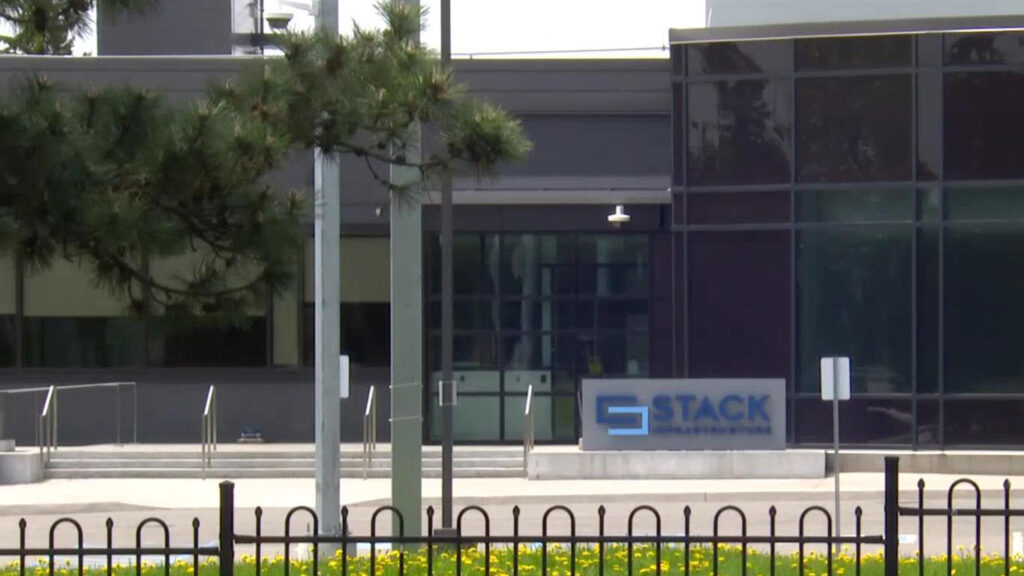
The facility located at 3650 Danforth Ave. in Scarborough has undergone a significant transformation. For decades, it operated as a pharmaceutical manufacturing plant; however, since 2023, it has become an 8 megawatt data centre managed by Stack Infrastructure. This change is part of a broader trend in the Greater Toronto Area (GTA), where numerous data centres have emerged, drawing attention from environmental groups.
Anna Hardy from Climate Fast has voiced concerns regarding the noise and emissions produced by these data centres. She highlighted that although Stack Infrastructure has self-reported their noise and pollution levels to the Ministry of Environment, Conservation and Parks, there is skepticism about whether they will adhere to these self-imposed standards. Hardy emphasized the importance of public awareness regarding the locations of these rapidly growing facilities and their impact on neighboring communities.
Daniel Gruner, the Chief Technology Officer of SciNet High Performance Computing Consortium, explained that data centres are essentially large buildings housing powerful computers. In the context of the current AI boom, these facilities utilize energy-intensive machines. Viet Vu, the manager of economics research at the Dais at Toronto Metropolitan University, elaborated on the significance of data centres, noting that they host essential internet services like Instagram and WhatsApp. However, operating a data centre is not only costly but also resource-intensive, consuming vast amounts of energy.
Concerns about data centres extend beyond their energy consumption. Communities across North America are increasingly worried about their emissions, water usage for cooling, and overall impact on local resources. Stack Infrastructure’s current 8 megawatt capacity is poised for expansion to 56 megawatts, which is equivalent to the energy required to power around 56,000 homes. Nevertheless, experts like Vu downplay fears regarding potential strain on the power grid, citing Canada’s access to clean and abundant energy and water.
However, noise pollution remains a pressing issue. Social media videos have captured the loud sounds generated by some data centres. According to Vu, the City of Toronto addresses such noise levels in their bylaws, creating a framework for legislators and policymakers to monitor the effects of data centres on local communities consistently.
As the industry continues to grow, activists are pushing for more stringent regulations. Organizations such as Climate Fast are advocating for a moratorium on new developments and increased transparency in the approval processes for data centres. Hardy stressed the need for public consultation and community involvement in the construction of new facilities. She argued that as taxpayers and ratepayers, citizens should not bear the negative consequences of these AI data centres without having a say in their development, a practice that is currently lacking in Ontario.
CityNews has attempted to contact Stack Infrastructure for further insights into their operations but has yet to receive a reply.