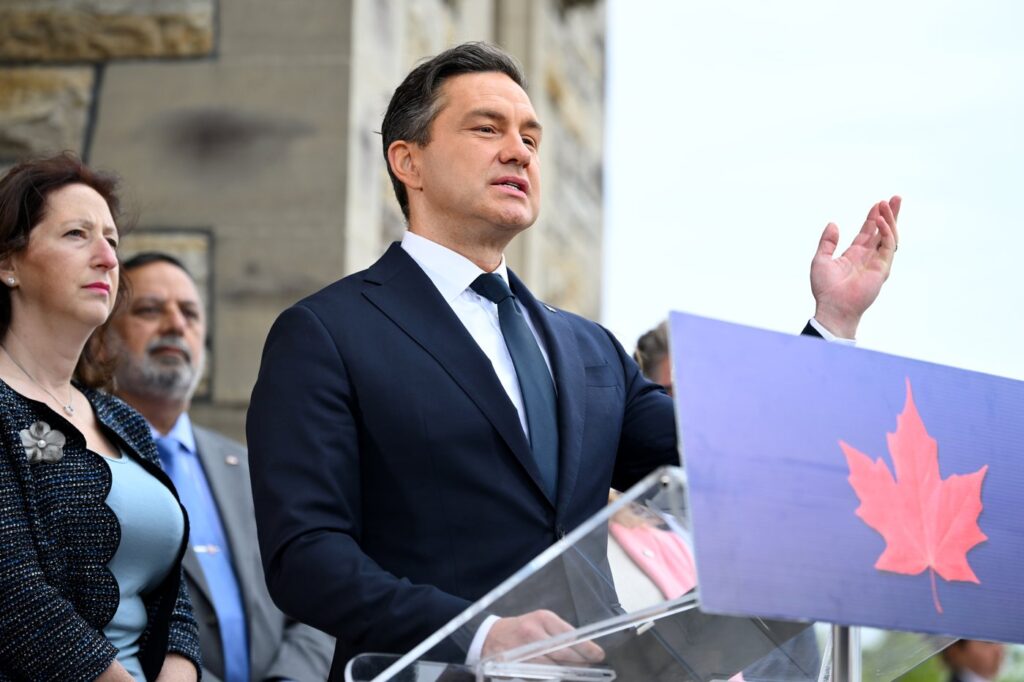
OTTAWA – Conservative Leader Pierre Poilievre is set to deliver a speech in Calgary on Monday, where he will contend that amendments to federal policies would mitigate separatist sentiments in Alberta. In an excerpt provided to The Canadian Press, Poilievre articulates that the separatist voices in Alberta harbor concerns not against their compatriots in the rest of Canada, but primarily against the federal government. He asserts, “We do not need a different country, Alberta. We need different government policies in Ottawa.”
During his address, Poilievre plans to advocate for changes that would unlock resources, facilitate pipeline construction, uphold provincial autonomy, and alleviate burdens on taxpayers. This follows Alberta Premier Danielle Smith's recent announcement indicating that her government intends to gauge Albertans' opinions in October regarding whether the province should either remain within Canada or initiate a legal process for a separation referendum.
Prime Minister Mark Carney has characterized the proposed Alberta referendum on separation as a potentially “dangerous bluff.” In past statements, Poilievre mentioned his intention to campaign across Alberta throughout the summer, promoting the idea of remaining within “the Canadian family.” His team, represented by Sam Lilly, Director of Media Relations for the Office of the Official Opposition, refrained from disclosing specific details regarding the campaign but stated that it would make reference to Poilievre’s forthcoming speech.
In the prepared remarks, Poilievre insists that Alberta should collaborate with other provinces to advocate for federal policies that enhance common interests and support industries that operate across provincial borders. He names the repeal of what he deems Liberal “anti-development laws” such as bills C-69 and C-48 as beneficial for both Alberta and Newfoundland and Labrador. He posits that residents in Toronto and various Albertan cities would also stand to gain from a stronger criminal justice system.
Furthermore, Poilievre urges Alberta to ally with Quebec to reclaim provincial authority over federal policies, particularly concerning immigration. He states, “Locking arms with other provinces is the practical, realistic path to a stronger Alberta within a united Canada.”
In contrast, Prime Minister Carney remarked that a referendum campaign could be detrimental while Alberta is vying for investors to back a pipeline project. He emphasized that the provincial electorate did not grant Smith’s government a mandate to pursue such a referendum. Smith, in a televised address the previous month, argued that not asking Albertans about separation in a referendum would suppress the voices of many citizens, labeling such an omission as “unjustifiable” in a democracy.
Earlier this month, a petition aimed at triggering a referendum on Alberta separation was dismissed by a judge, who cited the provincial government's lack of consultation with Indigenous communities regarding the potential implications of separation on treaty rights. The Alberta government is currently appealing this ruling.
Carney has expressed his intention to advocate for national unity and demonstrate that co-operative federalism is a viable approach. He referred to an agreement signed with Smith earlier in the month, which facilitates collaboration between the provincial and federal governments to advance the construction of a new oil pipeline to the Pacific coast, contingent upon meeting industrial carbon price targets and advancing carbon capture projects.
This evolving dialogue underscores the tensions between Alberta's provincial aspirations and the federal government's regulatory framework, illustrating the complex landscape of Canadian federalism and the ongoing debates surrounding regional autonomy and economic development.