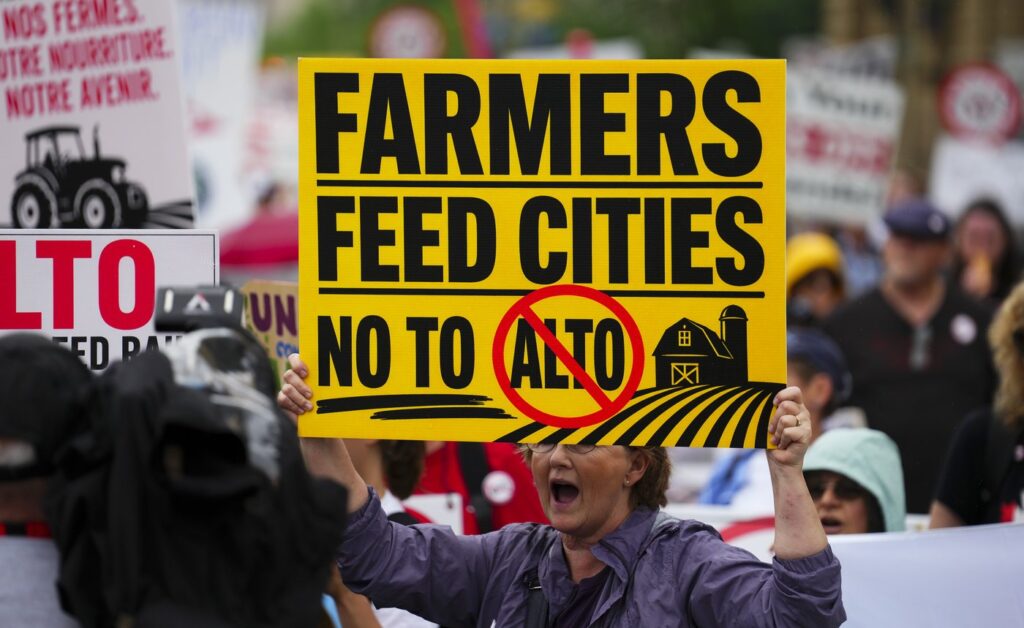
OTTAWA – Protesters gathered outside the Prime Minister's Office on Parliament Hill on Wednesday to voice their opposition to the Alto high-speed rail project, chanting “No Alto!” as they marched. The demonstration was primarily organized by farmers and rural residents who fear that the proposed rail line will disrupt their properties and livelihoods.
The proposed route for Canada's first high-speed rail line is set to extend from Toronto to Quebec City, with connections in key urban centers, including Ottawa, Montreal, and Laval. Alto, the Crown corporation responsible for the development, construction, and operation of the rail line, is facing increasing pushback from local residents concerned about the impact on their land.
Lise Beauchamp, a dairy farmer from Mirabel, Quebec, expressed her concerns regarding the disruption of rural farm roads that would complicate the transportation of large agricultural equipment, such as combines. She mentioned that the lack of clarity from Alto about access points across the rail corridor is causing anxiety among farmers. “There are fences on each side of that train,” Beauchamp stated, questioning how farmers would navigate their transportation needs effectively.
Bruno Proulx, who co-owns the same dairy farm, pointed out that losing access to a municipal road could result in a significant detour of up to 50 kilometers. He warned that the generated detours would not only waste time but also fuel, affecting agricultural efficiency and increasing costs for everyone involved. Many farmers in the area share similar concerns, with Proulx noting that thousands of properties could face similar access issues.
Brigitte Berube, another farmer from the Hawkesbury area of Ontario near the Quebec border, echoed these sentiments. She explained that the proposed route's uncertain parameters create significant stress within the community. “Honestly, this not knowing – can you imagine the stress levels in our communities? It's really brutal,” Berube lamented.
Alto is set to release a more focused corridor plan for the Ottawa-Montreal segment later this year. However, the uncertainty surrounding the project has led to political maneuvering. Conservative Leader Pierre Poilievre addressed the protesters, criticising Alto as a “white elephant” and pledging that his party would cancel the project to preserve community and agricultural land. He emphasized the importance of allowing farmers to keep their properties and maintaining local peace.
In a recent social media update, Parti Québécois Leader Paul St-Pierre Plamondon also promised to withdraw from the Alto project should his party win the government. When asked about this potential obstacle to progress, Alto CEO Martin Imbleau remained focused on the benefits of the high-speed rail corridor, stressing that postponing the project could leave the provinces missing out on significant advantages in the future.
Imbleau acknowledged the growing resistance to the project in certain regions and revealed that Alto personnel conducting technical and environmental analyses have faced threats. However, he refrained from disclosing the specifics or the numbers involved. Transport Minister Steven MacKinnon reinforced the government's commitment to engaging with farmers and communities throughout the planning process, as they determine the precise route for what he termed a “nation-building project.”
Responding to questions about the project's estimated cost of $90 billion, MacKinnon admitted that many uncertainties remain regarding potential unforeseen events. “It is a very ambitious federal project that we will continue pursuing on the accelerated timeline,” he stated.
Alto claims that it can operate trains at speeds of up to 300 kilometers per hour over a planned 1,000-kilometer stretch of electrified rail. The initial phase of construction from Montreal to Ottawa could commence as soon as 2029.