WASHINGTON (AP) – A coalition of twenty-five states has launched a lawsuit against the Trump administration regarding its recent imposition of tariffs. The states argue that these tariffs are merely a pretext for replacing import taxes that were invalidated by the Supreme Court earlier this year. The legal action was announced on a Monday, signaling a significant pushback against the administration’s trade policies.
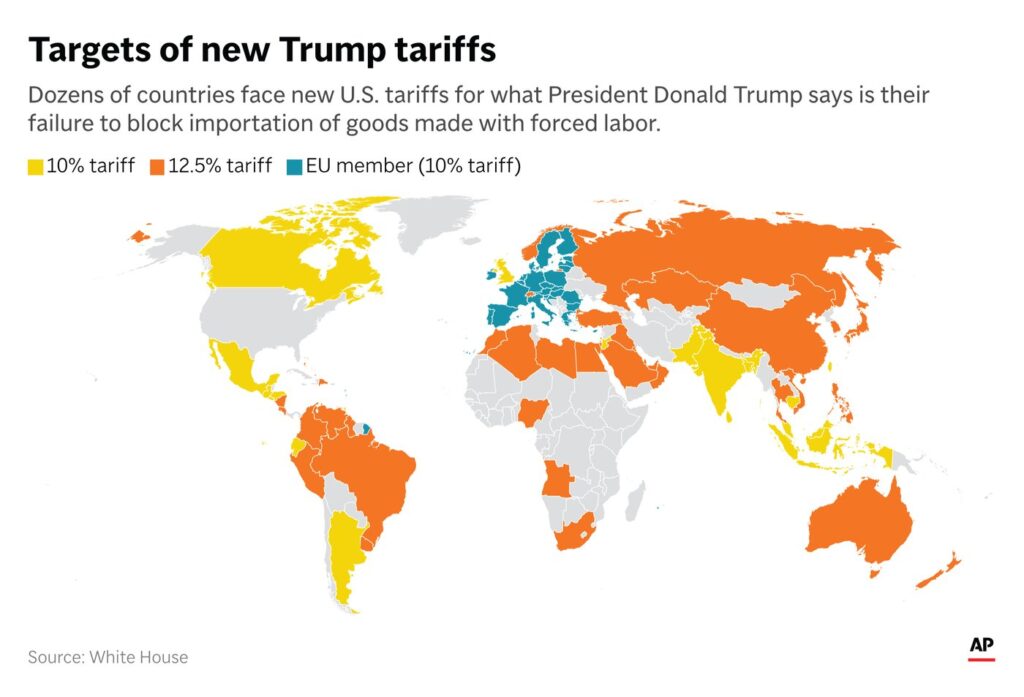
In July 2023, the United States enacted double-digit tariffs on imports from 59 countries and the European Union, citing deficiencies in their efforts to combat forced labor in production. This new round of tariffs was implemented just as the temporary tariffs, introduced by President Donald Trump in response to a Supreme Court ruling, were set to expire. Trump's previous tariffs were a direct response to a decision indicating that the basis for such tariffs was not authorized under the International Emergency Economic Powers Act (IEEPA).
New York Attorney General Letitia James criticized the administration, stating, “After losing at the Supreme Court, the administration is once again trying to illegally raise taxes on families and businesses with a new round of tariffs.” This statement reflects the sentiment of many state officials who are concerned about the financial implications these tariffs may impose on their constituents.
The states involved in this lawsuit include New York, Arizona, California, Colorado, Connecticut, Delaware, Hawaii, Illinois, Kentucky, Massachusetts, Maryland, Maine, Michigan, Minnesota, Nevada, New Jersey, New Mexico, North Carolina, Oregon, Pennsylvania, Rhode Island, Virginia, Vermont, Washington, and Wisconsin. This wide-ranging coalition emphasizes the widespread discontent with the administration’s tariffs across the country.
President Trump’s approach marks a departure from decades of U.S. trade policy, which traditionally advocated for lower tariffs and freer trade. Citing the 1977 IEEPA, Trump previously justified the imposition of tariffs by claiming that the U.S. trade deficit was a national emergency. However, the Supreme Court made it clear that such authority under IEEPA was not valid for imposing tariffs.
Following the Supreme Court's ruling, the administration was forced to issue refunds to importers who had paid tariffs, leading to a renewed push to maintain revenue through alternative means. With the expiration of temporary 10% worldwide tariffs on July 24, 2023, Trump has now turned to Section 301 of the Trade Act of 1974. This section allows the president to impose tariffs and other sanctions against countries engaged in unfair trade practices.
Using Section 301, the administration has introduced new tariffs targeting forced labor, which range from 10% to 12.5% and affect countries that supply 99% of U.S. imports. White House spokesperson Kush Desai defended the legality of these actions, arguing that they are necessary to address unreasonable practices that burden U.S. commerce and workers.
The states' lawsuit follows two similar legal challenges filed in July 2023 in The Court of International Trade by small businesses, which also contested the legality of the Section 301 tariffs. Both lawsuits raise concerns that the government failed to establish a sufficient justification for the tariffs or demonstrate how they would effectively combat the specified practices.
Barry Appleton, a law professor at New York Law School, noted that the current administration's attempt to impose tariffs under Section 301 marks the third instance of pursuing global tariffs under varying statutes. He highlighted that the similarities between these cases could complicate the administration's defense in court. Despite this, he acknowledged that Section 301 has historically been employed for such measures and has proven resilient against legal challenges.
Appleton explained that the government’s argument in court would not hinge on a lack of authority but rather on adherence to the procedures established by Congress for invoking such tariffs. The outcome of this legal battle could significantly impact the administration's trade policies and the economic landscape for affected states.