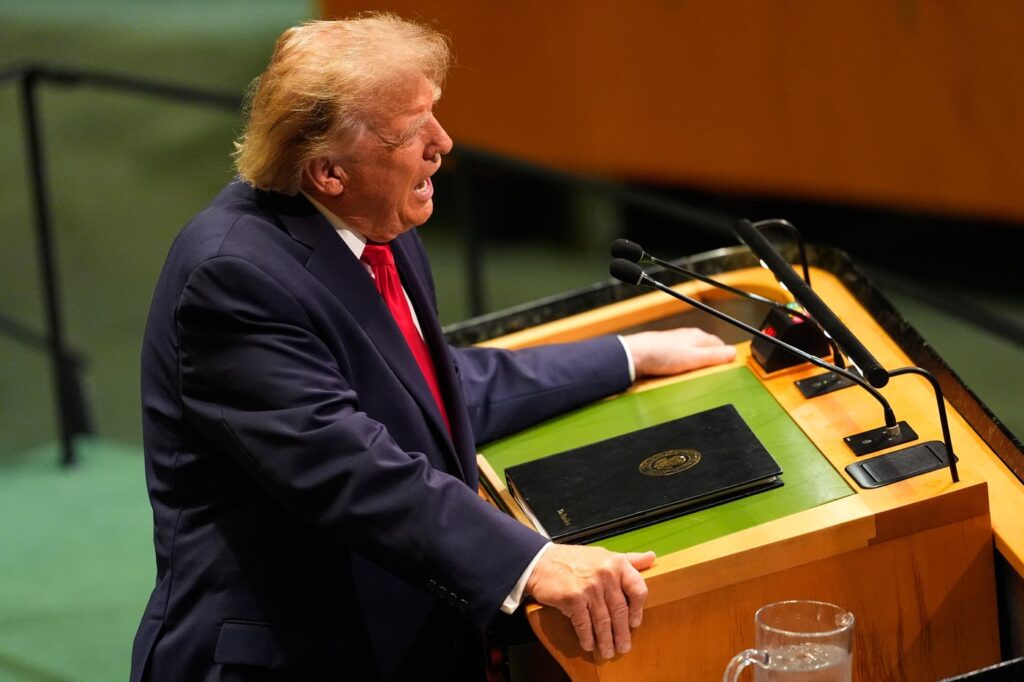
UNITED NATIONS (AP) – President Donald Trump signed an agreement on Tuesday with Denmark and Greenland to enhance Arctic and North Atlantic security, which facilitates the establishment of a larger U.S. military presence in Greenland, while maintaining Danish control over the territory. This signing took place on the sidelines of the U.N. General Assembly in New York, just days after Trump revealed his intentions to bolster U.S. military operations in Greenland.
The newly signed agreement aims to address security concerns regarding the mineral-rich Greenland, a territory that has been a focal point for Trump's administration since he expressed interest in acquiring the island in 2019. The agreement stipulated that it would remain valid even if Greenland eventually opts for independence. Trump referred to the deal as "tremendous" for Europe, the United States, and Greenland, emphasizing its positive implications.
Since 1945, the U.S. military presence in Greenland has dramatically decreased from thousands of personnel across 17 bases to approximately 200 stationed at the Pituffik Space Base in the northwestern part of the island. This base supports missile warning and surveillance operations for both the U.S. and NATO. To address the ongoing security concerns, U.S., Greenland, and Danish officials have been at the negotiating table for months.
The standoff over Greenland had previously strained relations within NATO, particularly when Danish Prime Minister Mette Frederiksen cautioned that any attempt by the U.S. to take control of Greenland would jeopardize the Atlantic alliance. This tension caused unease among Greenland's 56,000 residents, alienated the U.S. from Denmark and its European Union counterparts, and triggered increased security exercises and financial support for Greenland from EU nations.
Trade interests and the potential resource exploitation due to climate change were also integral to the discussions, particularly as the Arctic Circle region faces the consequences of melting sea ice, which presents new shipping routes. As such, Trump's previous comments indicating a desire to "take Greenland" to prevent Russian or Chinese influence underscored the strategic importance assigned to the territory.
The recent accord, which does not have a designated end date, includes provisions for the U.S. to modernize and expand its military activities at Pituffik, and it outlines plans for creating additional defense locations across the island. U.S. military mobility is emphasized in the agreement, which permits undersea access as well. Moreover, the deal includes stipulations that no non-NATO country can establish military installations in Greenland without mutual consent from the signatories.
Leaders from Denmark and Greenland expressed their contentment with the agreement after the signing, framing it as a beneficial arrangement for their respective countries, the U.S., and NATO. Frederiksen deemed the agreement a "deal that can last forever," while Greenland’s Prime Minister Jens-Frederik Nielsen praised it as a "win-win-win" scenario.
The agreement signifies a substantial step for Greenland, represented as the first binding accord signed by the territory as a country, moving towards enhanced self-autonomy. However, the lingering effects of previous tensions regarding U.S. interests in Greenland are still felt, as local representatives expressed concerns over trust and security in the region.
In concluding remarks at a post-signing event, political leaders celebrated the progress made. A relieved Frederiksen noted that "the kingdom of Denmark is in a better place than we were yesterday," indicating optimism about the future relations among the involved nations. Baltic state leaders, noting the positive momentum created by the signing, showed approval but expressed hopes that the contentious discussions are over, wishing for a return to more comfortable conversations among allies.