LONDON (AP) – Amid escalating tensions among NATO allies regarding U.S. President Donald Trump's persistent proposals to acquire Greenland as U.S. territory, he notably shared an online map depicting the island adorned in the colors of the American flag.
Such a precarious situation seems to have been mitigated, following an announcement from Greenland, Denmark, and the United States regarding a new agreement focused on the future of this resource-rich territory. The accord, which was signed on Tuesday during the United Nations General Assembly, is poised to enhance the U.S. military presence on the semi-autonomous Danish territory. This development may result in the Stars and Stripes being displayed more frequently alongside Greenland's iconic flag.
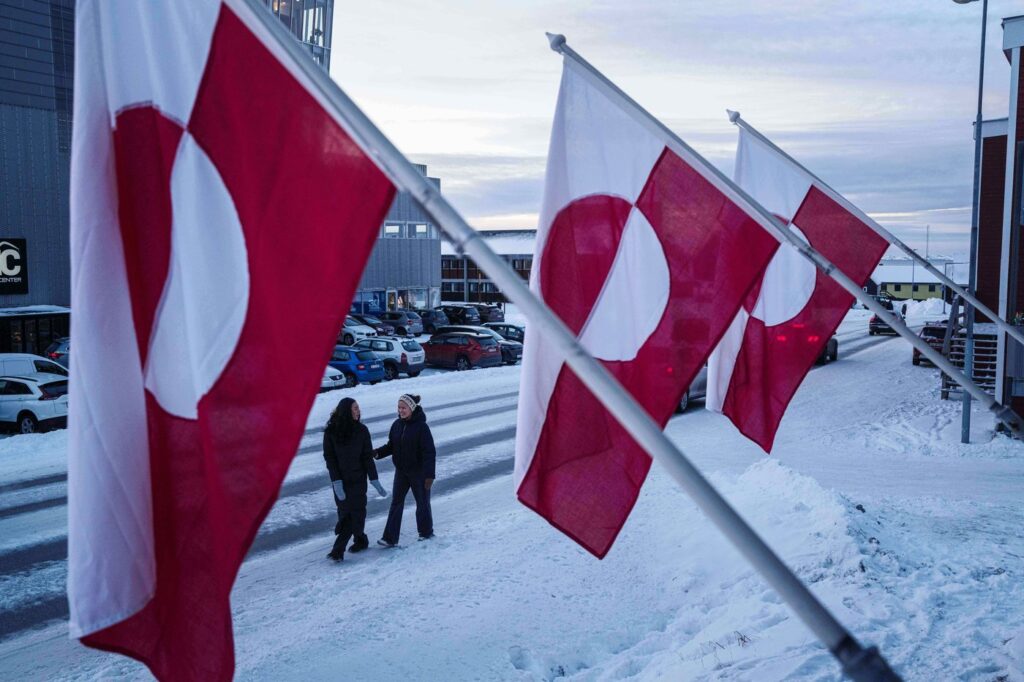
Greenland's flag itself possesses a unique design marked by simplicity and rich symbolism. Created by Greenland native Thue Christiansen, it was officially adopted on June 21, 1985. The flag features two equal horizontal bands of white and red, accompanied by a large circle positioned slightly off-center, nearer to the flagpole. This circle, akin to the symbolism in Japan’s flag, represents the sun and is "counterchanged," meaning it is divided into red and white, contrasting with the colors of the horizontal bands.
The off-center placement draws attention and carries symbolic significance of a sun setting on the horizon, reflecting the light and warmth that return to the island during the midsummer season. Notably, approximately two-thirds of Greenland lies within the Arctic Circle.
The flag also embodies the long-standing connections to Denmark, as Greenland is currently a semi-autonomous territory of Denmark, which governed the island for many centuries. The red and white colors mirror those found in the Danish national flag, emphasizing this historical relationship. In a deliberate choice to showcase Greenland’s distinction and autonomy, the flag stands out among Nordic territories, as it is the only one in this group without an offset cross.
In the Greenlandic language, the flag is referred to as both Erfalasorput, meaning "our flag," and Aappalaartoq, which translates to "the red one."
The discussion surrounding the creation of a flag for Greenland first emerged in the early 1970s. Following a referendum in 1979, the island gained home rule from Denmark, prompting the new government, known as the Naalakkersuisut, to organize a design contest for a national flag. This initiative attracted hundreds of design submissions.
However, Greenland’s parliament encountered difficulties in reaching a consensus, which prolonged the decision-making process for several years. Ultimately, the options were narrowed down to two designs: Christiansen’s submission and an alternative featuring a green and white Nordic cross. Following extensive deliberation, parliament members cast their votes in 1985, with a slim majority of 14 out of 25 members favoring Christiansen’s flag design, which continues to fly over Greenland today.
Jamey Keaten contributed to this report from Geneva.
Jason Saber, The Associated Press