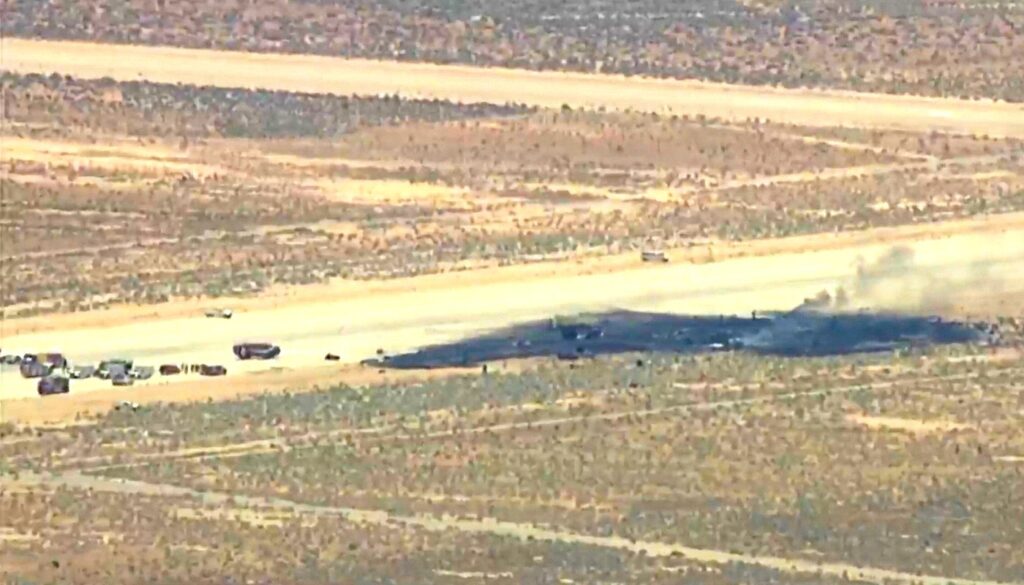
LOS ANGELES (AP) – A tragic accident occurred on Monday, June 15, 2026, when a B-52 bomber crashed shortly after takeoff at Edwards Air Force Base, located in Southern California's Mojave Desert. The incident, which took place around 11:20 a.m. during a routine test mission, resulted in the deaths of all eight individuals aboard, including both government contractors and uniformed military personnel. Boeing confirmed that two of its employees were among the victims.
Aerial footage captured the devastating aftermath, revealing virtually no remnants of the aircraft. The crash site, characterized by a large area of charred desert near the runway, was engulfed in black smoke, prompting a heightened response from emergency crews. Colonel James Hayes, the deputy commander for the 412th Test Wing at Edwards, stated during a news conference that after reviewing footage, it was concluded that no one could have survived the crash, adding, “We lost eight great Americans.”
The cause of the crash remains undetermined, with a complete investigation expected to take up to six months. Colonel Hayes mentioned that the B-52 was involved in the “radar modernization program,” although specific details regarding the aircraft's condition prior to the crash have not been disclosed. The B-52 Stratofortress, a long-range bomber that has been in service since 1955, is able to carry both conventional and nuclear weapons. Over the years, it has participated in various military operations across multiple conflicts.
Previously, in 2025, a B-52 equipped with a new, modernized radar system was dispatched to Edwards for ground and flight testing activities throughout 2026. The upgraded Active Electronically Scanned Array (AESA) radar system was designed to replace the aircraft's outdated radar. However, it remains unclear whether the aircraft involved in Monday’s crash was the same one recently modernized.
Edwards Air Force Base is recognized for its significant role in aircraft testing and development, situated approximately 100 miles (161 km) north of Los Angeles. It hosts the 412th Test Wing, which conducts essential testing of Air Force aircraft, weapon systems, software, and components both pre-and post-purchase. The base has historical importance; it was here that test pilot Chuck Yeager broke the sound barrier in 1947.
Following the crash, the airfield was closed for the majority of the day, with incoming flights being redirected. By late afternoon, the base reopened to personnel, although non-commercial visitor access was briefly suspended as emergency teams managed the situation.
Air Force Secretary Troy Meink expressed his sorrow over the loss of lives, stating, “We mourn this loss and honor the service of our Airmen, civilians, and contractors who work every day to advance our mission.” Aviation safety expert Jeff Guzzetti, who previously investigated crashes for federal agencies, speculated that the rapid nature of the crash, occurring shortly after takeoff without significant altitude gain, might indicate a flight control failure. He suggested potential factors, including maintenance-related issues or catastrophic engine problems, contributing to the crash's outcome.
Despite the long operational history of the B-52, testing new equipment introduces inherent risks. Guzzetti noted, "A flight test is always riskier than normal operations," emphasizing the necessity for specialized test pilots and robust safety protocols. The Air Force has faced multiple training-related accidents in recent years, underscoring the dangers associated with military aviation.
This incident not only highlights the perils involved in aircraft testing but also serves as a solemn reminder of the sacrifices made by military personnel and contractors in the name of national defense and technological advancement.