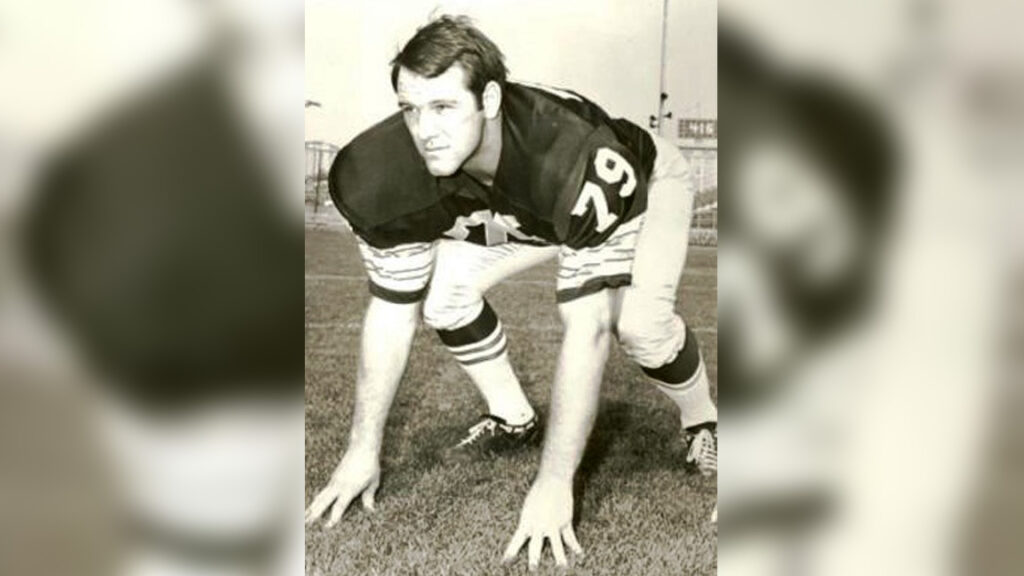
Jim Corrigall, the celebrated Canadian defensive lineman who opted for a career with the Toronto Argonauts over the NFL, has passed away at the age of 80. His alma mater, Kent State University, announced his death on Wednesday, though the specifics of the cause were not revealed. In a previous interview in 2019, Corrigall and his daughter, Amy Corrigall Jones, disclosed that he had likely been diagnosed with chronic traumatic encephalopathy (CTE), a severe and untreatable brain condition linked to repeated head injuries.
Kent State expressed their sorrow on social media, stating, "We mourn the passing of Kent State great Jim Corrigall. Jim embodied what it means to be a Golden Flash both as a player and a coach. Our thoughts are with his family, friends, teammates, and all who had the privilege of knowing him."
Kent State head coach Mark Carney shared his condolences, stating, "Sad to hear of the passing of @KentStFootball great Jim Corrigall. (He’s) one of just five players to have his number retired here. Your legacy will not soon be forgotten Coach!"
Born in Barrie, Ontario, Jim Corrigall's football journey began at North Bay high school before making his mark at Kent State. Over his collegiate career, the six-foot-three, 253-pound defensive lineman earned accolades as the team's most valuable sophomore, top defensive lineman, and most inspirational player. Corrigall was the first athlete from Kent State to be named to the first-team All-Mid-American Conference for three consecutive years. Following his college tenure, the university honored him by retiring his No. 79 jersey.
Despite being selected as the second-round pick, No. 33 overall, by the St. Louis Cardinals in the 1970 NFL Draft, Corrigall chose to join the Toronto Argonauts, who held his territorial rights. He devoted his entire 12-year Canadian Football League (CFL) career to the Argonauts, expressing a preference for their two-year contract which he found appealing compared to the NFL offers.
Corrigall was recognized as the East Division's top rookie in 1970 and was named a conference all-star eight times throughout his career. He was also awarded the CFL's top defensive player title in 1975, along with nominations for Toronto's outstanding player and top Canadian categories multiple times. He concluded his playing career with a dual role as a player-coach in his last two seasons.
Reflecting on his experience, Corrigall remarked, "It was an energizing time for me. My emotions really run the gamut 0 it was exciting, it was sad, it was rock ’n’ roll time. It was a great, great time and you couldn’t find a better place to play than in Toronto. The people, the press, they were always very, very good to me."
Over his career, Corrigall played in 148 regular-season games and participated in five playoff contests, highlighting his commitment to the Argos. He was part of the 1971 Grey Cup, which was a nail-biter, as the Calgary Stampeders narrowly defeated them 14-11 amidst challenging weather conditions.
In 1990, Jim Corrigall was inducted into the Canadian Football Hall of Fame, further solidifying his legacy in football. His induction was a moment of great pride, as he expressed, "It was very humbling. I never thought I would get elected. It’s because of the people who pushed me throughout my life. I am very fortunate to get there."
Additionally, Corrigall received honors in several halls of fame, including Kent State's Athletics Hall of Fame, the Mid-American Conference Hall of Fame, and regional halls of fame such as Summit County Sports Hall of Fame and Barrie Sports Hall of Fame.
Former Argonauts head coach Leo Cahill praised Corrigall's versatility and talent, stating, "He was a great football player. He was actually a middle linebacker at Kent State and I converted him to defensive end. I didn’t think he had the mobility and quickness to drop back on pass coverage. But Corrigall could do a lot of things very, very well 0 Corrigall had an insatiable need to get to the ball carrier in the least amount of time in a bad frame of mind. I think that best sums up Jim Corrigall."