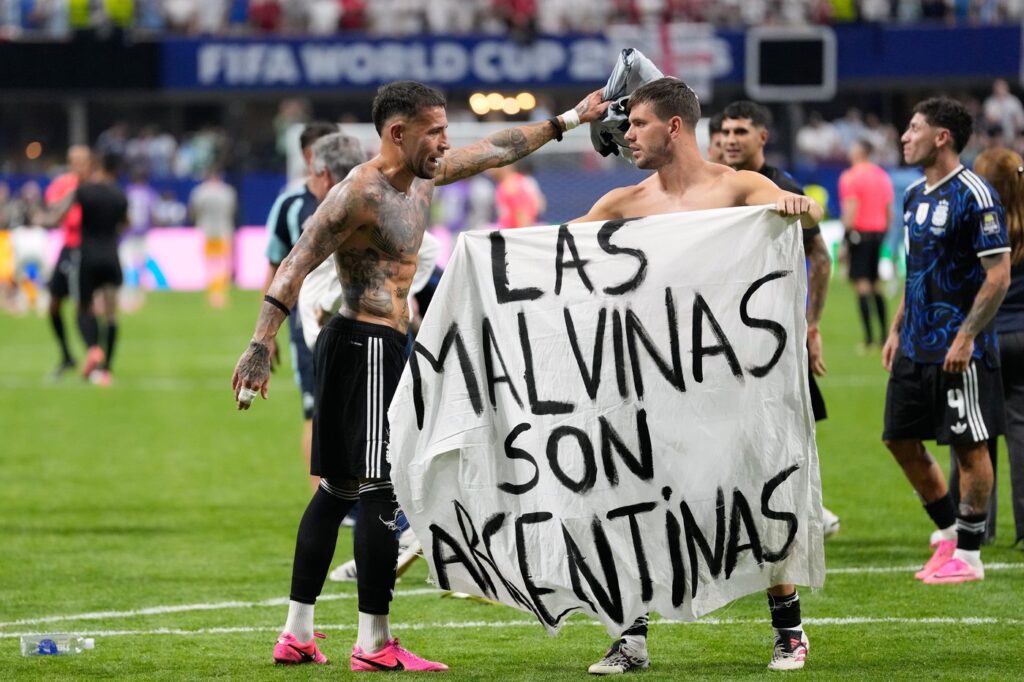
LONDON (AP) — The British government urged FIFA to investigate Argentina's national team following a controversial celebration by the players after their 2-1 victory over England in the World Cup semifinals. During the post-match festivities on Wednesday in Atlanta, Argentine players displayed a banner that read "Las Malvinas son Argentinas," which translates to "The Malvinas are Argentine," asserting Argentina's claim over the disputed Falkland Islands.
The territorial dispute dates back to 1982 when the islands were invaded by Argentina, leading to a 10-week war with Britain that resulted in the deaths of 649 Argentine soldiers, 255 British personnel, and three islanders. The British government maintains its commitment to the sovereignty of the Falkland Islands, describing the players' display as "entirely inappropriate." A spokesperson for Prime Minister Keir Starmer echoed this sentiment, stating, "The World Cup might not be ours, but the Falkland Islands definitely are," emphasizing that self-determination lies with the islanders.
The players' actions have drawn criticism, as British Business Secretary Peter Kyle labeled the behavior as unacceptable. FIFA's disciplinary code prohibits messages of a political or ideological nature at sports events, which may lead to sanctions against Argentina. Fines for such political messages can range from $5,000 to $20,000, with FIFA acknowledging receipt of inquiries regarding the incident.
In contrast, Argentinian President Javier Milei defended the players, calling their celebration "perfectly valid" and a reflection of national sentiment. He anticipated that FIFA would likely impose a fine due to the nature of the message. Vice President Victoria Villarruel supported the players on social media, declaring, "The Malvinas are Argentine!" and asserting that the sentiment is ingrained in the national spirit.
This incident is not isolated; it recalls previous cases where FIFA took disciplinary actions for political messages. For example, South Korean player Park Jong-woo was banned for two World Cup qualifying matches in 2014 for displaying a similar banner regarding territorial claims against Japan at the London Olympics. The longstanding rivalry between Argentina and England in soccer is exacerbated by the underlying political tensions over the Falkland Islands, a British overseas territory claimed by Argentina.
On the sidelines of the ongoing World Cup, discussions have ignited around the appropriateness of political messaging in sports. British government officials stress the need for politics to remain distinct from football, as highlighted by Minister Kyle's assertion that football should not entangle with political issues. FIFA's commitment to political neutrality has also come under scrutiny, especially in light of recent controversies regarding player sanctions and an apparent leniency concerning the suspension of a U.S. player, Folarin Balogun.
The emotional weight of the Falklands War continues to resonate within Argentina, as players like Lisandro Martínez expressed their intentions to honor the memories of those affected by the conflict. The rivalry and the historical context embedded within it heighten the stakes for players representing their nations.
Considering the intricate connections between sports and national pride, this incident may provoke future discussions about boundaries for political expression in athletic contexts. FIFA's historical precedence of sanctioning political displays in sports suggests that the outcome of this incident could influence the approach to similar situations in the future.
The atmosphere surrounding the World Cup remains charged, and the aftermath of this incident will likely reverberate throughout the competition, especially given the significance of the games for both Argentina and England.