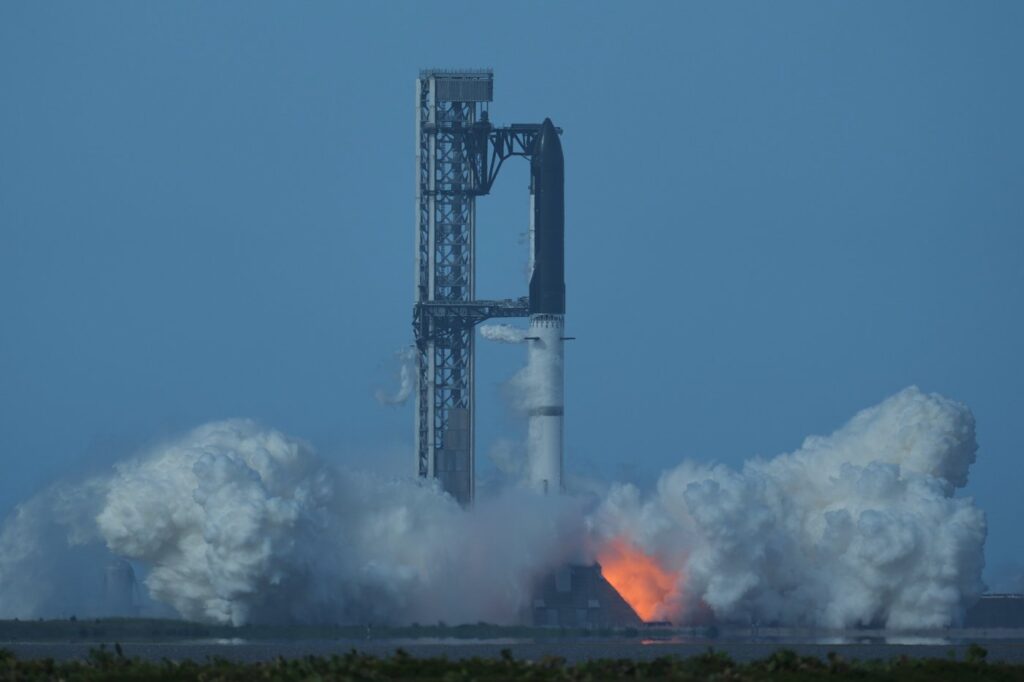
SpaceX's mega Starship rocket attempted a test flight on Thursday but fell just a second short of launch due to a failure in engine ignition. Amidst clouds of smoke and vapor, the launch was aborted when several engines did not ignite as planned. Elon Musk, the founder and CEO of SpaceX, announced that two engines would be replaced to ensure a more successful attempt in the near future.
The latest test represents the 13th flight for the Starship, which stands at 407 feet (124 meters) tall and is equipped with 33 main engines, making it the largest and most powerful rocket in the world. Onlookers could observe the start of engine ignition three seconds before the scheduled liftoff through SpaceX's launch webcast, monitored by a drone above the launch pad. Although the specifics of the failure were not clarified by the company, telemetry data indicated that four engines had failed to ignite, prompting the shutdown of the remaining 29 engines and preventing the rocket from launching.
Immediately following the launch abort, SpaceX's launch team began the process of draining fuel from the rocket. Musk speculated that the most likely launch window would be early the following week. Until the partial engine ignition, all conditions, including the weather, seemed favorable for a successful launch. The rocket's automatic launch system functioned correctly by stopping the countdown, highlighting the importance of having enough functioning engines to secure a safe launch. Previous Starship test flights had resulted in catastrophic failures, including explosive incidents.
The Starship was carrying 20 of SpaceX's newest and most advanced Starlink satellites, which were set to communicate with existing satellites already in orbit during the planned hour-long flight. The Starlink satellites also aimed to capture images of Starship's heat shield. Importantly, neither the first-stage booster nor the spacecraft was designed for recovery, with both intended to end their journeys in the sea.
Nasa is heavily relying on the Starship program, with it being crucial for landing astronauts back on the moon in the coming years. The space agency has contracted SpaceX and Jeff Bezos' Blue Origin to develop and operate lunar landers that would facilitate humanity's return to the lunar surface after a gap of over 50 years. Both companies must prepare their respective landers—Starship and Blue Moon—by next year, allowing the Artemis III crew to practice docking with them while in orbit around Earth.
Subsequent missions, like Artemis IV, are anticipated to take place no earlier than 2028, wherein one of the landers would be used to transport two astronauts to the moon's southern polar region.