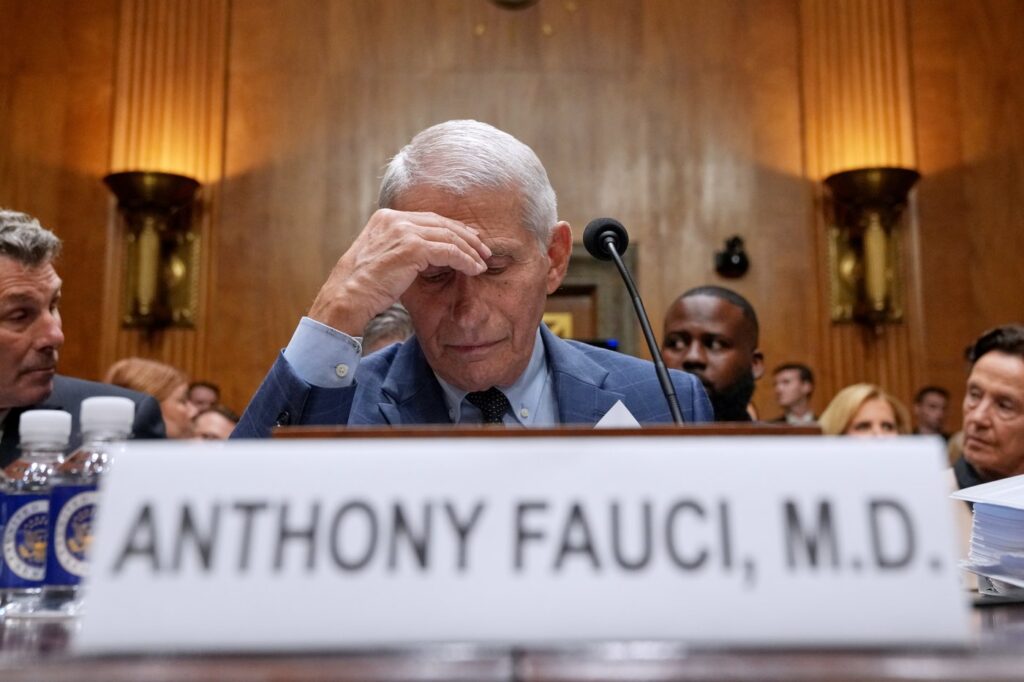
On Thursday, a Senate committee voted along party lines to hold Dr. Anthony Fauci in contempt of Congress for his refusal to answer questions during a hearing regarding his handling of the COVID-19 pandemic. This decision paves the way for a referral to the Justice Department to investigate whether Fauci, the nation’s top infectious disease official, properly exercised his constitutional rights.
A spokesperson from the Justice Department confirmed that it had received the contempt referral and is currently reviewing the case. This development follows a previous occurrence wherein Fauci invoked his Fifth Amendment right against self-incrimination over 100 times during his testimony before the Senate Committee on Homeland Security and Governmental Affairs. His refusal to cooperate has raised significant legal questions about Congress's ability to compel testimony from a witness who had previously been pardoned.
Republican Senator Rand Paul of Kentucky, who serves as the committee chairman, argued that Fauci’s constitutional protections should not apply since he received a pardon from President Joe Biden last year. Paul emphasized that Fauci faced no risk of federal prosecution and claimed that all Fauci needed to do was to tell the truth. He stated that the vote was not about Fauci’s opinions or past statements but rather focused on the committee’s authority to mandate testimony from a pardoned witness who subsequently defies that order.
In a statement explaining his choice to invoke the Fifth Amendment, Fauci expressed concern for the possibility of facing criminal charges, citing Paul’s repeated public declarations that he wished to see Fauci imprisoned. Fauci’s attorney, David Schertler, characterized the contempt resolution as part of Paul’s personal vendetta against Fauci. Schertler claimed that the resolution was a misuse of power intended to punish Fauci for exercising his constitutional rights. According to Schertler, Fauci has committed no crime, and the Senate should reject what he termed a politically motivated contempt resolution.
The pardon issued by Biden covers actions from 2014 until the pardon’s issuance in January 2025; however, it does not protect Fauci from potential state-level prosecutions or from federal investigations regarding any false testimony that may have been provided. Critics of the current Justice Department have noted instances where it initiated investigations into perceived adversaries of former President Donald Trump, raising concerns about retribution.
Democrats, who unanimously opposed the contempt resolution, sided with Fauci, arguing that he had reasonable grounds to fear self-incrimination, especially given the public declarations from Republican lawmakers about wanting to see him prosecuted concerning COVID. Senator Maggie Hassan, D-N.H., stated that the strategy appeared to aim for a scenario where Fauci could inadvertently make a misstatement, thereby allowing the Justice Department to file criminal charges based on that statement without the protection of the pardon.
Former President Trump commented on the situation during a press briefing, insinuating that Fauci should be prosecuted, arguing that his actions were more serious than many crimes. The contempt referral from Paul directly submitted to the Justice Department puts the onus on federal prosecutors to decide whether to investigate or pursue prosecution against Fauci, although such a referral does not compel action from the Justice Department.
Senator Gary Peters, the committee’s leading Democrat, raised concerns about the legal validity of the referral, especially if it did not obtain a vote from the full Senate, where achieving the necessary 60 votes for passage would be unlikely. Peters warned that punishing a witness for asserting their Fifth Amendment rights could hinder future congressional oversight efforts, as potential witnesses might refuse to cooperate, citing this vote as justification for their objections.