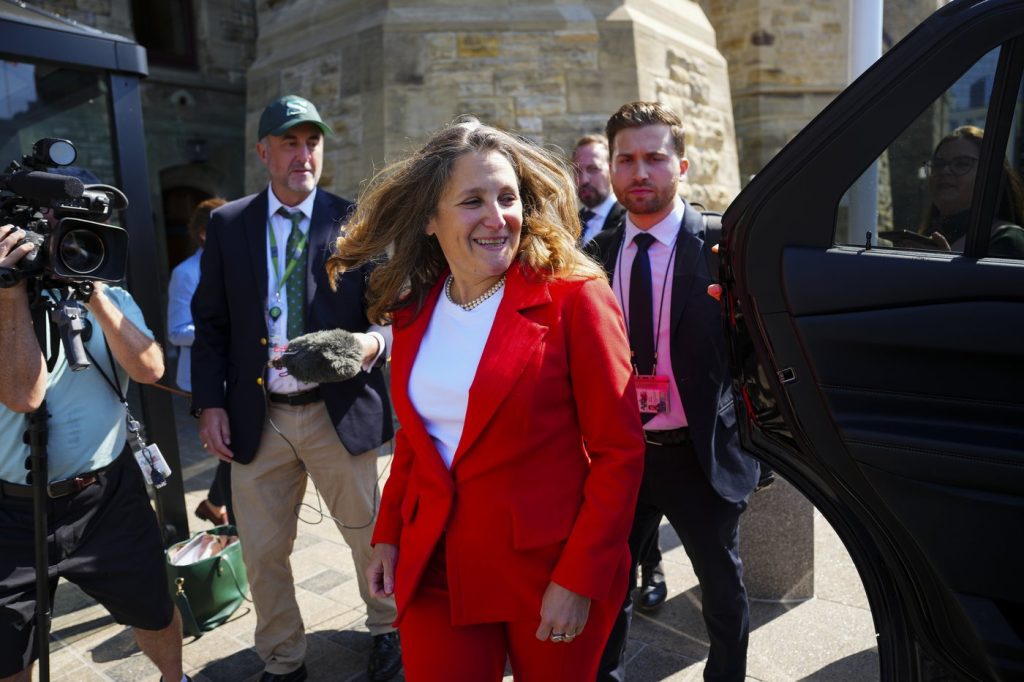
OTTAWA — Former Deputy Prime Minister Chrystia Freeland emphasized the importance of diversifying Canada’s trade relationships away from the United States due to national security concerns. Speaking at the Council on Foreign Relations in New York, Freeland highlighted the risks associated with maintaining a close economic bond with a partner that has expressed intentions to dominate Canada.
Freeland remarked, “Unfortunately, tragically, that’s where we are today,” referring to the statements made by U.S. President Donald Trump regarding Canada potentially becoming the 51st state. Despite ruling out military force for annexation in January 2025, Trump has suggested he might consider utilizing “economic force” instead.
Freeland noted that even with a U.S. president who advocates for free trade, reliance on a single trading partner is fundamentally unwise. “About 60 percent of Canadians live within a hundred miles of the Canada-U.S. border,” she stated, acknowledging the geographical and economic ties while arguing for a diversified trade strategy for national security reasons.
The Liberal government has committed to doubling non-U.S. exports over the next decade and has proudly announced the establishment of over 20 strategic trade and defense agreements globally amid ongoing trade tensions with the United States. Freeland pointed out that Canada’s ambition to diversify its trade relationships is longstanding and highlighted efforts to strengthen ties with Europe, a policy that has persisted since the Stephen Harper administration.
Freeland expressed optimism about growing Canadian-European relations, stating, “I think that what you’re seeing now for sure is a desire in Canada and in Europe to make that relationship even closer. I think that’s a good thing.” This sentiment was echoed in a recent speech by European Commission President Ursula von der Leyen to the European Parliament, where she indicated readiness to negotiate terms for Canada to become the first associate member of the European Union.
Following von der Leyen’s announcement, Canadian Prime Minister Mark Carney addressed the EU Parliament, welcoming this ambition and noting that polls indicate strong Canadian support for closer ties with Europe. “We welcome this ambition — polling shows an overwhelming majority of Canadians support much closer ties,” Carney stated in his speech, underscoring the shared objective between Canada and the EU.
Anticipation is building for an upcoming bilateral summit between Canada and the EU, with many observers hopeful that the gathering will yield concrete details about a new partnership between the two entities.
Freeland recently released a new book titled “Unreliable Boyfriend,” which serves as part international analysis on the shifting role of the United States and part political memoir. The title references her earlier remarks on an American talk show where she claimed the U.S. was “not a very reliable boyfriend right now.” Freeland, who served as Deputy Prime Minister under former Prime Minister Justin Trudeau for five years, resigned from the cabinet in December 2024 amidst a dramatic split from Trudeau. She later rejoined the cabinet under Carney, but eventually stepped down from both her cabinet role and Parliament in January, transitioning to a position as an economic development advisor to Ukrainian President Volodymyr Zelenskyy and taking on the role of CEO of the Rhodes Trust.