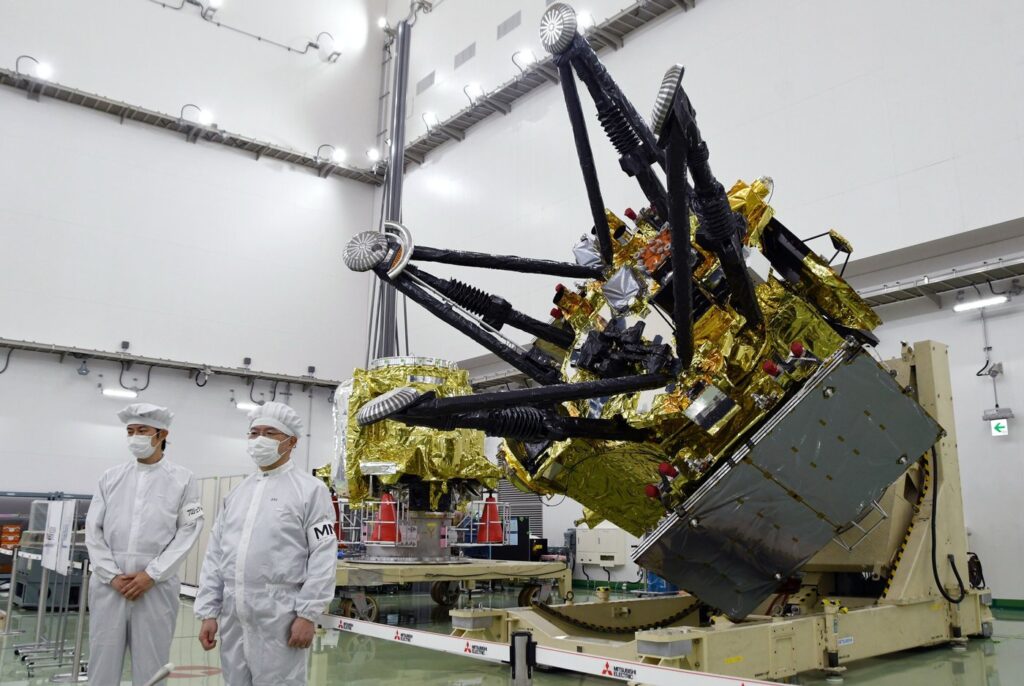
TOKYO (AP) – Japan is preparing to launch a groundbreaking spacecraft on the world's first mission to bring back samples from Phobos, one of the two small, potato-shaped moons orbiting Mars. The Japan Aerospace Exploration Agency (JAXA) is set to launch this mission using its new H-3 rocket. This mission is significant as it comes at a time when nations like the United States and China are contemplating sending astronauts to Mars.
The mission, known as MMX (Martian Moons eXploration), is expected to last approximately five years. Scientists involved in the project hope that it will provide valuable insights into how Phobos and its smaller counterpart, Deimos, were formed. It is anticipated that the findings could also illuminate the origins of life within the solar system. MMX project manager Yasuhiro Kawakatsu emphasized the importance of Martian moons, stating, "Despite their potential importance, Martian moons have never been fully investigated. They are known as the most important unclimbed mountains in the solar system."
JAXA's mission leads an international collaboration that features equipment and communication support from NASA and various other space agencies. Since the 1960s, Mars has been the target of numerous missions; however, much remains unknown about its moons. The names Phobos and Deimos derive from their associations with the Greek personifications of fear and terror, respectively, who were the sons of Ares, the war god, whose Roman equivalent is Mars.
Past attempts to land on Phobos, including a Russian initiative in 2011, have failed. Scientists are particularly interested in determining how Phobos and Deimos formed and what their compositions are. While some researchers propose that the moons could be residual debris from a significant impact on Mars, others suggest that they may be asteroids captured from elsewhere in the solar system. JAXA officials are optimistic that samples collected from Phobos will lead to conclusive insights regarding their origins.
The motivation behind selecting Phobos for sample collection lies in its proximity to Mars compared to Deimos. JAXA officials estimate that around 0.1% of the collected material from Phobos may derive from Mars itself. Phobos has a diameter of approximately 20 to 30 kilometers (10 to 20 miles) and orbits Mars at about 6,000 kilometers (3,700 miles), completing three orbits daily. The samples from Phobos might not only reveal details about its own origin but may also provide clues about Deimos since both moons are believed to share a similar genesis. Moreover, the MMX mission plans to fly by Deimos to record observations.
The journey to Mars will cover a distance of approximately 55 million kilometers (34 million miles) at their closest orbital alignment with Earth. Following its launch on the H-3 rocket, the spacecraft is projected to reach the Martian region within one year. The mission will then explore Phobos for three years to gather data and collect samples, aiming for a return to Earth in 2031. MMX consists of three modules dedicated to propulsion, exploration, and sample return, with the total weight of the mission being around 5 tons. Only the module designated for return will bring samples back, storing them in a specially designed capsule.
The MMX spacecraft will carry 13 scientific instruments, including a rover known as Idefix, which has been developed collaboratively by France and Germany. This rover will land on Phobos and embark on a 100-day mission, conducting surface exploration in preparation for subsequent soil sampling by the Japanese module. Upon landing, JAXA scientists intend to collect a minimum of 10 grams (0.35 ounces) of soil from Phobos through two sampling attempts, employing both U.S.-based and Japanese methods. NASA's device for sampling utilizes pressurized gas to gather surface dust, while JAXA's method involves coring to extract samples from a depth of around 2 centimeters (less than 1 inch).
Scientists believe that collecting samples from different locations will enhance the likelihood of finding any potential traces of past microbial life originating from Mars. These collected samples will be housed in a heat-protected capsule to ensure safe reentry into Earth's atmosphere, with plans for the capsule to land in Australia before being transported back to Japan.
Japan has previously undertaken notable space exploration missions through its Hayabusa programs, which successfully returned asteroid samples in 2010 and again in 2020. The low gravity on Phobos, which is only about one two-thousandth that of Earth’s, presents additional challenges for the mission. The exploration module’s landing gear, designed for shock absorption, along with the rover's innovative wheels, will help mitigate the risks associated with landing and moving in such a low-gravity environment.