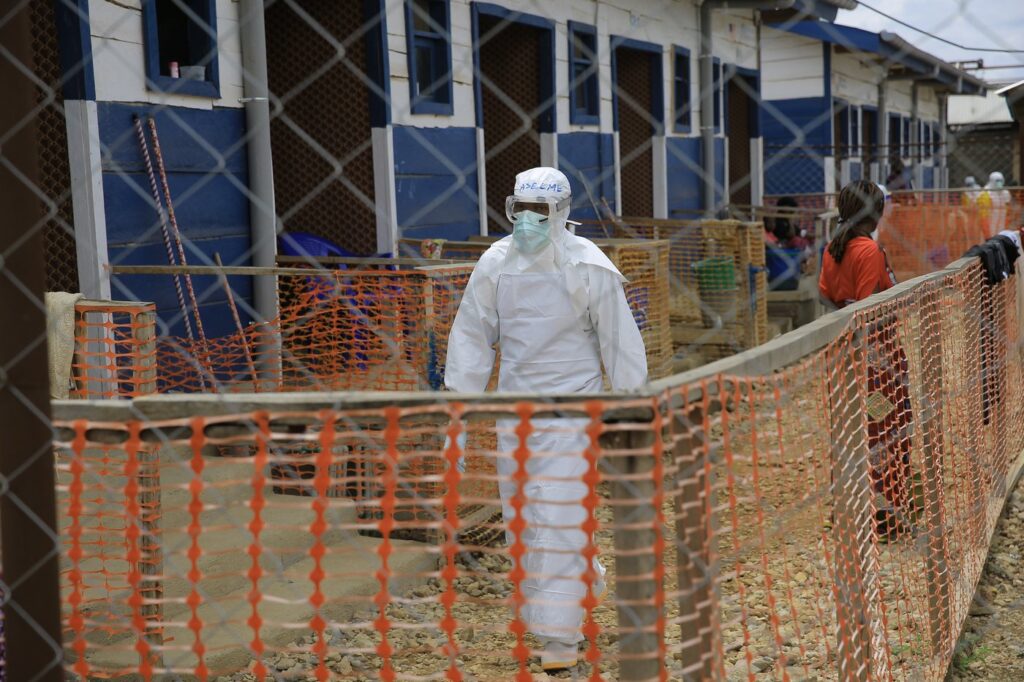
NEW YORK (AP) – The ongoing Ebola outbreak in Congo has tragically surpassed the milestone of 10,000 confirmed cases, raising concerns about the ability of health authorities to effectively manage the crisis. As nearly half of those infected have succumbed to the virus, experts fear that this could escalate into the most severe Ebola outbreak in history, while others remain cautiously optimistic that it may not reach such extreme levels. Researchers are actively working on updated projections to assess the outbreak's trajectory.
Although current assessments indicate that the outbreak is unlikely to cause significant issues in most other countries, approximately 30 confirmed cases have already been identified in nations beyond Congo. Justin Lessler, a researcher at the University of North Carolina specializing in infectious disease dynamics, warns that the risk of additional cases appearing internationally increases if the outbreak is not controlled promptly.
There is hope for the future, as health experts anticipate that a vaccine aimed at curbing the virus will become available in the upcoming year. During a virtual summit organized for African health ministers, Africa CDC Director-General Dr. Jean Kaseya emphasized that the continent is "not winning" in the battle against Ebola. He underscored the necessity for collective action to prepare each country, ensure border coordination, and monitor them closely, all while keeping borders open.
Currently, Congo is witnessing a steady rate of confirmed cases, with approximately 400 to 500 new cases reported each week. While Dr. Boghuma Titanji, an infectious disease specialist at Emory University, noted that the numbers are not rising exponentially, the plateau at which they have stabilized poses significant concern. A notable challenge in Congo lies in the limited contact tracing and the need for cooperation from local communities, where health workers often invest more time persuading residents to engage than they do in providing care.
The statistics reveal that fewer than 25% of new cases emerge from known contacts of infected individuals, indicating that unnamed chains of transmission persist unnoticed by health authorities. As case numbers continue to accumulate, the likelihood of infected individuals traveling to other nations increases, which has already been observed in countries like France, Kenya, Nigeria, and Uganda, all of which are tied to the outbreak. Travel restrictions, such as those enforced by the U.S., serve as barriers to the virus's spread beyond Africa; however, experts advocate for the rapid isolation of any infected individuals upon their emergence in various locations.
Despite the low direct risk to the U.S. at present, according to Lessler, concerns remain for poorer nations and those afflicted by conflict, where health systems are considerably weaker, such as South Sudan. Ebola is primarily transmitted through contact with bodily fluids, such as vomit and blood.
This outbreak is now recognized as the second largest in history. Historically, dozens of Ebola outbreaks have emerged since the disease was identified in 1976. The largest and deadliest outbreak occurred in West Africa from 2014 to 2016, resulting in 28,000 infections and over 11,000 fatalities. In contrast, the current outbreak has surpassed three times the number of cases and deaths reported during the same period of the previous major outbreak, despite its declaration in May 2023. Medical evidence suggests that infections may have already been occurring months prior, with past outbreak responses often mistakenly focused predominantly on the Ebola virus rather than the Bundibugyo strain that is currently responsible for these illnesses.
The outbreak's response has been further complicated by armed conflicts in afflicted regions, systemic health gaps, widespread mistrust among communities, misinformation, and reductions in global aid. Conditions within Congo vary greatly, contributing to fluctuations in case trends across different locales. In addressing the need for effective testing, care, and contact tracing, Katie Thomas-Canfield from the International Rescue Committee stressed the importance of community collaboration to dismantle the transmission chain and mitigate the deadly escalation.
Dr. Wendy Armstrong, president of the Infectious Diseases Society of America, expressed concerns that the situation remains far from under control, predicting worsening conditions ahead. In contrast, Titanji holds an optimistic outlook for 2027, citing the ongoing vaccine trials targeting the Bundibugyo virus, with hopes for an effective solution within a year.
While forecasting the outbreak remains inherently challenging, scientists are diligently updating their models and projections. In May, the U.S. Centers for Disease Control and Prevention (CDC) released scenarios generated by computer simulations, which estimated that case growth could range from 10,000 to more than 20,000 in three months' time. Although the CDC is revisiting its modeling efforts, they have not permitted direct interviews with staff scientists regarding trends in the outbreak. Alessandro Vespignani, a disease modeler from Northeastern University, has noted that the persistent lack of a decrease in weekly case numbers suggests that clearer signs of resolution are still distant.