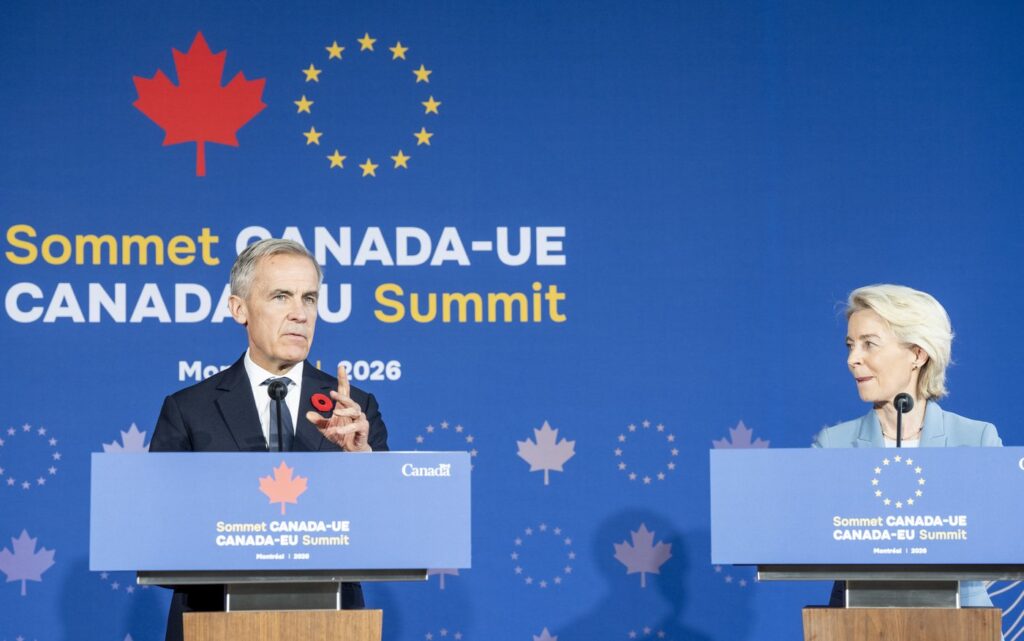
OTTAWA — Canada has strengthened its ties with the European Union (EU) through a newly established partnership intended to provide benefits to citizens on both continents. The partnership was marked by a summit held in Montreal on Friday, where various agreements were reached, although many will require months, or even years, to finalize.
The partnership targets multiple groups, including youth, tech workers, mining firms, regulators, soldiers stationed in Latvia, and efforts concerning Ukraine.
Youth
One of the core elements of the partnership is the enhancement of the "youth mobility partnership." Both Canada and the EU aim to provide greater opportunities for young people to travel abroad. This initiative seeks to expand existing university exchange programs and working-holiday opportunities that Canada currently operates with various European countries. Furthermore, European Commission President Ursula von der Leyen expressed the EU's desire for Canada to fully join Erasmus+, the EU's well-established student exchange program that facilitates training and study across member nations. Canada hopes to also become a full member of the Horizon Europe research partnership program by 2028, which will introduce new funding avenues for collaborative research and innovation projects with European counterparts.
Tech Workers
The new pact is expected to significantly benefit Canadian researchers and tech workers, as they will gain access to European supercomputers, reducing processing times from six months to just one day. Additionally, a digital trade agreement has been signed, which will integrate certain digital sectors into the trade agreement that has been in place for over a decade. The European Commission defines digital trade as "commerce enabled by electronic means," encompassing transactions such as banks transferring data and companies tracking freight through the internet. Canada is actively pursuing participation in the EU's "instant payment systems," fostering easier fund transfers between the two regions. Both parties are also looking to open their respective markets to allow greater access for Canadian and European banks, insurers, and fintech enterprises.
Mining Firms
In a significant development for the mining sector, the European Investment Bank will pursue funding for critical raw materials mining projects in Canada. According to von der Leyen, European "industrial demand, technology, and investment" can play a vital role in advancing these mineral operations, promising economic growth and collaboration in this field.
Regulators
Canada has also entered into an updated competition agreement with the EU aimed at addressing anticompetitive actions by businesses operating across the Atlantic. Although specific details about this agreement were sparse, the EU's border agency is set to support Canada in combatting issues related to migrant smuggling, human trafficking, and identity fraud via information sharing through the European Border Surveillance System. Moreover, both jurisdictions have committed to initiating formal discussions on various topics such as Arctic policy, combatting foreign information manipulation, climate security, and transportation.
Soldiers in Latvia
Canada's involvement in EU defense initiatives has also expanded; in June, Canada became the only non-European participant in the EU's defense procurement program, SAFE. Until recently, only one project had emerged from this partnership. However, on Friday, Canada announced a contract valued at up to $43 million for the supply of helmets to Latvian troops, to be produced by Montreal-based firm Galvion. Canadian soldiers remain stationed in Latvia as part of efforts to counter potential Russian aggression in the region.
Support for Ukraine
As the United States appears to be reducing its support for Ukraine amidst ongoing conflict with Russia, the EU has ramped up its commitment to aid the war-torn nation. Prime Minister Mark Carney announced Canada's intention to join the EU's loan program for Ukraine, with an initial pledge of 500 million euros, approximately C$775 million. The joint statement released on Friday emphasized that Canada will continue to provide extensive support to Ukraine — encompassing political, financial, economic, energy, humanitarian, military, and diplomatic assistance.