Democratic Leader Hakeem Jeffries is poised to make history as the first Black speaker of the House of Representatives following the Democratic victory in the midterm elections. He is set to face a vote from his colleagues when the new Congress convenes on January 3. If elected, it will mark the first time a Black lawmaker has held the influential House speaker's gavel, a position critical as the second in line to the presidency.
Jeffries's elevation to the speakership at the U.S. Capitol is symbolic, representing over 150 years of progress that began with the election of Joseph Rainey, the first African American elected to the House during the Reconstruction era. His rise comes at a time when many achievements from the 20th-century Civil Rights movement are being challenged, particularly during the final two years of the Trump administration.
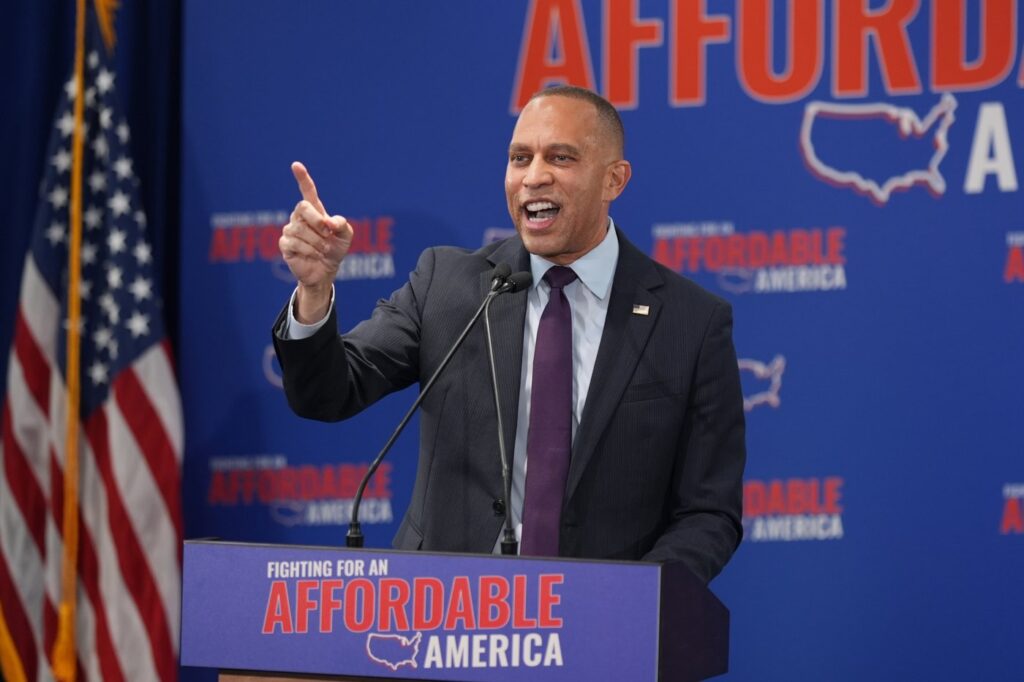
At a Democrats’ watch party, Jeffries received enthusiastic cheers of "Speaker! Speaker!" and emphasized the importance of this moment as patriotic, stating, “This is not a partisan moment. This is a patriotic one.” He acknowledged a national call for transformational change and pledged to work diligently to deliver the change that Americans deserve.
The 56-year-old Brooklyn native, who has been lauded for his ability to integrate old-school hip-hop lyrics into his speeches, would succeed near the end of Speaker Mike Johnson, a Republican. His leadership comes amid a rapidly changing political landscape in Congress as Democrats prepare to confront President Donald Trump and navigate leadership challenges from a new wave of elected Democrats, some backed by the Democratic Socialists of America.
In a letter to House Democrats, Jeffries declared, “America is back!” and laid out his goal of empowering all members to decisively act over the next Congress. His priorities are affordability, accountability, and upholding American values. Jeffries, alongside Rep. Katherine Clark of Massachusetts and Rep. Pete Aguilar of California, represents a new leadership era for House Democrats.
As the first Democratic speaker since Nancy Pelosi, Jeffries has been groomed for leadership over the past four years with her support, particularly after the Democrats faced setbacks in the 2022 elections. His leadership will be promptly tested, as controlling the House involves navigating a range of pressing issues, including rising healthcare costs, inflation, and ongoing foreign policy challenges.
Jeffries has outlined a bold 100-day agenda aimed at lowering living costs and establishing oversight over the Trump administration, with the potential for impeachment proceedings. He seeks to demonstrate the Democrats' capability to govern effectively in contrast to the tumultuous leadership experienced under the GOP's slim majority.
Despite being praised for his collaborative style, some critics have noted that Jeffries's calm, deliberative approach to leadership may not align with the demands for swift political action in today's fast-paced environment. He acknowledges pressing voter concerns about rising prices, national security, and government corruption.
Born to an Air Force veteran and a social worker, Jeffries navigated challenges during New York’s crack epidemic, informing his desire to uplift his community. He represents parts of Brooklyn once held by trailblazing Congresswoman Shirley Chisholm and has an educational background that includes a bachelor's degree from the State University of New York at Binghamton, a master's degree from Georgetown University, and a law degree from NYU, where he graduated magna cum laude.
Jeffries, elected to Congress in 2013 after defeating a long-time incumbent, has become a prominent figure in the Congressional Black Caucus, continuing the legacy of political leaders like Joseph Rainey, who was the first Black American elected to the House in 1870. While Rainey did not achieve the Speakership, he was the first Black legislator to preside over the House with the gavel.