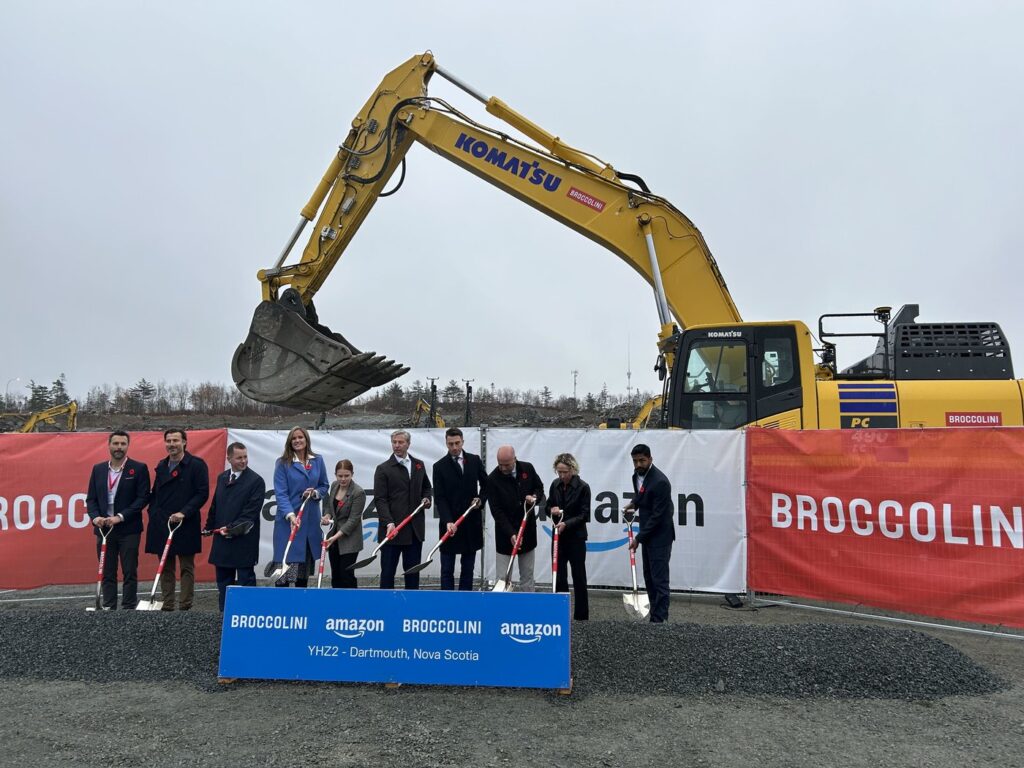
DARTMOUTH — American e-commerce giant Amazon held a groundbreaking ceremony in Dartmouth, Nova Scotia, on Wednesday for a massive new warehouse. This facility is expected to utilize robotics and employ over 1,000 full-time workers to efficiently fulfill customer orders.
The warehouse, located in Burnside Industrial Park, will span more than 200,000 square meters and is scheduled to open in 2029. Amazon has not disclosed the project's cost, but Brooks Barnett, head of economic development for Amazon Canada, indicated that the company was drawn to Halifax due to its port, expanding customer base, and welcoming stance towards investment.
Barnett noted that the new site will enhance product availability and reduce delivery times in the region, although he did not commit to offering same-day delivery. "The second you click ‘buy,’ a robot in this building will be moving to satisfy your order," he stated, highlighting how the new facility will complement Amazon's existing delivery operations in Dartmouth.
Employee wages at the new site will start at $26 per hour and include benefits such as health, dental, and a retirement savings plan. When asked if the new warehouse would replace a Quebec facility that was closed in January 2025 after employees there formed a union, Barnett refrained from providing specifics. He emphasized the company's respect for employees' rights regarding unionization but stressed the focus of the announcement was on the new investment in Dartmouth.
Notably, approximately 240 workers at Amazon’s Laval, Quebec warehouse unionized in May 2024, marking the first instance of unionization at the company’s Canadian warehouses. The company’s efforts to challenge this union drive were dismissed by the province's labor tribunal, a ruling that was subsequently upheld by Quebec Superior Court.
Additionally, Amazon has faced allegations of anti-union practices related to a now-closed warehouse in Lachine, Quebec. In August 2024, a labor tribunal ordered Amazon to cease interference in union matters and imposed a $30,000 fine. By January 2026, Amazon announced plans to close all seven warehouses in Quebec, impacting around 1,700 permanent and 250 temporary jobs. The company framed this move as a cost-cutting measure to improve service, asserting that it was unrelated to union activities.
Amazon's expansion in Nova Scotia aligns with a broader trend of U.S. tech companies increasing their operations in the province. For instance, artificial intelligence firm Anthropic recently signed a 20-year lease for a proposed $10-billion data center in Cape Breton, set to open late next year.
Premier Tim Houston confirmed that there is no provincial government funding for Amazon's new warehouse project. While the province offers economic development programs that Amazon could apply for, he emphasized that the investment is primarily driven by the company itself. "This is a company investing in our province, like the data centre as well. That's not government money either," he commented, noting the positive perception of Nova Scotia's economic prospects by international companies.
Barnett declined to speculate on how the new political landscape in the U.S., following the Democratic control of Congress after the recent midterm elections, might affect Amazon's operations. Historically, Amazon's ties with former U.S. President Donald Trump have been complex, with Trump previously accusing Amazon of manipulative practices related to his coverage in The Washington Post, which he owns.
The relationship has evolved, especially after Trump won the 2024 election, with Amazon planning significant contributions to his inauguration fund and showcasing a more favorable stance toward his administration, including the streaming of Trump's reality show "The Apprentice" and acquiring documentary rights related to Melania Trump.
This report details a significant development in Amazon’s expansion strategy, emphasizing both the economic implications for Nova Scotia and the ongoing complexities surrounding unionization within the company. The investment in Dartmouth reflects a broader trend of tech growth within the region, positioning it as a notable player in the North American economic landscape.