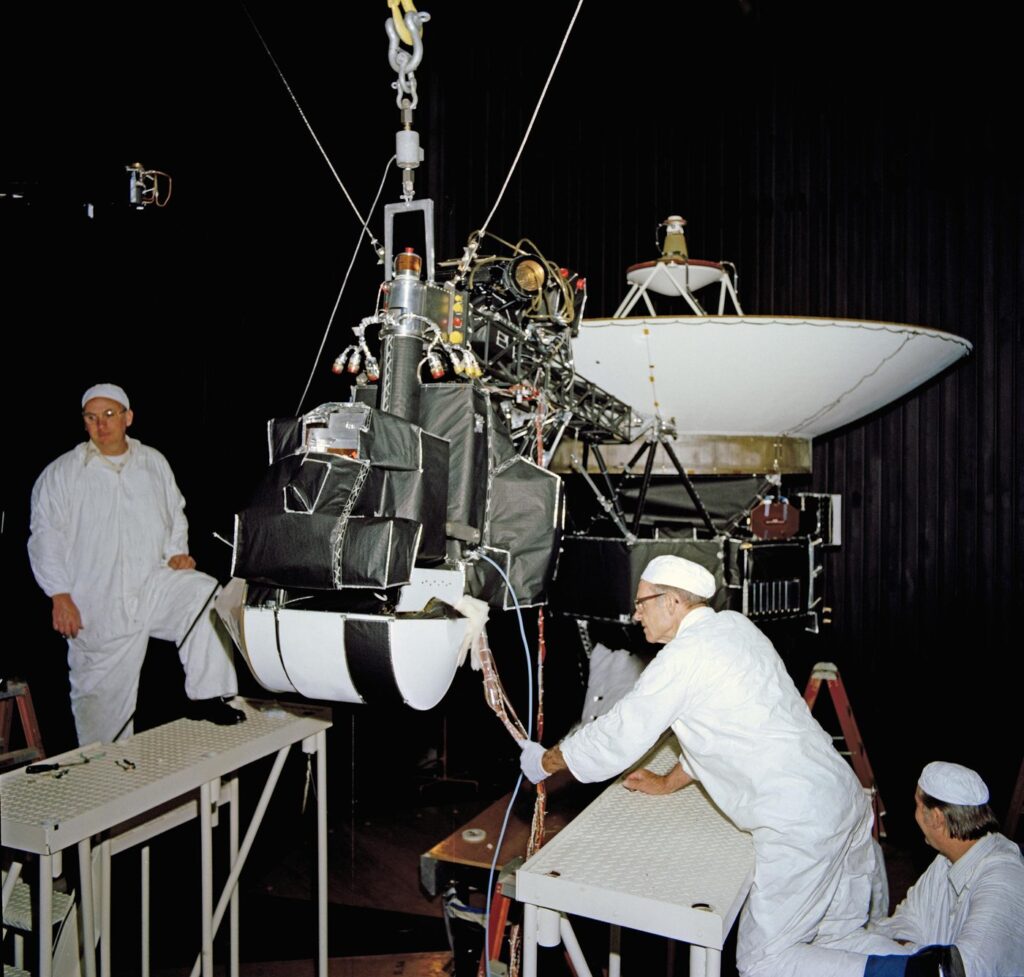
CAPE CANAVERAL, Fla. (AP) - NASA's Voyager 1 is on the brink of becoming humanity's first object to reach a distance of one light-day from Earth as it ventures further into interstellar space. This incredible journey marks a distance of over 16 billion miles (approximately 26 billion kilometers) since its launch 49 years ago.
Voyager 1 is expected to reach this remarkable milestone on Wednesday, whereby its radio signals will take 24 hours to travel at the speed of light to reach Earth—essentially making it one light-day away. NASA anticipates that it will take another 18,000 years for the spacecraft to cover a full light-year, and even longer before it approaches another star.
Suzanne Dodd, the project manager, regards Voyager 1 as an ambassador of Earth traveling through the cosmos, generating a sense of wonder back home. "It's a national treasure," she remarked, highlighting the significance of the mission. To commemorate this occasion, NASA is inviting people all over the globe to participate in a light wave event after sunset on Tuesday, using their phones or flashlights to create a wave of golden light that spells out the letters V-G-R in Morse code, representing Voyager’s call sign.
Despite experiencing intermittent issues typical of aging technology, Voyager 1 and its twin, Voyager 2, continue to relay valuable scientific and engineering data as they travel at a speed of 38,000 mph (61,000 kph). Although Voyager 1 was launched first in 1977, Voyager 2 is not expected to reach the one light-day mark until 2035.
Voyager 1 made enthralling flybys of Jupiter and Saturn in 1979 and 1980, respectively, before exiting the solar system and entering what NASA classifies as interstellar space in 2012. Voyager 2 followed suit, having explored Uranus and Neptune while providing stunning imagery, before entering interstellar space in 2018.
Every day, the Voyager spacecraft collect and transmit data regarding their uncharted surroundings, such as measurements of the magnetic field's strength and direction, as well as information about pressure, dust, and cosmic rays. In this capacity, they are likened to weather satellites by Dodd, who has been involved with the missions since 1984.
NASA’s Jet Propulsion Laboratory in Pasadena, California, maintains a skeleton flight control team that sends commands to the spacecraft roughly once a week. The response is intensified whenever the spacecraft encounters problems, sometimes enlisting the help of retired engineers who previously worked on the project.
In September, mission controllers implemented the latest effort to conserve power for the plutonium-powered Voyager spacecraft. However, communication was briefly disrupted in October, and teams are currently investigating the cause of this interruption.
Throughout its journey, Voyager 1 has set numerous records, including being the farthest human-made object from Earth, and it is famously known for capturing the 'Pale Blue Dot' photograph in 1990—a distant image of Earth from beyond Neptune, as articulated by Cornell University astronomer Carl Sagan. He poignantly remarked that this "very small stage in a great cosmic arena" is where every human being who ever lived spent their lives.
Though most individuals alive today were not born when the Voyager missions began, Bill Nye of the Planetary Society emphasizes that "all of us—everyone on Earth—have been touched by these missions." The Golden Record, which is a compendium of greetings in 55 languages along with images and diagrams, originated from Sagan's efforts as well.
Every Voyager spacecraft carries a 12-inch gold-plated phonographic record, intended as a time capsule of life on Earth from 1977. It also includes the voice message of Sagan's young son, Nick, who said, "Hello from the children on Planet Earth." Dodd hopes someone or something might discover it in a millennium.