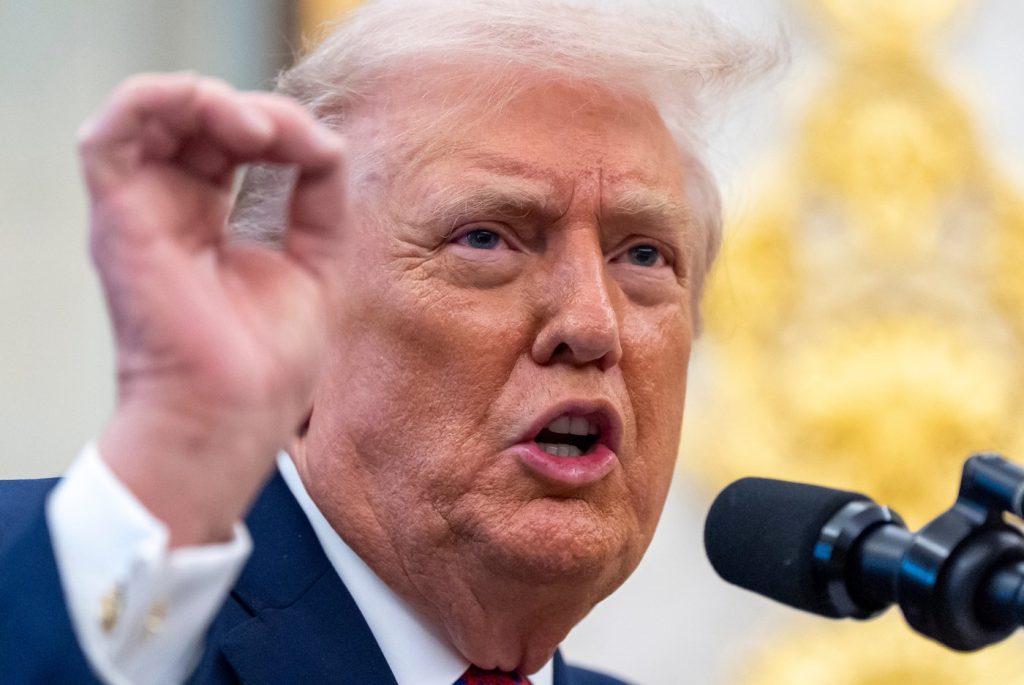
WASHINGTON (AP) – President Donald Trump announced on Tuesday the imposition of a blockade against all “sanctioned oil tankers” entering Venezuela, increasing pressure on the nation's authoritarian leader, Nicolás Maduro. This decision appears to be aimed at tightening the U.S. grip on Venezuela's economy.
This recent escalation follows the seizure of an oil tanker by U.S. forces off the coast of Venezuela, marking a notable military presence in the region. In a social media post, Trump accused the Venezuelan government of utilizing oil revenues to fund drug trafficking and other crimes. He vowed to maintain a military buildup in the area until Venezuela returns what he described as “oil, land, and assets” previously taken from the United States, although the basis for this claim remains unclear.
In his statement, Trump claimed, “Venezuela is completely surrounded by the largest Armada ever assembled in the History of South America.” He further warned that the U.S. military presence would increase, leading to unprecedented consequences for the Venezuelan regime unless they comply with his demands.
In response, Venezuela's government accused Trump of breaching international law and free trade principles, labeling his threats as “reckless” and a significant threat to its sovereignty. The Venezuelan statement criticized Trump for assuming ownership over the nation’s resources and asserted that his intentions could lead to a “total and complete blockade” against the country.
The Maduro administration plans to raise this issue at the United Nations, asserting that Trump's actions reflect an irrational desire to seize Venezuela's wealth through military intimidation.
Recent U.S. military activities have included strikes on vessels in international waters, which have drawn bipartisan criticism from U.S. lawmakers and reportedly resulted in the deaths of at least 95 individuals involved in these operations. Despite this, the Trump administration maintains that these actions are essential in preventing drug trafficking to the U.S. It has indicated plans to extend its military campaign beyond maritime operations to land strikes against targets related to the Maduro regime.
Trump’s chief of staff, Susie Wiles, affirmed in a Tuesday interview that the military strategy aims to pressure Maduro into compliance, stating, “Trump wants to keep on blowing boats up until Maduro cries uncle.”
Venezuela, home to the world’s largest proven oil reserves, has traditionally depended on oil revenue, with current production around one million barrels per day. However, since the imposition of U.S. oil sanctions beginning in 2017, the Maduro government has resorted to using unregistered tankers to circumvent these restrictions. The state oil company, Petróleos de Venezuela S.A. (PDVSA), is largely excluded from global markets and is forced to sell oil at heavily discounted rates, primarily to China and Cuba.
Trump has previously indicated that Maduro has offered concessions regarding oil and natural resources to avoid further U.S. pressure. Nevertheless, details on how the U.S. will implement the proclaimed blockade of sanctioned oil tankers remain vague.
The U.S. Navy currently has a significant presence in the region with 11 ships, including an aircraft carrier and amphibious assault vessels. These assets are equipped to monitor maritime traffic and could contribute to enforcing the blockade Trump described.
Notably, Trump characterized the Venezuelan regime as a “FOREIGN TERRORIST ORGANIZATION,” though this designation typically applies to non-state actors without sovereign immunity. Historical U.S. designations have rarely classified foreign governments in this manner, prompting questions regarding the legal standing of Trump's assertion.
In conclusion, the ongoing tensions highlight the complicated interplay between U.S. foreign policy and Venezuela’s political landscape, reflecting the broader implications of economic sanctions and military engagement in the region.