MONTREAL – The union representing American air traffic controllers has acknowledged serious allegations regarding two of its members who reportedly left work early prior to a tragic incident at LaGuardia Airport involving an Air Canada regional jet. This unfortunate event occurred in March and resulted in the deaths of two pilots.
According to various U.S. media reports, the Federal Aviation Administration (FAA) is contemplating the dismissal of these two flight controllers. Allegedly, they clocked out approximately an hour before their scheduled shifts ended, which left two other controllers at the LaGuardia control tower without essential backup during a critical time.
The National Air Traffic Controllers Association (NATCA) confirmed the allegations, which were first highlighted by the Wall Street Journal. In a statement sent via email, the union expressed that it is actively engaging with FAA leadership to discuss these serious accusations. NATCA emphasized that these discussions are the appropriate venue to address such matters, indicating their intention to ensure a fair process.
While the FAA has not directly commented on the allegations against the controllers, they reaffirmed their commitment to employee accountability. In an email, the agency stated, “We will not compromise the safety or efficiency of the National Airspace System.” This response highlights the FAA's focus on maintaining standards within air traffic control operations amidst the ongoing investigations.
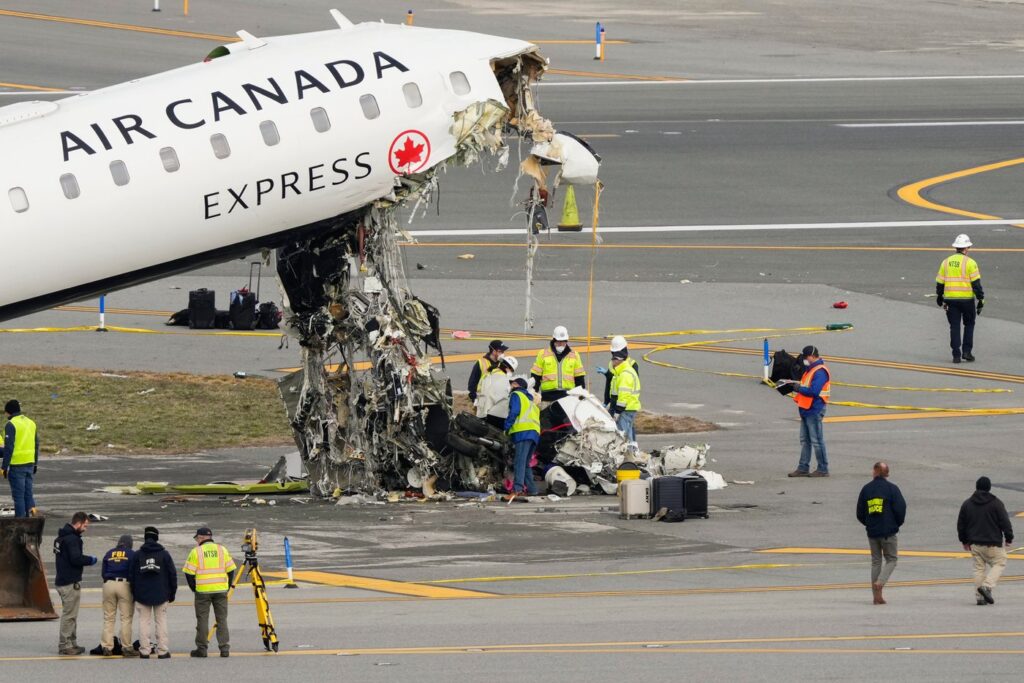
The tragic accident occurred shortly after 11:30 p.m. on March 22, when an air traffic controller granted clearance for an Air Canada Express plane to land, just two minutes before also approving a fire truck to cross the active runway. The resulting collision between the jet and the fire truck led to the deaths of two Canadian pilots, identified as Quebec resident Antoine Forest and Ontarian Mackenzie Gunther. Additionally, more than 40 individuals were sent to the hospital following the incident.
Footage from the scene reveals the jet racing down the rain-soaked runway as the fire truck crossed its path. Despite the quick actions of the pilots, who were commended for their response, the truck failed to veer away in time, resulting in a catastrophic impact that left debris scattered and caused major destruction to the jet's cockpit.
Reports indicate that the air traffic controller recognized the perilous situation moments before the collision and attempted to instruct the fire truck to “stop” multiple times, specifically 12 commands within a span of 10 seconds. Unfortunately, the truck did not respond to these urgent warnings.
A preliminary investigative report released by the U.S. National Transportation Safety Board (NTSB) in April has highlighted that system failures and communication breakdowns were significant factors that contributed to the accident. Experts weighed in on the situation, praising the quick reflexes of Forest and Gunther in applying the brakes—decisions that likely prevented further loss of life and additional injuries.
This developing story not only sheds light on the accountability among air traffic control personnel but also raises critical questions about operational safety and communication protocols in the aviation industry. The situation continues to unfold as investigations proceed, and the FAA seeks to address the identified issues comprehensively.
Companies involved in this situation include Air Canada, which operates the regional jet through its carrier Jazz Aviation.