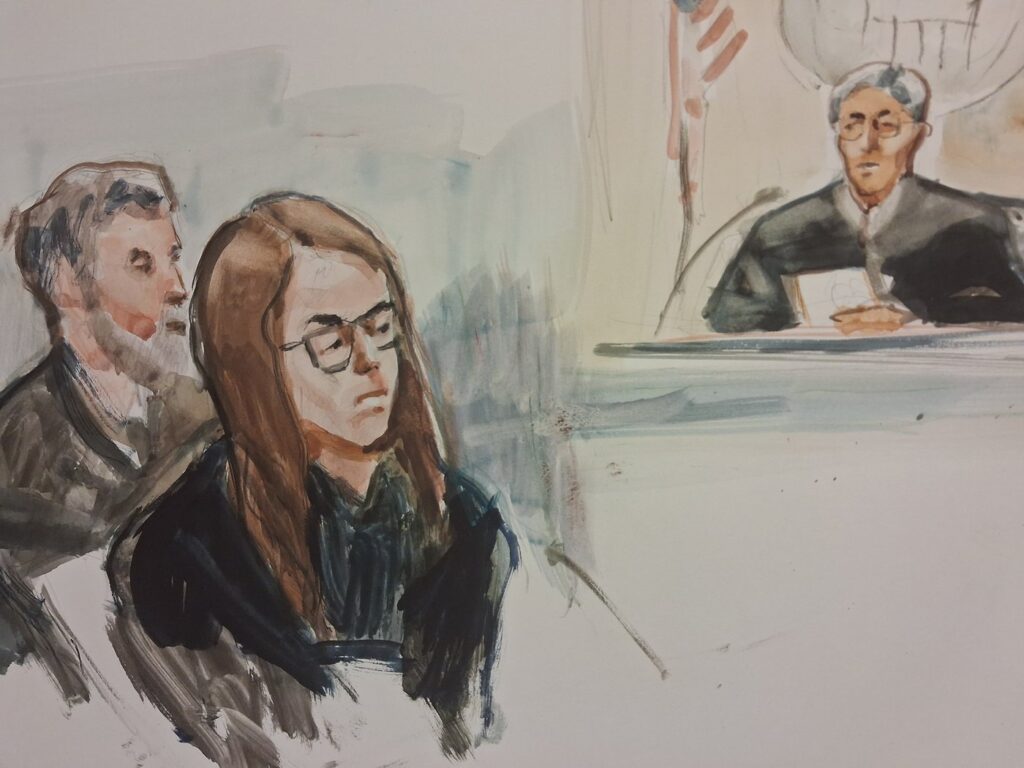
SEATTLE — In a significant legal development, James Bryant was denied bail on Tuesday by a Federal Court in Seattle, Washington. Bryant is implicated in conspiring online with Jesse Van Rootselaar, the alleged perpetrator of a mass shooting that occurred in Tumbler Ridge, British Columbia. The U.S. District Court for the Western District of Washington ordered Bryant's detention based on concerns regarding public safety and the nature of the accusations against him.
Federal prosecutors presented compelling arguments for maintaining Bryant’s custody, suggesting that he played an active role in facilitating a mass murder plot over several months. The prosecutors' memorandum indicated that Bryant communicated with Van Rootselaar, providing both guidance and financial support as the teenager developed plans for the massacre. They emphasized that releasing Bryant could endanger the community, citing his willingness to refrain from reporting the planned attack.
The memorandum included reference to Bryant expressing "disapproval" of Van Rootselaar's plans but ultimately promising not to "snitch," which further influenced the court's decision to deny bail. The prosecutors contended that someone who could assist in planning such a heinous act, while choosing to watch instead of intervening, poses a significant threat to society. Specifically, the memo stated, “Anyone whose character allows them to help plan a mass shooting and then sits back and (literally) tries to watch as schoolchildren are murdered... is a danger to the community and should be detained pending trial.”
The tragedy unfolded on February 10 of this year when Van Rootselaar, after murdering her mother and brother, proceeded to a high school where she killed five students and an educational assistant before taking her own life. The document submitted by prosecutors highlighted that Bryant's communication with Van Rootselaar predominantly took place online, indicating that no conditions could be enforced to prevent him from posing a continuing threat through similar online activities.
In contrast, Bryant's defense, represented by public defenders Dennis Carroll and Gregory Murphy, painted a different picture. They referred to Bryant using female pronouns and noted the preferred name, Melody. The defense argued for Bryant's release, citing a lack of prior criminal record, stable housing, employment, and strong community ties as indicators of her character.
The defense’s written submission questioned the integrity of the evidence against Bryant, which largely comprised a large volume of online messages exchanged via the Discord platform that had not been fully disclosed. They pointed out that law enforcement held the evidence for seven months before Bryant's arrest, during which she remained in the community without restrictions. The defense also drew attention to violent fantasies shared by Van Rootselaar with ChatGPT, arguing that the absence of criminal charges against OpenAI demonstrated that a mere failure to report does not imply collusion.
Furthermore, the defense contended that Bryant's First Amendment rights protect such speech, even when it implies non-imminent violence. They maintained that there was no indication of substance abuse or mental health issues to justify ongoing detention. “There is no reason to suspect that Ms. Bryant has chatted, or could chat, with another person planning another horrifying crime,” they stated, emphasizing that the government’s delay in arresting her contradicts the assertion of her posing a danger.
In conclusion, Bryant's legal team argued that she should be granted release under conditions such as house arrest, a mental health evaluation, and strict limits on internet access. They contended that while Van Rootselaar's actions were reprehensible, there was insufficient evidence to label Bryant as an ongoing threat to the community. Bryant’s public defender, Dennis Carroll, was not available for comments following the court's decision.