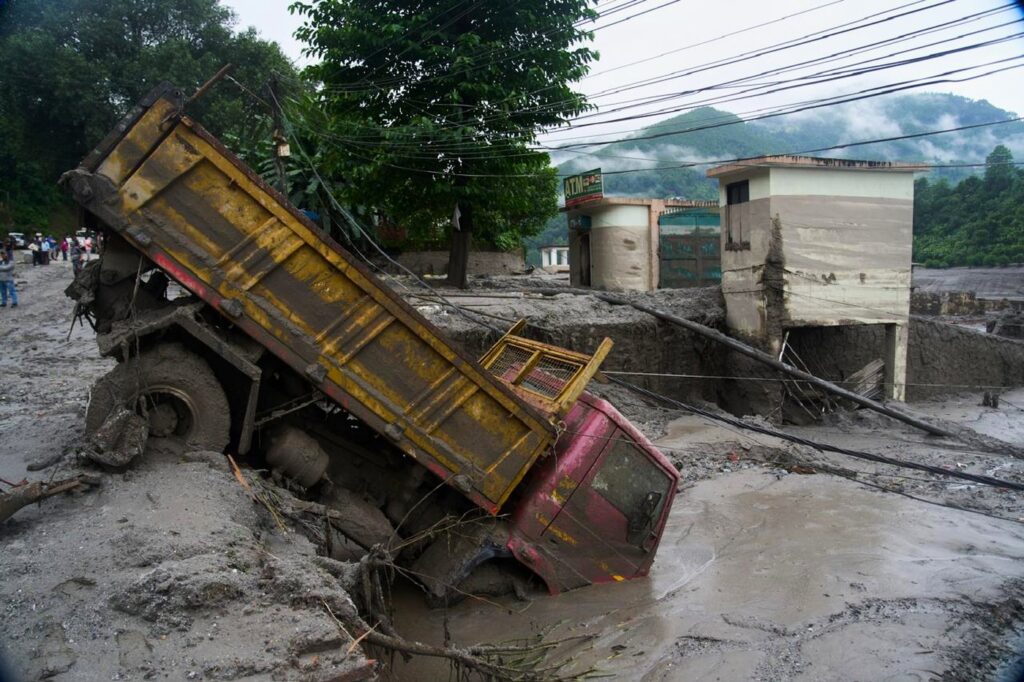
BENGALURU, India (AP) – A recent flash flood in Nepal has been tentatively linked to a significant glacier collapse. Scientists suggest that a large chunk of ice broke off from a glacier and temporarily dammed a river, causing a vast surge of water to flow downstream with devastating results. Preliminary investigations are ongoing as researchers analyze satellite and ground-level data to determine the exact sequence of events that led to this disaster, which tragically claimed hundreds of lives and left many others missing, including both locals and foreign pilgrims.
The U.S. Geological Survey reported a magnitude 5.2 glacier collapse, which resulted in debris impacting nearby communities. This determination was reached through data from seismic stations, long-period seismic waves, and satellite imagery. Jakob Steiner, a geoscientist based at the University of Graz in Austria, explained that a significant portion of the glacier appeared to have broken away in a manner reminiscent of a knife cutting through ice, precipitating chaos.
While scientists are cautious about directly attributing this incident to global warming, they acknowledge the rising temperatures caused by human activities—such as burning fossil fuels—are making such disasters increasingly probable. The Himalayan region is particularly affected, experiencing a warmer climate at a rate faster than many other areas globally. Saswat Sanyal from the International Centre for Integrated Mountain Development expressed the need to refrain from making direct connections but noted that rising temperatures are causing changes in the region's climate and melting of glaciers.
The flood resulted in substantial devastation, with thousands losing their homes and key infrastructure, including hydropower dams, roads, and bridges, suffering extensive damage. Researchers indicated that water levels surged by up to 9 meters (29.5 feet) within a mere 30 minutes, creating a massive wave of destruction. Initial evidence suggests that a significant volume of ice and rock fell into the Lhende Khola, a tributary of the Bhote Koshi River, leading to a powerful surge downstream. There is also an investigation underway to assess whether debris may have temporarily held back the river, causing further flooding once it burst through the accumulation.
The area has a documented history of hazardous events; flooding from glacial lakes struck the same valley in 2025, and other catastrophic events like ice and rock avalanches have been recorded. Climate scientists emphasize that the Hindu Kush Himalaya is warming considerably, which is leading to essential changes in glacier dynamics, permafrost conditions, and mountain slope stability. It is estimated that more than 63,000 glaciers in this region sustain numerous major Asian river systems, crucial for the food, water, and livelihood security of billions of people.
With approximately 78% of the glacier area in the region being highly vulnerable to warming, experts warn that the frequency of such disasters may become the new normal. In the face of climate change, projections indicate significant ice loss, with forecasts suggesting that up to 50% of glaciers could disappear by 2100 without effective policy changes to limit global warming.
Recent findings indicate a doubling of ice-loss rates since 2000, exacerbating the risk of glacial lake formation and subsequent floods. As glaciers retreat, rock surfaces that were once insulated become exposed to warmer temperatures, leading to increased instability in mountain areas. Current scientific discourse emphasizes that events like the recent flash flood may represent a cascade of typical hazards, occurring initially as a glacier collapse followed by debris flows and blockages, culminating in devastating floods.
The rapid growth of settlements in Nepal, combined with insufficient warning systems, has intensified the impact of such calamities. With about 10% of Nepal's power production reliant on the affected region, it is critical that improved early warning systems and monitoring initiatives are established. However, monitoring the vast and complex geography of the Himalayas is fraught with challenges, and when cascading disasters occur, there is often little time for communities to react effectively.
Experts warn that regions in Nepal have reached a point where certain areas may no longer be safe for habitation. This crisis underscores the urgent need for coordinated efforts among various stakeholders to establish proactive measures against future risks, given that the lessons from previous disasters have not resulted in the necessary changes to mitigate impacts.