More than a year after President Donald Trump deployed National Guard members to patrol the streets of Washington, D.C., a federal appeals court heard arguments regarding the legality of that action. The court sought clarification on whether there are any limits to a president’s authority to mobilize the National Guard, especially in relation to the Posse Comitatus Act of 1878, which restricts the use of federal military forces for domestic law enforcement.
The hearing featured a three-judge panel questioning government attorney Eric McArthur. Judge Cornelia T.L. Pillard probed the government's stance on presidential authority and its potential conflicts with the Posse Comitatus Act. McArthur argued that the president’s authority to call out the guard must align with aiding civil authorities, emphasizing the parameters of such actions.
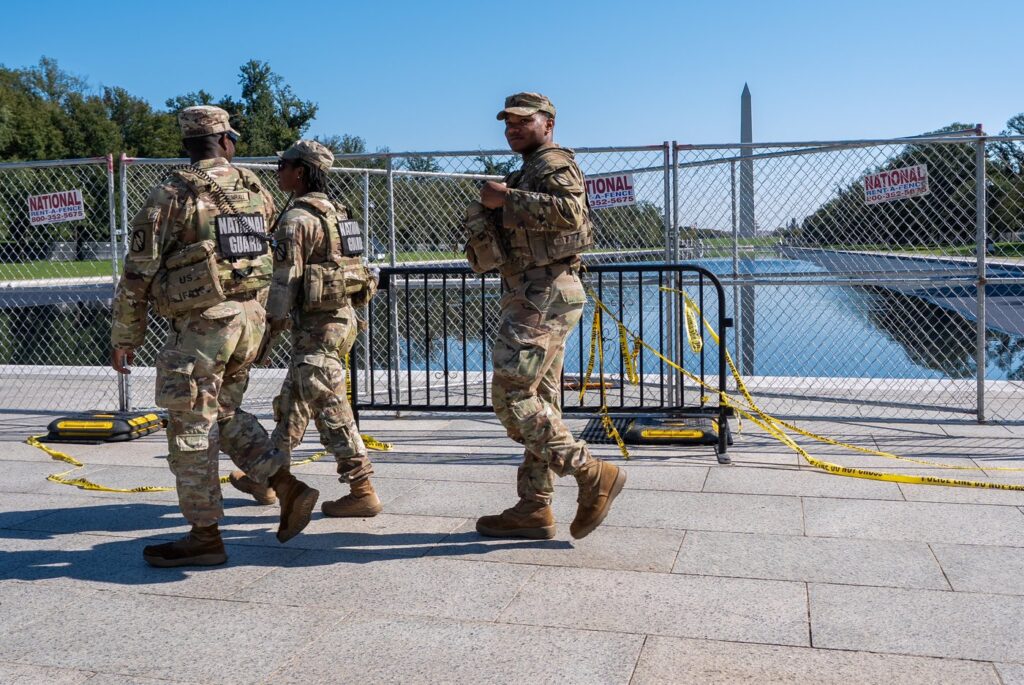
President Trump deployed the National Guard in August 2025 as part of a crime-fighting mission. At its peak, the deployment rose to about 5,000 troops, who supported arrest operations, patrolled neighborhoods, and participated in cleanup efforts. The Trump administration maintains that this deployment has contributed to a decline in crime rates, although crime was already on the decline before their arrival. Critics, including D.C. officials and activists, argue that this action wastes taxpayer money and contributes to the militarization of the city.
During the hearing, Mitchell Reich, representing D.C., faced intense scrutiny from the panel regarding his argument that legal frameworks govern presidential authority in mobilizing the guard. He mentioned that deployments could be justified in situations like invasion or insurrection. However, the judges challenged the notion that the president’s authority could be unlimited during such circumstances.
The hearing followed a December ruling where a different panel of judges paused a lower court's decision that deemed Trump’s deployment illegal. Those judges, two appointed by Trump and one by Obama, ruled that various factors favored the administration’s position, including the disruption caused to service members and the president's interest in protecting federal functions in D.C.
The crux of the case lies in whether the president can legally deploy the National Guard in a district with limited self-governance. The U.S. Constitution grants Congress authority over Washington, D.C., while the Home Rule Act of 1973 allows residents to elect local officials. D.C. argues that the deployment constitutes an illegal military action against domestic law enforcement, as Reich emphasized during the hearing.
Legal experts, including Syracuse law professor William Banks, indicate that D.C.’s chances hinge on its home rule argument. They suggest that a lack of overarching federal principles could weaken D.C.'s position, given that the president holds significant authority over military deployments in the district, which behaves more like a federal entity than a state.
Furthermore, U.S. District Judge Jia Cobb previously determined that Trump’s military intervention illegally infringed on local authorities' ability to manage law enforcement. Cobb noted that while the president could protect federal interests, he cannot indiscriminately deploy the National Guard to address crime control without proper authorization.
The appeals court has delayed the enforcement of Cobb's order, permitting the National Guard’s presence to continue while the case is active. This situation has evolved into what feels like a permanent military presence in the city, sustained by a contract worth $292 million to house troops. Their number has fluctuated throughout the year, peaking during events like the semiquincentennial celebration. Recent figures indicate staffing has decreased to approximately 2,900 troops.
Outside the courthouse, people rallied against the ongoing military presence, expressing concerns about the local governance and lack of representation. David Barrows, a resident dressed in a Trump costume, criticized the federal oversight, emphasizing Washington D.C.’s unique position as a federal district. Other residents, like Jennifer Pace, expressed hope for a swift resolution to the case to return the National Guard to their home states.