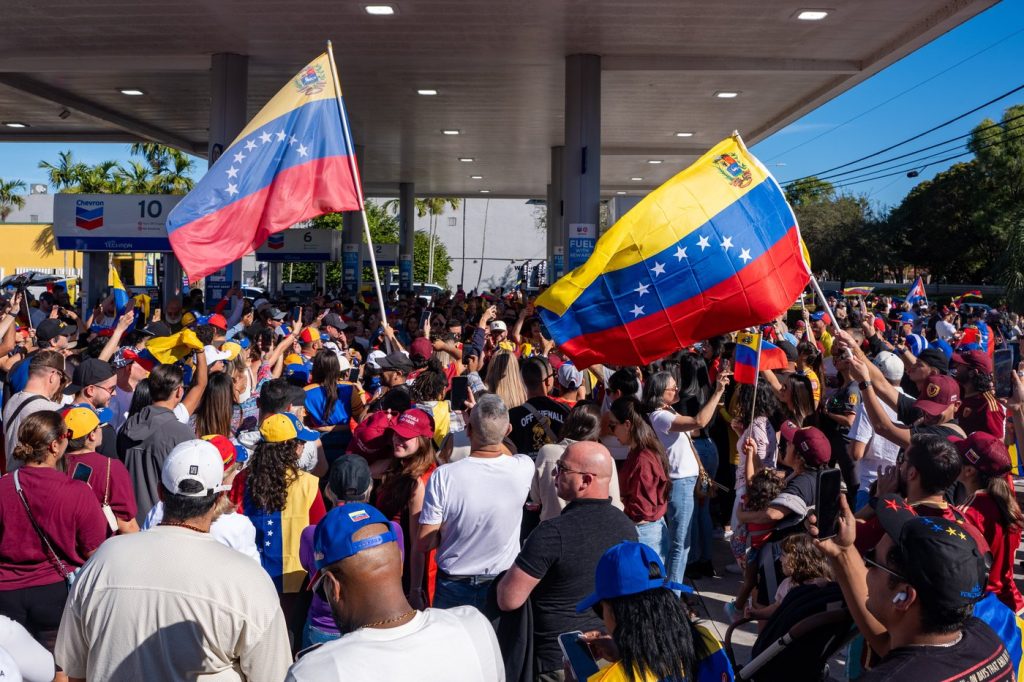
DORAL, Fla. (AP) — On Saturday, January 3, 2026, a celebration erupted in Doral, a Miami suburb with a significant Venezuelan community, following the capture of Nicolás Maduro by U.S. military forces. Revelers chanted "liberty" and adorned themselves with Venezuelan flags, expressing joy and relief at the long-awaited outcome of a U.S. military operation aimed at removing Maduro from power.
The news of Maduro’s capture sparked emotions among Venezuelan natives, many of whom were filled with excitement and hope for the possibility of reuniting with family members after years of separation. The military action was seen as the culmination of escalating pressure from the U.S. on the Maduro regime, providing a glimmer of hope for change in their homeland.
As people gathered outside El Arepazo restaurant, a cultural anchor for the Venezuelan community in Doral, many expressed mixed feelings. Alejandra Arrieta, who immigrated to the U.S. in 1997, articulated the complexity of emotions surrounding the event, citing excitement, fear, and the longwait for freedom as pivotal sentiments in the crowd.
David Nuñez, a political activist who fled Venezuela six years ago, voiced hope for reconnecting with his daughters aged 8 and 17 for the first time since his exile. "The most important thing is that we’re going to be able to be with our families soon," he shared, shedding tears of joy over the prospect of returning home.
President Donald Trump declared that the U.S. government would temporarily administer the affairs of Venezuela, a claim he reinforced during a press conference. This announcement came amid a campaign of increasing pressure, reflecting a strategic effort by the Trump administration regarding the oil-rich South American nation.
As the emotional atmosphere enveloped Doral, crowds continued to gather outside the restaurant, with many singing, dancing, and celebrating. Cooks were instructed to prepare additional food in anticipation of the swelling demand, as hundreds flocked to the area to commemorate the historic moment.
Venezuelans like Alexa Perez viewed the capture as a new beginning, referring to it as a second independence day. Newly married, Perez described the news as "the best wedding gift" she could have hoped for, while her husband, Aldo Amenta, echoed the sentiments of joy mixed with trepidation, relieved that their family members remained safe.
In the wake of Maduro’s ousting, some community members expressed optimism regarding future U.S. involvement in managing the country and its resources. Perez underscored the dire situation in Venezuela, pointing out the lack of healthcare and basic rights, and believed that U.S. administration could lead to a positive transition.
Over the past decade, approximately 8 million Venezuelans have fled their country, many seeking refuge in the U.S. after facing oppression, economic hardships, and humanitarian crises. In Florida, a sense of celebration emerged despite initial apprehensions surrounding U.S. immigration policies.
Niurka Meléndez, a Venezuelan who arrived in 2015, expressed hope that the end of Maduro's regime would pave the way for recovery. As a co-founder of the Venezuelans and Immigrants Aid group in New York City, Meléndez has become an advocate for her country's future, believing that removing authoritarian leaders is essential for establishing justice and rebuilding the nation.
In the face of hopes for a better future, Meléndez highlighted the necessity for international humanitarian support to assist Venezuela in overcoming the severe hardships its citizens have endured. She emphasized that while the removal of an oppressive regime creates possibilities for recovery, it does not guarantee immediate improvements, underscoring the need for systemic change.