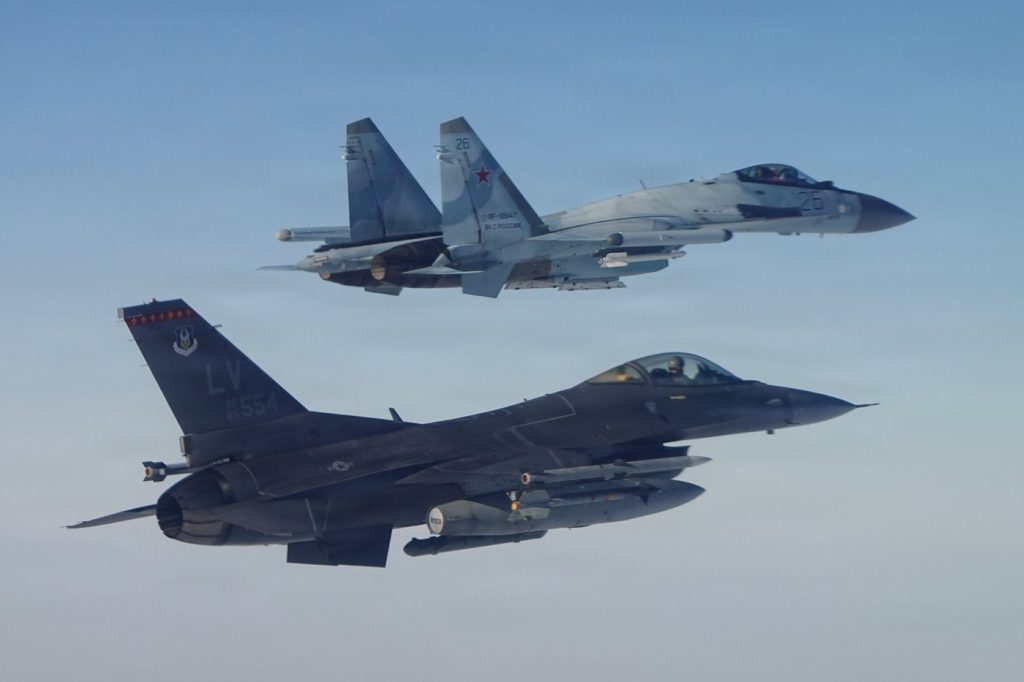
ANCHORAGE, Alaska (AP) - Military jets were dispatched to intercept five Russian aircraft flying in international airspace off the western coast of Alaska. However, military officials stated that these Russian aircraft activities were not perceived as provocative. The North American Aerospace Defense Command (NORAD) reported that it detected and tracked two Russian Tu-95 bombers, two Su-35 fighters, and one A-50 surveillance aircraft operating near the Bering Strait on Thursday.
In response to the Russian aircraft's presence, NORAD launched a comprehensive interception operation. This included two F-16 fighter jets, two F-35 stealth fighters, one E-3 surveillance aircraft, and four KC-135 refueling tankers. The goal was to intercept, identify, and escort the Russian aircraft until they left the operational area, according to the statement released by NORAD.
According to NORAD, "The Russian military aircraft remained in international airspace and did not enter American or Canadian sovereign airspace." The command acknowledged that such activities occur regularly and are not considered a threat. The Russian aircraft were operating in an area near the Bering Strait, a narrow passage approximately 50 miles (80 kilometers) wide that connects the Pacific and Arctic Oceans, specifically within the Alaskan Air Defense Identification Zone (ADIZ).
These ADIZ zones begin where sovereign airspace ends. Although it is classified as international airspace, all aircraft are required to identify themselves upon entering these zones for national security reasons, as explained by NORAD. To monitor the airspace, the command employed a combination of satellites, ground-based and airborne radars, alongside aircraft.
NORAD's headquarters is located at Peterson Space Force Base in Colorado, but its operations in Alaska are based at Joint Base Elmendorf-Richardson in Anchorage. This operational setup allows NORAD to effectively respond to any aerial activities that could pose a risk to U.S. and Canadian airspace.
Throughout this incident, the U.S. military demonstrated its capability to respond swiftly and efficiently to unknown aircraft in the vicinity. This robust response is part of a broader strategy to maintain air security and monitor foreign military activities near North American borders.
The consistent presence of Russian military aircraft in the Arctic region, particularly near the Bering Strait, underscores ongoing geopolitical tensions. Despite these tensions, NORAD’s assessment emphasized that the situation did not escalate into a direct threat. This highlights the importance of ongoing monitoring and readiness to ensure national security while managing international military interactions.