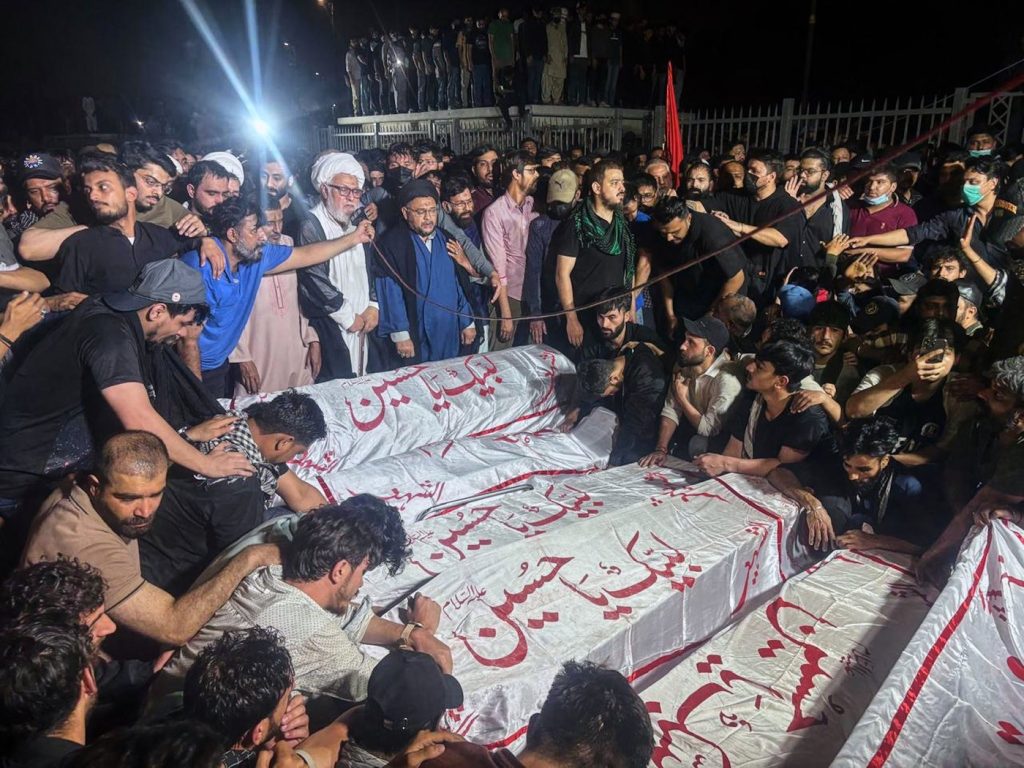
Pakistani authorities imposed a three-day curfew and deployed troops in the northern cities of Gilgit and Skardu early Monday after violent protests erupted, resulting in multiple deaths and injuries. This unrest followed the killing of Iran's Supreme Leader Ayatollah Ali Khamenei in alleged U.S.-Israeli airstrikes. Reports indicate that at least 12 individuals were killed and around 80 were injured during the protests, according to local police in the Gilgit-Baltistan region.
On Sunday, thousands of Shiite demonstrators clashed violently with security forces, targeting the offices of the U.N. Military Observer Group (UNMOGIP) and the U.N. Development Program in Skardu. Protesters also set fire to a police station, caused significant property damage, and attacked a local charity's offices in Gilgit. Stéphane Dujarric, a spokesperson for the U.N., confirmed that the protests became violent near the UNMOGIP Field Station, emphasizing the organization's commitment to ensuring the safety of its personnel amid escalating tensions in the region.
Shabir Mir, a spokesperson for the Gilgit-Baltistan government, reported that the situation was under control, but the curfew would remain in place until Wednesday to prevent further violence. Gilgit police chief Akbar Nasir Khan urged residents to remain indoors, citing concerns about "deteriorating law and order conditions." Concurrently, demonstrators in the southern city of Karachi stormed the U.S. Consulate on Sunday, resulting in extensive property damage, injuries, and at least 10 fatalities.
A further layer of violence was reported in Islamabad, where clashes during a planned march by the Shiite minority occurred as they attempted to reach the U.S. Embassy to voice their support for Iran. The protests are emblematic of the growing anger among Shiites in Pakistan in the wake of the attacks on Iran that resulted in significant loss of life, including the death of Khamenei.
In response to the escalating unrest, the U.S. diplomatic mission in Pakistan announced a temporary closure of its consulate in Peshawar, while the embassy in Islamabad continued to provide routine and emergency services for American citizens. On social media platform X, the embassy communicated that due to ongoing disruptions around the U.S. consulates in Karachi and Lahore, all appointments for U.S. visas and American citizen services scheduled for Tuesday were canceled, although normal operations were set to resume in Islamabad on that day.
In light of these developments, Pakistani authorities heightened security protocols at U.S. diplomatic missions nationwide to preempt any further outbreaks of violence. The Pakistan Stock Exchange also reacted negatively, with the benchmark KSE-100 Index plummeting nearly 10% amid concerns about geopolitical instability linked to the situation in Iran, triggering widespread investor sell-offs across various sectors.
Anger among the Shiite minority in Pakistan has been exacerbated by the recent U.S. and Israeli strikes on Iran, reflecting long-standing tensions and grievances within this demographic group. While Shiites make up a minority nationwide, they represent a majority in select northern districts and in regions of Khyber Pakhtunkhwa bordering Afghanistan. The unrest coincided with ongoing cross-border fighting between Pakistan and Afghanistan that flared up last Thursday and has led to a series of military confrontations along the border.
Overall, these events underline a critical juncture in Pakistan, marked by a confluence of internal strife, geopolitical tensions, and community unrest, leading to a state of emergency in various parts of the country.