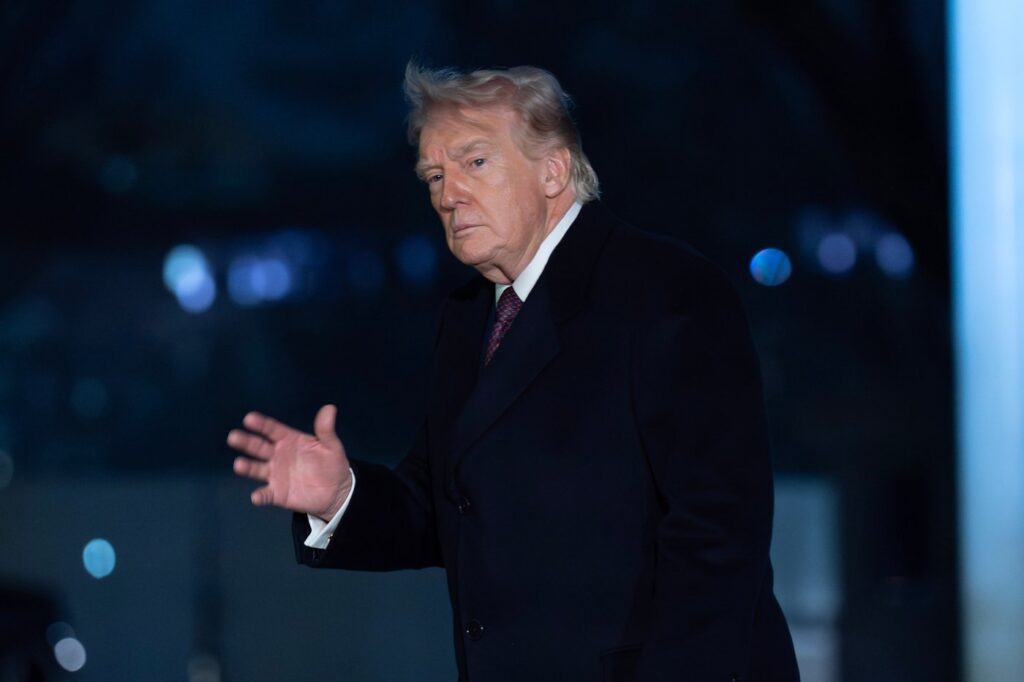
ABOARD AIR FORCE ONE - In the two weeks since the United States and Israel initiated military strikes on Iran, President Donald Trump has been increasingly challenged in the political arena. Reports suggest that Trump's agitation has grown due to unfavorable news coverage, as he struggles to articulate the reasons behind the war and his plans for its resolution. Public sentiment appears to be swayed by concerns over American casualties, rising oil prices, and declining financial markets, leading to a decrease in Trump's overall poll numbers, even among some of his steadfast supporters.
The situation has also inadvertently strengthened Russia, as Trump softened sanctions on certain Russian oil shipments, counteracting previous efforts to limit President Vladimir Putin's capacity to wage war in Ukraine amid surging global oil prices resulting from the conflict in Iran. This geopolitical maneuvering has not gone unnoticed, particularly by Democrats who are reeling from Trump's unexpected victory in the 2024 election. With the stakes high in the upcoming November midterms, the Democratic Party is uniting to criticize Trump's Iran policy and highlight the economic instability that contradicts Republican promises to reduce costs for Americans.
According to Kelly Dietrich, CEO of the National Democratic Training Committee, recent developments indicate that the Trump administration lacks effective long-term planning, noting that the situation amounts to a crisis for which ordinary Americans are paying the price. Trump has expressed his frustrations on Air Force One during a return flight from his Mar-a-Lago estate, directing criticism at allies and other petroleum-dependent nations for not taking a more assertive stance against Iran. He specifically called out British Prime Minister Keir Starmer for initially hesitating to deploy British aircraft carriers.
As Trump continues to seek assistance in securing the vital Strait of Hormuz, his weekend schedule in Florida included participating in a closed-door fundraiser for his MAGA Inc. super PAC. The geopolitical climate grew more tense after the dignified transfer of six U.S. soldiers who lost their lives in the Iran war, an event that was later used in a fundraising email by a political action committee. However, Trump dismissed concerns about the appropriateness of utilizing the somber occasion for campaigning, asserting his administration's strong support for the military.
In recent media engagements, Trump and his administration have raised complaints regarding the coverage of the conflict, suggesting it is being skewed by Iranian propaganda. Trump indicated that the U.S. needs to collaborate with the international community to ensure the safe passage of oil tankers through the Strait of Hormuz, where disruptions have affected global energy markets. Iran has openly declared its intention to continue attacks on energy infrastructure, leveraging the strategic waterway to exert pressure on both the U.S. and Israel.
Trump's administration is reportedly in discussions with several nations regarding military support to reopen the Strait of Hormuz. However, specifics on these potential partnerships remain undisclosed. Cautiously, other countries have responded to Trump's exhortations for action, with nations like South Korea and Japan signaling careful consideration and deliberation over their roles in the situation. Trump previously advertised that U.S. naval forces would escort tankers through the strait, although this commitment has not yet been realized.
As rising gas prices emerge as a focal point of political discourse, the implications of the ongoing war have given rise to division within Trump's "Make America Great Again" base. Consequently, some members of the Democratic Party predict potential midterm gains that could echo the blue wave experienced in their ranks during the 2018 elections. Observers note that the narrative of rising costs amid ongoing commitments in the Middle East could significantly influence voter sentiment in the lead-up to the midterms, challenging Trump’s previous assertions of having achieved rapid victory in the conflict.
The U.S. Treasury Department's recent decision to temporarily ease sanctions on Russian oil, attempting to alleviate supply shortages caused by the Iran war, has faced backlash, deemed by critics as inadvertently empowering Moscow amidst its ongoing military endeavors in Ukraine. Against this backdrop, President Trump's administration is navigating a complex geopolitical landscape while attempting to maintain domestic support as it faces mounting challenges both at home and abroad.