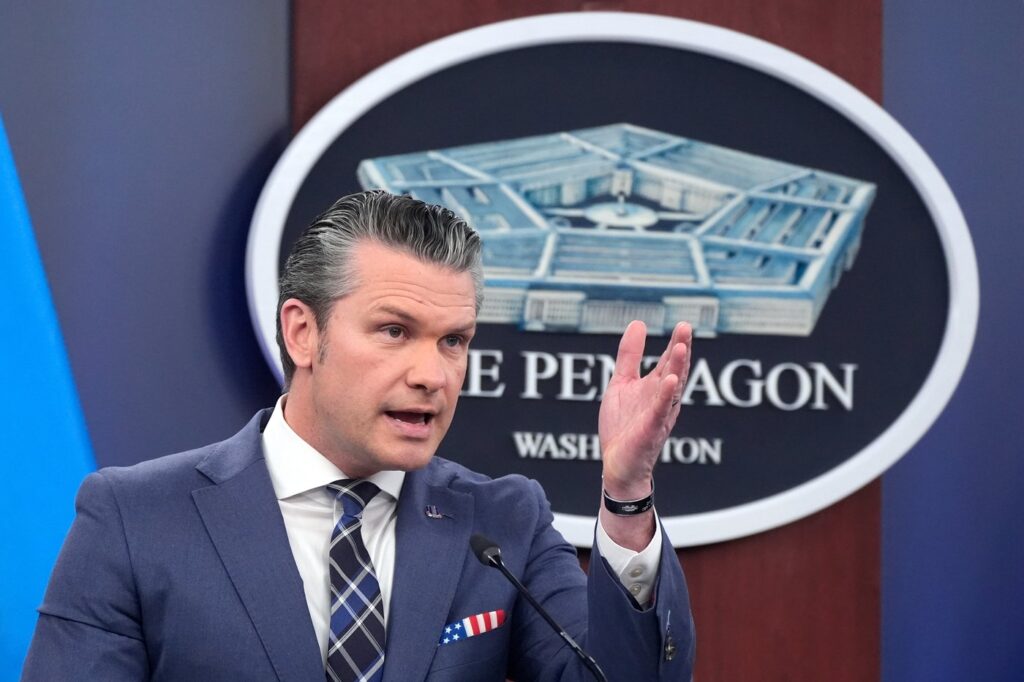
WASHINGTON (AP) — A federal judge has issued a ruling blocking the Trump administration from enforcing a controversial policy that limits news reporters' access to the Pentagon. U.S. District Judge Paul Friedman upheld a lawsuit filed by The New York Times, determining that significant portions of the new reporting rules are unlawful and infringe upon the rights of journalists.
The ruling emerged after The Times challenged a credentialing policy implemented by the Pentagon and Defense Secretary Pete Hegseth in December, claiming that it violates constitutional rights to free speech and due process. Judge Friedman sided with The Times, stating that the new policy unconstitutionally restricts the press credentials of reporters who chose to dissent by leaving the building rather than accepting the new terms.
Currently, the Pentagon press corps largely consists of conservative media outlets that accepted the new policy. Conversely, reporters from news organizations, including The Associated Press and The Times, that refused to comply with the restrictions have continued to report on military matters. Although some journalists who initially rejected the terms have been permitted back into the Pentagon for certain briefings, such as Hegseth's updates on military activities concerning Iran, they are seldom acknowledged during these sessions.
Judge Friedman pointed out that the Pentagon's policy lacks explicit guidelines regarding which journalistic practices could lead to the denial, suspension, or revocation of press credentials. Citing violations of both the First and Fifth Amendments, he emphasized the necessity of a free press for maintaining national security. “Those who drafted the First Amendment believed that the nation’s security requires a free press and an informed people,” Friedman stated, highlighting the enduring principle of press freedom.
The Pentagon has announced plans to appeal the ruling, with spokesperson Sean Parnell expressing disagreement with the judge’s decision. In contrast, a spokesman for The New York Times, Charlie Stadtlander, praised the judgment as a reaffirmation of press freedom principles, asserting that Americans deserve transparency concerning government operations and military actions taken in their name.
The attorney representing The Times, Theodore Boutrous, described the court's ruling as a significant rebuke to the Pentagon’s attempts to undermine journalistic freedom during critical wartime reporting. Judge Friedman ordered the Pentagon to reinstate the press credentials of seven Times journalists and extended the ruling’s impact to all regulated parties affected by the disputed policies.
The Pentagon Press Association, which includes members from The Associated Press, called for the immediate reinstatement of all its members' credentials, marking the ruling as a landmark victory for press freedom. The Pentagon has defended the credentialing policy as a means to impose “common sense” regulations aimed at protecting national security interests, arguing it is essential to prevent security risks from accessing sensitive military facilities.
In contrast, The Times’ attorneys have alleged that the policy was designed to silence dissenting voices and discourage critical press coverage of the Trump administration. They emphasized that permitting the government to wield arbitrary power to restrict speech poses a substantial risk of self-censorship among journalists.
While acknowledging the importance of national security, Friedman's comments indicated that public access to diverse perspectives about government actions is crucial, particularly concerning ongoing military involvements such as the conflicts in Venezuela and Iran. The judge noted that evidence showed the policy's intent was to eliminate “disfavored” journalists while favoring those aligned with the administration's narratives.
Friedman’s ruling concluded that the policy explicitly allows for the potential suspension of credentials for any journalistic activity not approved by the Pentagon, underscoring the policy's lack of transparency. Furthermore, he noted inconsistencies in how the policy was applied among reporters, questioning why one journalist, Laura Loomer, faced no consequences for potentially violating the policy while another did.
The judge required the Pentagon to provide a report on compliance with the ruling within a week, allowing no delay for the appeal. This ruling underscores the critical balance between national security and the fundamental rights guaranteed by the Constitution, particularly concerning the press’s role in a democratic society.