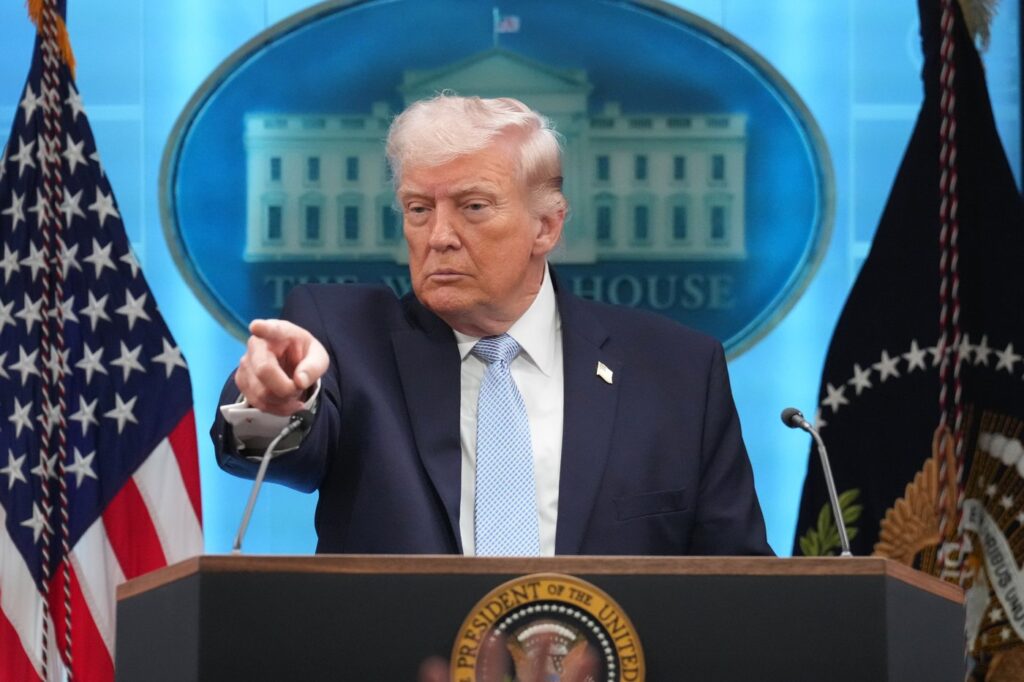
President Donald Trump has issued alarming threats directed at Iran, stating he would consider destroying every bridge and power plant in the country. This rhetoric raises significant concerns among military law experts, who suggest that such actions could potentially amount to war crimes. The legal implications hinge on whether these infrastructure targets are deemed legitimate military objectives, the proportionality of such attacks compared to Iran's actions, and how effectively civilian casualties are minimized.
The broad nature of Trump’s threats has prompted reaction from various quarters, including congressional Democrats, United Nations officials, and military law scholars, who argue that bombing civilian infrastructure is forbidden under international law. A spokesman for U.N. Secretary-General Antonio Guterres emphasized that even if certain civilian targets are considered military objectives, attacks are still prohibited if they risk causing excessive incidental civilian harm.
Rachel VanLandingham, a law professor and former judge advocate general in the U.S. Air Force, pointed out the severe humanitarian implications of cutting power to essential services like hospitals and water treatment facilities. She criticized Trump's approach, suggesting it lacks a focus on precision and the potential impact on civilian life. The potential for a humanitarian crisis is significant, given the ramifications of destroying essential utilities in a country like Iran.
The situation has been exacerbated by ongoing tensions in the Strait of Hormuz, a strategic maritime route through which about 20% of the world's oil flows. As shipping through the strait has nearly stopped, oil prices have surged, causing turbulence in global markets. Trump has made it clear that he would prefer not to resort to military action, but his statements have indicated that he is prepared to escalate the situation further if Iran does not comply with demands to reopen the strait. His comments include threats of destruction to Iranian infrastructure, supported by a deadline for Iranian compliance.
In stark contrast, White House spokeswoman Anna Kelly asserted that the Iranian people are supportive of U.S. military actions against their regime, framing their leadership as oppressive. The narrative from the administration is that Iranian civilians should welcome the prospect of bombings, as they would signify a weakening of the current regime, which has faced accusations of severe human rights violations.
The legal repercussions of Trump's threats have been widely debated. Republican Senator Joni Ernst defended the president's comments as a tactical move that does not constitute a war crime, arguing that the infrastructure also serves military purposes. Conversely, Democratic Senator Chris Van Hollen labeled the targeting of civilian infrastructure as “textbook war crime,” highlighting the grave implications of such an approach.
Michael Schmitt, an international law scholar, pointed out that while attacks on civilian infrastructure can be legal under specific circumstances—particularly if they serve military purposes—they must adhere to the principles of proportionality and minimization of civilian harm. He noted the importance of considering alternative strategies to achieve military goals without disproportionately harming innocent civilians.
As the discourse around military action continues, some experts warn that such aggressive rhetoric could diminish U.S. standing and provoke a longer conflict. VanLandingham expressed concerns about the long-term consequences of Trump's threats, drawing parallels to past U.S. military interventions and the challenges faced in Iraq and Afghanistan. The potential for escalating violence under the guise of lawful military action could alienate ordinary Iranians and inadvertently bolster government propaganda.
Domestic accountability for Trump's potential military actions is uncertain. Experts agree that any international legal accountability is unlikely, given the complexities of sovereignty and national law within the U.S. political landscape. As it stands, the prospect of Congress challenging Trump's military decisions remains slender, especially given political dynamics that favor presidential power in wartime situations.