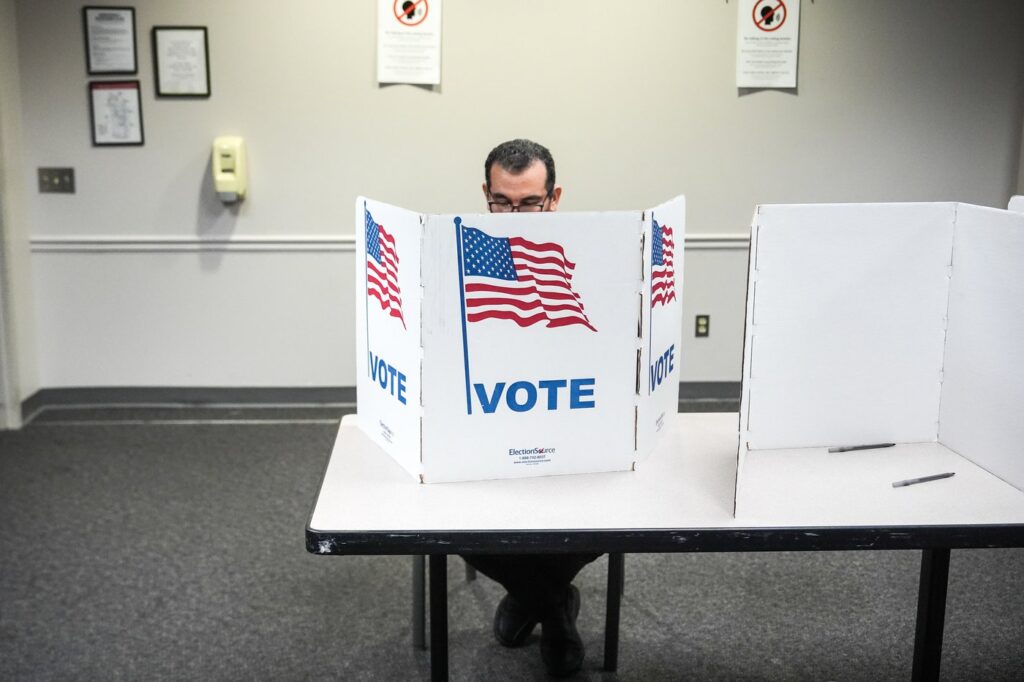
The Virginia Supreme Court recently ruled against a voter-approved Democratic congressional redistricting plan, marking a significant loss for the Democratic Party as they attempt to gain an advantage in the upcoming midterm elections. The court's decision, which was passed with a narrow 4-3 vote, indicated that the Democratic-led legislature had failed to meet procedural requirements in placing a constitutional amendment on the ballot to authorize mid-decade redistricting.
On April 21, voters had narrowly approved this amendment, but the court's ruling effectively nullified the results of that vote. Justice D. Arthur Kelsey, writing for the majority, expressed that the legislature submitted the proposed amendment in an "unprecedented manner." He asserted that this procedural violation "irrevocably undermines the integrity of the resulting referendum vote."
Democrats had anticipated that the newly drawn congressional map would allow them to gain up to four additional U.S. House seats. This plan was part of a broader strategy to counteract Republican redistricting efforts promoted by then-President Donald Trump. Following the ruling, Virginia Democrats declared their intent to file an emergency appeal with the U.S. Supreme Court to overturn the Virginia court's decision.
The Virginia ruling, in conjunction with a recent U.S. Supreme Court decision that substantially weakened the Voting Rights Act, has bolstered the Republicans' gerrymandering advantage in the lead-up to the midterms. Trump praised the Virginia Supreme Court's decision, calling it a "huge win for the Republican Party, and America," while Richard Hudson, chairman of the National Republican Congressional Committee, lauded it as a sign of GOP momentum.
Conversely, Democratic leaders expressed their discontent with the ruling. Don Scott, the Democratic speaker of the Virginia House of Delegates, voiced his respect for the court’s opinion but lamented the decision's contradiction with voters' wishes. Suzan DelBene, chairwoman of the Democratic Congressional Campaign Committee, critiqued the majority for disregarding voters’ will, expressing confidence that the electorate would ultimately decide in favor of Democrats in the upcoming elections.
However, the Democratic appeal to the U.S. Supreme Court may be a long shot, as the court typically refrains from intervening in state court rulings regarding their constitutions. In 2023, the U.S. Supreme Court denied a request from North Carolina Republicans seeking to overturn a state Supreme Court decision related to congressional maps.
Despite the potential challenges ahead, Democrats may use any unfavorable ruling from the Supreme Court as an opportunity to ascribe their electoral losses to the conservative majority influencing the court. The ongoing redistricting saga reflects a much larger national strategy that began with Trump's urging of Republican officials to pursue mid-decade redistricting to secure House seats and retain their slim majority.
Redistricting usually occurs once a decade following the census to adjust for population changes. Yet, the past year has seen an unusual surge in mid-decade redistricting, especially in Republican-led states. While Virginia's new districts could have improved Democrats' chances of securing a majority in the state's 11 congressional seats, the court's decision calls into question the viability of such plans.
The majority of Virginia's Supreme Court justices criticized the redistricting intended to favor one party over another, highlighting that 47% of Virginians had supported Republican candidates in the 2024 elections while the new Democratic map would have given Democrats 91% of the state's House seats.
The proposed Democratic map would have solidified five districts in the northern Virginia Democratic stronghold, while revising districts across Richmond and southern Virginia to limit the voting power of conservative voters. Judicial arguments in the case centered on the procedural aspects of how the General Assembly authorized the amendment, emphasizing that lawmakers violated constitutional procedures when they submitted the proposed amendment, as early voting had already commenced.
The Supreme Court found that the General Assembly's initial endorsement occurred after early voting had started, rendering the procedural approach unconstitutional. The court's ruling not only supports a decision made by a lower court in Tazewell County but also underscores the complexity of redistricting processes amid contentious political landscapes.