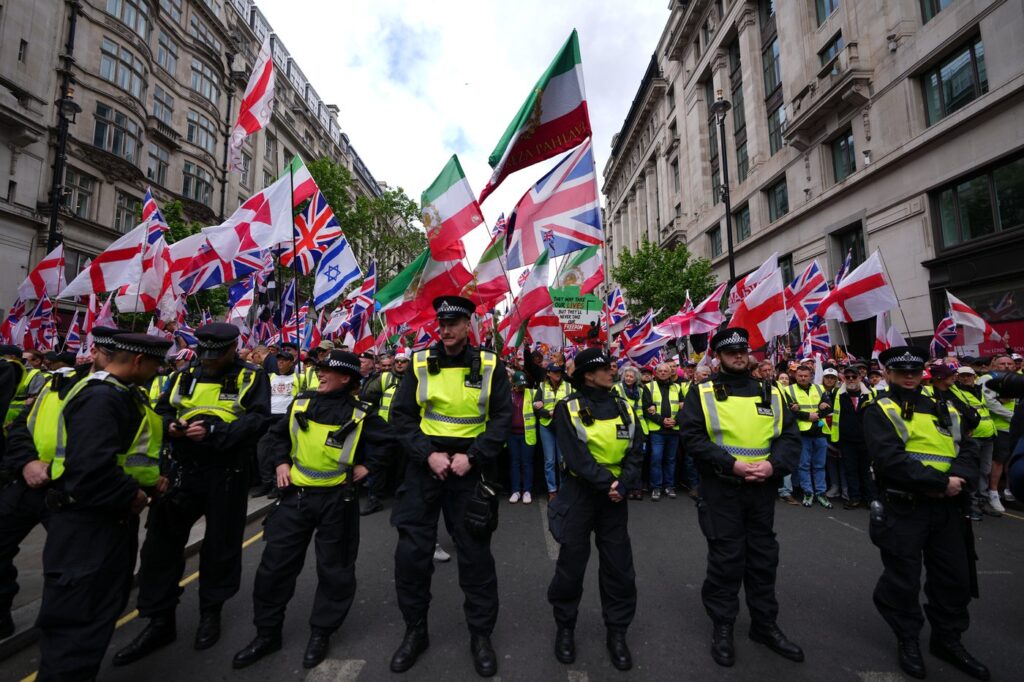
LONDON (AP) – On Saturday, police were deployed in significant numbers across London to manage two rival marches, both attended by tens of thousands of individuals, coinciding with the FA Cup final, a major event in English soccer. London's Metropolitan Police organized what they termed a “significant public order policing operation,” deploying at least 4,000 officers, alongside armored vehicles, horses, dogs, drones, and helicopters.
Concerns primarily focused on central London, where police aimed to prevent any interaction between two groups: one demonstrating led by far-right figure Stephen Yaxley-Lennon, also known as Tommy Robinson, and another commemorating Nakba, which represents the displacement of approximately 700,000 Palestinians from what is now Israel in 1948. Police continued to monitor the situation closely, especially after the FA Cup final, which had over 83,000 fans in attendance at Wembley Stadium.
As of 7:30 p.m. on the same day, police reported that 43 individuals had been arrested for various offenses, along with an additional 22 arrests made at the FA Cup final, where Manchester City triumphed over Chelsea. Four police officers were assaulted, though none suffered serious injuries, and an additional six officers faced hate crime incidents.
The timing of the marches coincided with a politically charged atmosphere in the U.K., as extreme views from both the right and left gained traction following recent elections. Protesters were motivated by numerous issues, including discontent over the influx of asylum-seekers crossing the English Channel, as well as outrage over Israel's military actions in Gaza, which have reportedly caused over 72,700 fatalities according to the Gaza Health Ministry.
As the day unfolded, police remained vigilant against any splinter groups that might clash. The British government took preventive measures, barring 11 foreign nationals from entering the country for the "Unite the Kingdom" rally, which included notable right-wing figures such as Polish politician Dominik Tarczynski and Belgian politician Filip Dewinter.
Prime Minister Keir Starmer emphasized the government's stance on preventing hate and violence, stating, "We will block those coming into the U.K. who seek to incite hatred and violence.” He highlighted the government's commitment to law enforcement against those intending to create chaos or intimidate the public.
In light of the heightened tensions, the Crown Prosecution Service instructed prosecutors to evaluate whether certain protest placards, banners, and social media chants could constitute offenses related to inciting hatred during the rallies. Starmer defended these measures as necessary for public safety, asserting, "This is not about restricting free speech; it is about preventing hate crime and protecting the public."
Additionally, for the first time in a protest policing operation, live facial recognition technology was implemented, with camera setups located in Camden, a neighborhood expected to be frequented by attendees, despite not being on the direct march route.