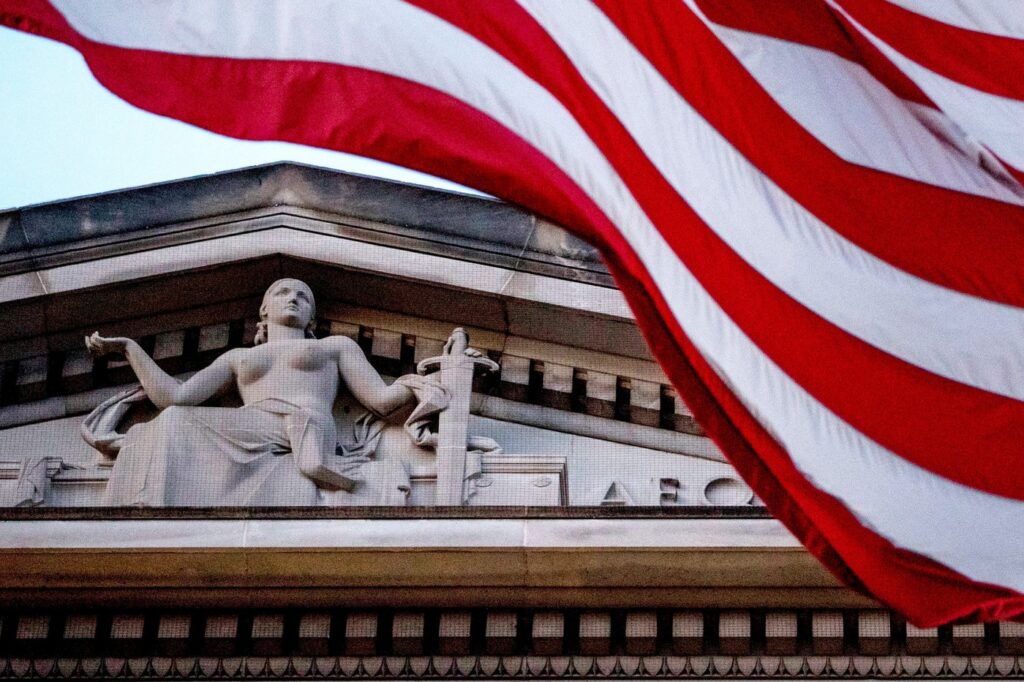
On June 2, 2023, a federal judge in Alexandria, Virginia, issued a temporary injunction halting the Trump administration's creation of a new $1.776 billion settlement fund aimed at compensating individuals who allege they were victims of a "weaponized" government. The ruling by U.S. District Judge Leonie Brinkema comes amidst ongoing litigation concerning the fund, officially referred to as the "Anti-Weaponization Fund." This fund was established to support President Donald Trump’s lawsuit against the Internal Revenue Service regarding the unauthorized leak of his tax returns.
Judge Brinkema has set a hearing for June 12, during which she will consider arguments on whether to extend her order that currently prevents any movement on the fund, including the distribution of payouts. The Justice Department expressed confidence in the fund's legal foundations, stating it adheres to precedent from previous settlements during the Obama administration. However, the White House opted not to comment on the ruling, directing inquiries to the Justice Department.
The Anti-Weaponization Fund has faced significant backlash since its announcement, with even some Republicans questioning its legitimacy. Concerns have been raised regarding who would qualify for compensation, particularly the possibility that individuals involved in the January 6 Capitol riots could file claims. The fund has not yet been operational, as the required five-member commission to determine payout criteria has not been established, meaning no claims or payments have been processed.
Plaintiffs represented by the legal advocacy group Democracy Forward have brought forth a lawsuit seeking to halt the fund's implementation, arguing that it lacks a legal basis and transparency. The lawsuit accuses the Trump administration of failing to recognize the targeting of individuals for retribution based on personal and ideological grounds. The plaintiffs, including a dismissed prosecutor and an acquitted college professor, claim that the fund is fundamentally unlawful and should be dismantled.
In related legal proceedings, a judge in Florida overseeing Trump's lawsuit against the IRS has demanded that Trump's legal team address serious allegations regarding the legitimacy of the settlement discussions. U.S. District Judge Kathleen Williams has given the Trump attorneys until June 12 to respond to claims of collusion and potential fraud linked to the case.
Following the emergence of the conditions surrounding the fund, it has sparked a series of lawsuits, including one from the group Citizens for Responsibility and Ethics in Washington, which characterizes the fund as an instance of presidential corruption. Notably, police officers who defended the Capitol during the January 6 insurrection have also filed lawsuits challenging the fund's creation.
During a recent congressional hearing, Acting Attorney General Todd Blanche did not rule out the possibility that individuals involved in violent actions during the January 6 riots could qualify for payouts from the fund. Since the Capitol event, nearly 1,600 individuals have been charged with federal offenses connected to the riots, resulting in over 1,200 convictions, with many pardoned by Trump in the past year.
Among the plaintiffs in the Virginia case is Andrew Floyd, a former Assistant U.S. Attorney who was terminated after prosecuting Capitol riot cases; he alleges his firing was politically motivated. Another plaintiff, Jonathan Caravello, a professor, was acquitted of assault charges related to a protest against an immigration raid. Both plaintiffs argue that the existence of the fund poses a threat to the integrity of the legal system and sets a dangerous precedent.