SEOUL, South Korea (AP) – Chinese President Xi Jinping arrived in Pyongyang on Monday for a rare state visit, marking his first trip to the country in seven years. Experts believe the visit aims to reaffirm China's unique influence over North Korea, which could lead to potential economic and political benefits for both nations.
During his two-day stay, Xi is set to meet North Korean leader Kim Jong Un. This summit represents their first encounter since September, which took place in Beijing. The two leaders were accompanied by Russian President Vladimir Putin and other foreign dignitaries for a military parade at that time.
China's official Xinhua News Agency confirmed Xi's arrival in Pyongyang, reporting that he was accompanied by key officials, including his wife, Peng Liyuan, Foreign Minister Wang Yi, and high-ranking Communist Party member Cai Qi. Although specific details regarding the agenda of Xi's visit have not been disclosed, foreign analysts anticipate that the discussions could significantly impact the bilateral relationship and regional dynamics, particularly as both leaders face challenges from the United States.
Leif-Eric Easley, a professor at Ewha Womans University in Seoul, emphasized that a visit by a Chinese leader carries significant implications for China-North Korea relations. He noted that this meeting is crucial for reinforcing their alliance, especially in light of the separate confrontations both countries are experiencing with the U.S.
Xi's visit follows his meetings with U.S. President Donald Trump and President Putin in Beijing last month. It sets the stage for another planned meeting between Xi and Trump in September, where Xi is expected to showcase China's influence over the Korean Peninsula and establish its leadership role amid competitive geopolitical tensions with the U.S.
China has historically been a crucial economic and diplomatic ally for North Korea, providing it with essential resources and support. Analysts indicate that China has been reluctant to fully enforce U.N. sanctions against North Korea and has been known to provide covert aid to help its neighbor sustain its economy. The year 2023 also marks the 65th anniversary of the mutual defense treaty between China and North Korea.
However, recent years have raised questions about the strength of their ties, as North Korea has shown a growing inclination to foster closer relations with Russia, including supplying troops and military support for its campaign in Ukraine. In return, North Korea has garnered economic and military assistance from Moscow.
Experts suggest that restoring a more exclusive influence over North Korea could bolster Xi's leverage in discussions with Trump, who has reiterated his interest in reigniting diplomatic efforts with Kim. Easley pointed out that the Chinese government's focus does not seem to include aggressively enforcing U.N. Security Council resolutions or sanctions concerning North Korea.
In a statement published by the North's primary newspaper, Rodong Sinmun, Xi called for enhanced strategic cooperation between China and North Korea. He emphasized the need to jointly oppose "hegemonism and coercive politics," advocating for a multipolar world order.
Analysts predict that Xi may extend economic assistance to Kim, which could include food relief, resuming Chinese tourism to North Korea, and initiating joint economic ventures. Kwak Gil Sup from the One Korea Center highlighted the necessity for North Korea to align more closely with China, as reliance on Russia alone may not suffice.
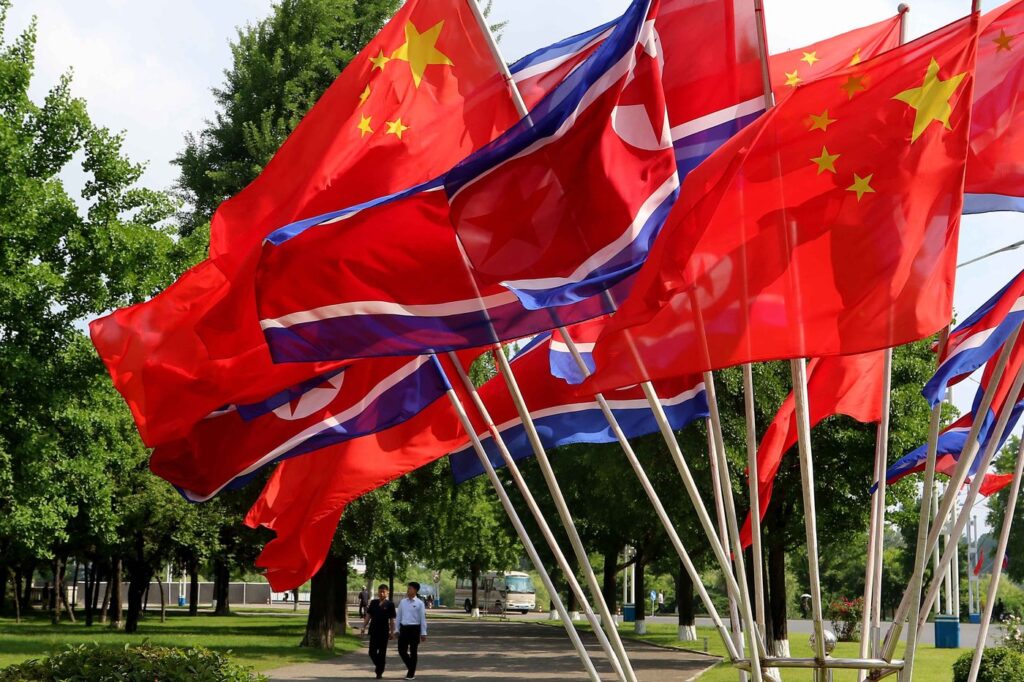
The editorial from Rodong Sinmun referred to Xi as "the most honored state guest," conveying an atmosphere of friendship in streets decorated with flags symbolizing the two nations.
Furthermore, Xi may choose not to confront Kim regarding the denuclearization issue directly but instead focus on vague comments about maintaining peace and stability on the Korean Peninsula. This approach would benefit Kim, who seeks global acknowledgment of North Korea's nuclear status to advocate for lifting U.N. sanctions.
Experts interpret that Chinese officials have chosen a public stance of avoiding discussions about denuclearization while maintaining it as a long-term goal. There are indications that Kim is attempting to persuade Xi to accept North Korea's position as a nuclear-capable nation.
After the previous summit involving Trump, the White House announced that both leaders acknowledged a shared objective of denuclearizing North Korea, whereas China merely stated they discussed nuclear matters related to the peninsula. Following this, Kim Yo Jong, Kim's sister, publicly dismissed the U.S. account of the Xi-Trump meeting as "false information."
Recently, Kim revealed a new facility for producing nuclear materials and pledged to enhance the country’s nuclear capabilities at a faster pace, while also overseeing sea trials for a new naval destroyer with nuclear ambitions. South Korean President Lee Jae Myung reported that North Korea is now capable of generating sufficient materials to produce approximately 10-20 nuclear weapons annually and is nearing perfection in intercontinental ballistic missile technology.
In conclusion, the international community must consider strategies to compel North Korea to freeze its nuclear development and ICBM programs as a primary goal, according to Lee.
Kim Yo Jong reiterated her brother's sentiments by labeling the U.S. denuclearization push as an "escapist and anachronistic dream." Since the collapse of high-stakes diplomacy with Trump in 2019, Kim Jong Un has rejected overtures from the U.S. and South Korea, focusing instead on expanding and modernizing his nuclear arsenal. Kim expressed a desire for the U.S. to abandon its denuclearization preconditions before any diplomatic engagements can resume.
Experts predict that Kim may eventually seek negotiations with the U.S. regarding arms reduction in hopes of securing concessions for a partial rollback of his nuclear arsenal.