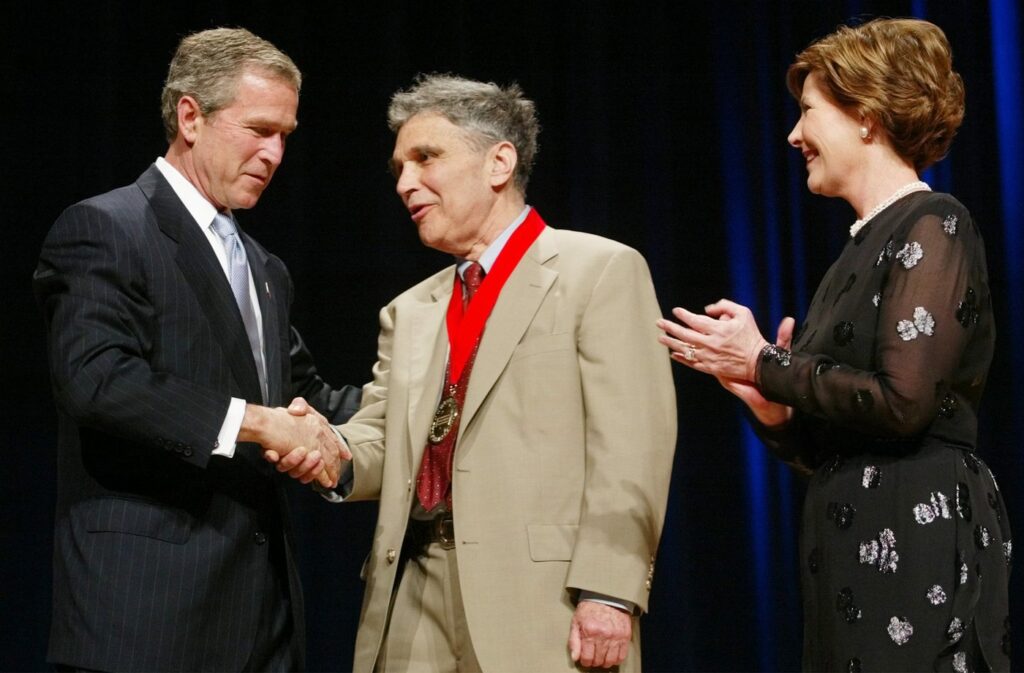
Robert Coles, a Harvard University professor and Pulitzer Prize-winning author renowned for his dedication to understanding the challenges faced by children in poverty and segregation, has passed away at the age of 97. His son, also named Robert Coles, confirmed that the elder Coles died on Thursday at a hospice center in Lincoln, Massachusetts.
The distinguished psychiatrist was particularly acclaimed for his five-volume series titled “Children of Crisis.” The second and third volumes earned him the Pulitzer Prize for general nonfiction in 1973. Coles's work offered invaluable insights into the emotional resilience of children living in conditions of social upheaval and economic hardship. Reflecting on his experiences, he noted in a 1965 essay for The Washington Post that rather than finding an abundance of psychiatric problems among disadvantaged children, he was “constantly surprised at the endurance shown by children we would all call poor or, in the current fashion, ‘culturally disadvantaged.’”
Throughout his career, Coles engaged deeply with the families he studied, often visiting them repeatedly. He employed creative methods, such as bringing crayons for children to draw their experiences, allowing him to understand their perceptions and emotions more intimately. His dedication to the subject matter earned him the Presidential Medal of Freedom in 1998, and he was among the first recipients of the MacArthur Foundation “genius grant.” In 1999, “Children of Crisis” was recognized as the 44th best English-language work of nonfiction of the century by a panel of judges.
The “Children of Crisis” series was published from 1967 to 1978, with each volume focusing on different demographics and issues affecting children. The initial volume centered on the effects of school desegregation, while subsequent works examined the lives of migrant workers, sharecroppers, and the experiences of Southern children relocating to Northern urban areas. The series culminated in a volume that looked at children of wealth and privilege.
Coles authored more than 50 books and hundreds of articles and essays over his lifetime, including works such as “Their Eyes Meeting the World,” which explored the significance of children's drawings, and “The Moral Life of Children.” He also conducted research on children worldwide while being a firm advocate for their rights and well-being. Some peers described his work as more journalistic than scientific; Lawrence Kohlberg, a respected Harvard professor, remarked in 1986 that “he's a very good journalist who talks to kids sensitively and tells stories well,” although he contended that no psychiatrist would take Coles’s conclusions seriously.
Coles’s interest in children's reactions to crisis began during his service in the South as an Air Force doctor in the early 1960s. He was particularly influenced by Ruby Bridges, the first Black child to integrate an all-white school in New Orleans at the age of 6. Coles admired her “moral stamina” and even wrote a children's book about her, titled “The Story of Ruby Bridges,” published in 1995. Notably, Bridges’s experience also inspired artist Norman Rockwell's portrayal of her in his famous 1964 painting, “The Problem We All Live With.”
Coles often engaged with children in a manner that made them feel comfortable; he recounted how he would discard his formal attire and instead sit on the floor during interviews. This approach was showcased in the 1995 PBS documentary “Listening to Children: A Moral Journey with Robert Coles,” which featured him interviewing children and analyzing their drawings.
His distinguished academic career included a long-term role as a research psychiatrist at Harvard's University Health Services. In 1977, he was appointed as a professor of psychiatry and medical humanities, later becoming a professor of social ethics in the School of Education in 1995. He taught a popular class known as the Literature of Social Reflection, humorously dubbed “Guilt 105,” where he encouraged students to reflect deeply on the meaning and purpose of their lives.
Born in Boston, Coles graduated from Harvard in 1950 before obtaining his medical degree from Columbia University in 1954. He expressed discomfort regarding the financial disparities between his life and the communities he documented, acknowledging this dichotomy in a 1997 interview with The New York Times. His wife, Jane, who contributed significantly to his interviews with children, passed away in 1993, and the couple had three sons.