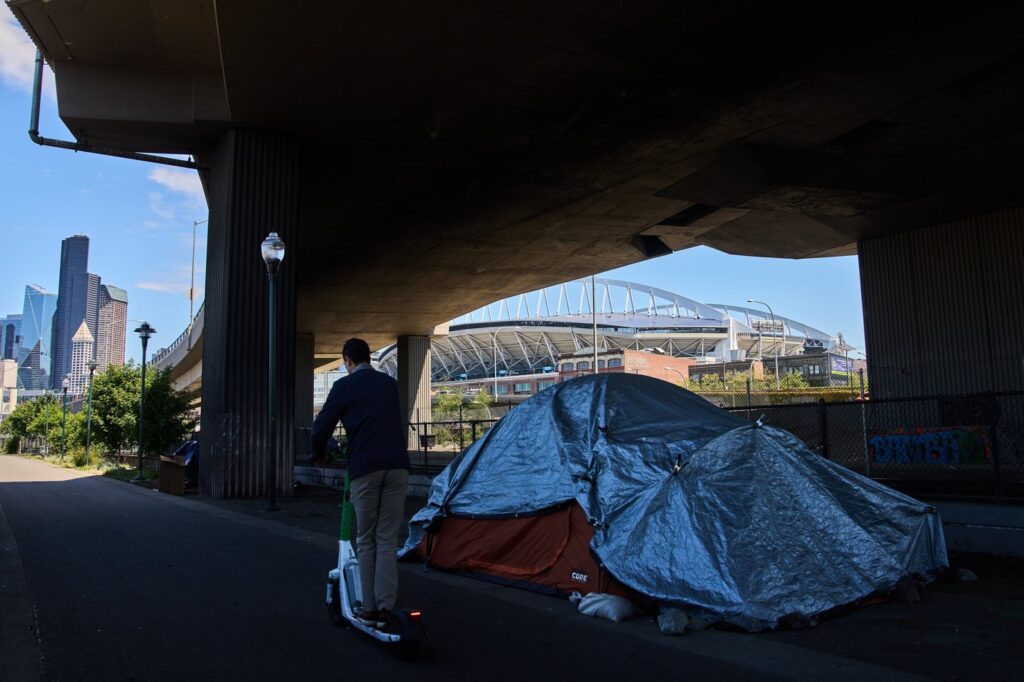
ATLANTA (AP) — Just a mile from Atlanta's stadium, poised to host the World Cup games this month, a stark reminder of the city’s ongoing homelessness crisis is visible. Dozens of individuals camped out on a downtown sidewalk awaited the opening of a homeless shelter. Some attempted to shield their eyes from the afternoon sun with sleeping masks, while others occupied themselves with cereal boxes on the ground, surrounded by discarded items like scattered shoes and empty liquor bottles. Meanwhile, a boom box echoed Jay-Z’s lyrics, “This can't be right, there's gotta be more.”
Last summer, Atlanta launched an ambitious plan named “Downtown Rising” to tackle visible homelessness and encampments before the 39-day soccer event. The initiative reported the housing of nearly 500 individuals; however, the sight of people waiting outside a shelter on Pryor Street indicated that the efforts had not reached all in need. This situation is echoed in several cities hosting the tournament, including Seattle and Dallas, which aim to leverage the World Cup's attention to combat homelessness.
A survey conducted by The Associated Press revealed that most of the 16 cities involved in the World Cup preparations, including major urban centers like New York, Boston, Philadelphia, and Miami, are relying on existing homelessness programs without additional funding specifically linked to the event. The problem of increasing tent encampments in urban areas has plagued city officials for years. Federal statistics highlighted a nationwide increase in homelessness, with 770,000 people identified as homeless in 2024, though this is acknowledged to be an undercount, followed by a slight decrease to 745,652 in the previous year.
Historically, major cities have attempted to “clean up” homelessness before significant public events. For instance, during last year's Super Bowl, New Orleans allocated millions to relocate the homeless population in the vicinity of the Superdome to a temporary shelter, while Chicago undertook similar action in anticipation of the 2024 Democratic National Convention. Ann Oliva, CEO of the National Alliance to End Homelessness, emphasized the importance of communities choosing to either displace individuals or engage in meaningful efforts that benefit both housed and unhoused residents.
Having previously expelled around 9,000 homeless individuals for the 1996 Olympics, Atlanta aims to adopt a different approach this time. The city successfully raised $185 million out of its $235 million goal through state and corporate funding to house an anticipated 3,900 people by the following year. As of last year, around 2,900 homeless individuals were accounted for in Atlanta, with approximately one-third residing in encampments or on the streets. Cathryn Vassell, CEO of Partners for HOME, expressed the hope of quickly transitioning those identified into shelter and housing.
Among those benefiting from the Downtown Rising initiative is Michael Sutton, a former foster child who has lived in multiple unstable conditions over the past decade, including train stations and abandoned buildings. Since September, he has secured his own one-bedroom apartment in an Atlanta suburb, a pivotal change for him. However, barriers such as stringent shelter rules, lack of necessary documentation, and mental health challenges hinder progress for many others.
Tommy Elam, who has been homeless since early 2020, shared his difficulties with being found despite being on various housing lists, as he lacks a phone to communicate. Living near the Pryor Street shelter, he expressed frustration with the limited outreach he has received.
In Dallas, significant changes have been observed in the past two years, with outreach programs that have reportedly reduced the visible homeless population by 87%. Sarah Kahn, head of Housing Forward, noted that various housing initiatives, backed by substantial funding, aim to house over 1,100 individuals. While many people have found shelter through these efforts, critical voices have arisen regarding policing tactics against those who remained after encampment clean-ups.
Meanwhile, Seattle has been working on a plan to set up 500 new shelters, although the outcome falls short of expectations. Many residents remain oblivious to these initiatives, as indicated by Chris Moore, who has been homeless for eight years near the stadium. Seattle Mayor Katie Wilson acknowledged the failure to meet the ambitious goal but stated that the endeavor has been a valuable motivator for progress.
In Inglewood, California, adjacent to the Los Angeles stadium, the mayor confidently remarked on the area's homelessness count being low. However, just outside city limits, local nonprofits continue their outreach efforts. In Toronto and Vancouver, authorities have expressed reliance on pre-existing services instead of implementing relocation strategies before the World Cup, yet activists have reported instances of aggressive policing and attempts to marginalized the homeless. Reports of forced removals and verbal abuse by transit police in Toronto and increased security measures in Vancouver have sparked protests advocating for the rights of the homeless population.