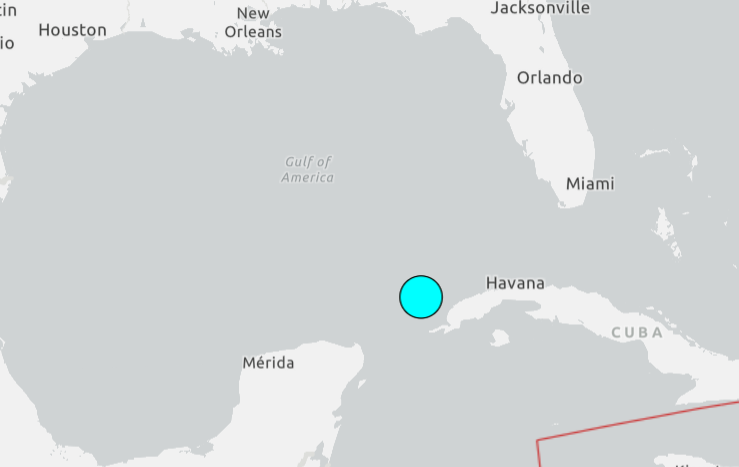
On Monday afternoon, a 6.1 magnitude earthquake struck near western Cuba, causing buildings in Havana and as far north as Orlando, Florida, to shake. Fortunately, there were no reports of injuries or damage in the aftermath of the tremor.
The U.S. Geological Survey reported that the earthquake occurred at a depth of 26 kilometers (16 miles) in waters just west of Havana. Flavia Pupo, a manager at the Pinar del Rio hotel in western Cuba, noted that the shaking generated a sense of fear among those present. "Everyone here is OK," Pupo reassured, adding that some people on the street were understandably nervous.
As the tremor was felt throughout southwestern Florida, the National Weather Service in Miami communicated the occurrence via a tweet. Numerous social media posts corroborated that residents felt the shaking well into areas north of Orlando, marking a significant seismic event.
Maria Moncayo, an employee at a law office in downtown Fort Lauderdale, described her experience during the quake. While quietly working, she felt a vibrating sensation akin to construction noise in another part of the building, lasting about a minute. The movement of a pendant hanging from her desk confirmed that the sensation was indeed caused by the earthquake, prompting a sudden recall of similar experiences of seismic activity in Ecuador, including a devastating 7.8 magnitude quake in 2016, which resulted in hundreds of fatalities.
Notably, Moncayo expressed how the unexpected tremor sparked memories of her past experiences, stating, "Since I moved here, it kind of left my mind, but when I felt my desk moving, I thought it was going to be like Ecuador. It kind of gave me flashbacks, but then I realized that it’s not bad, it’s just a little one."
In response to the earthquake, officials from Miami-Dade County initiated precautionary evacuations of several buildings, including the main government office building located in a 28-story high-rise in downtown Miami. Additionally, services for two elevated commuter trains passing through downtown were temporarily suspended to ensure public safety.
William Barnhart, a geophysicist associated with the U.S. Geological Survey, emphasized the rarity of Monday's earthquake, describing it as the largest of its kind recorded in the Gulf of Mexico since modern instruments were deployed in the 1950s. "It’s one of only five or six earthquakes of magnitude 5 or greater that we’re aware of in the entire Gulf," Barnhart clarified.
Interestingly, the earthquake did not generate a tsunami. Barnhart explained that while destructive ocean waves resulting from underwater disturbances occur more frequently in the Pacific Ocean, there is potential for such events in the Atlantic as well. He indicated that western Cuba might experience some strong aftershocks, though they are unlikely to be felt in Florida. "There’s always a very, very small chance that this could be followed by a larger earthquake, and people would feel that," he said, noting the minimal expectation of significant shaking from any aftershocks.
It is important to note that the Oriente fault zone, situated just off Cuba's southeast coast, has a history of unleashing damaging earthquakes. A notable incident was a 7.7 magnitude quake in January 2020, which caused destruction in both Cuba and the Cayman Islands.
For more information on the situation, ongoing coverage of Latin America and the Caribbean can be found at https://apnews.com/hub/latin-america.