PARIS (AP) — When the major powers convened in 1975 at a chateau near Paris to address a faltering global economy, China was notably absent from the inaugural summit of the G7, which has evolved into an annual gathering of wealthy nations. At that time, the notion of including Chinese revolutionary leader Mao Zedong alongside figures like U.S. President Gerald Ford would have been inconceivable.
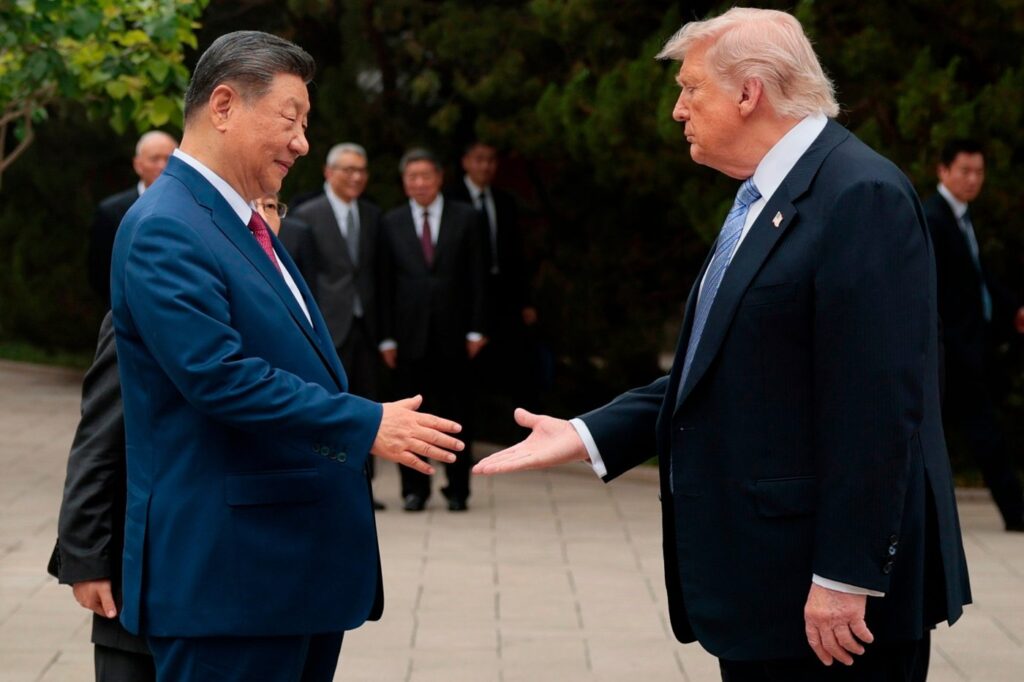
In 1975, China was embroiled in turmoil and far from the economic powerhouse it has become today. Mao had previously provided military support to the communists in Vietnam, contributing to the defeat of both France and U.S. forces. His presence at the first Rambouillet summit would have certainly been unwelcome, given the geopolitical climate. However, as President Donald Trump and his G7 counterparts meet again in France, China's exclusion has become increasingly questionable, particularly as its influence on the global economy continues to grow.
The numbers speak volumes. Economically, China is a strong candidate for G7 membership, given its rapid growth since Mao's death in 1976. The Chinese economy now surpasses those of all G7 countries, except for the United States, highlighting that a summit without China could be likened to a soccer World Cup devoid of its five-time champion, Brazil. "From being 'only a tiny, benign, panda bear' in 1975, China has become a great global dragon," remarks John Kirton, a G7 specialist at the University of Toronto. Many experts believe that the G7 and the global community could benefit from China's inclusion.
Nevertheless, the G7 has maintained an unwritten rule that membership is reserved for democracies. The founding leaders in Rambouillet asserted their commitment to governance rooted in "open, democratic society," a standard that Mao's China could not meet, nor can Xi Jinping's regime today. Various assessments indicate that China lags significantly behind G7 nations in terms of civil liberties and democratic governance.
Despite being excluded from the G7, China's influence is felt across all member nations, particularly in trade. In 2025, China announced a staggering trade surplus of nearly $1.2 trillion, creating friction with other industrial powers. The country wields control over essential rare minerals and is notable for its rapid technological advances and military build-up, raising considerable concerns among its rivals. Furthermore, China is the world's largest emitter of climate-warming pollution, meaning its presence looms large over discussions at the summit.
As host, French President Emmanuel Macron has scheduled discussions about rebalancing trade relations with China, particularly in light of increasing Chinese exports of vehicles and other goods that may threaten G7 industries. Despite recent tensions among G7 leaders, there is a shared acknowledgment that China poses a collective challenge. Cédric Dupont, an international politics specialist, states, “They agree on the same thing, you know: China is a problem.”
China's government has previously criticized the G7 as an exclusive club reminiscent of Cold War divisions. However, the Chinese Foreign Ministry's recent statement showed a desire for the G7 to foster solidarity rather than division. Analysts note that Beijing is wary of the G7’s focus on Sino-U.S. competition, viewing the group as a bastion of Western power where China is often portrayed as a threat.
Nonetheless, the idea of including China in the G7 raises concerns about the potential disruption of its unity. China's authoritarian governance, as well as its divergent interests on major global issues—like Russia and Iran—could threaten the cohesion of the G7, with some analysts even suggesting that China could act as a "Trojan horse." The experience of admitting Russia into the G7 in 1998, which ended poorly, has contributed to skepticism regarding the inclusion of another non-democratic state.
As the G7 continues to navigate international challenges, the question remains whether China's significant global footprint can be adequately addressed without its formal participation in a club designed for democracies.