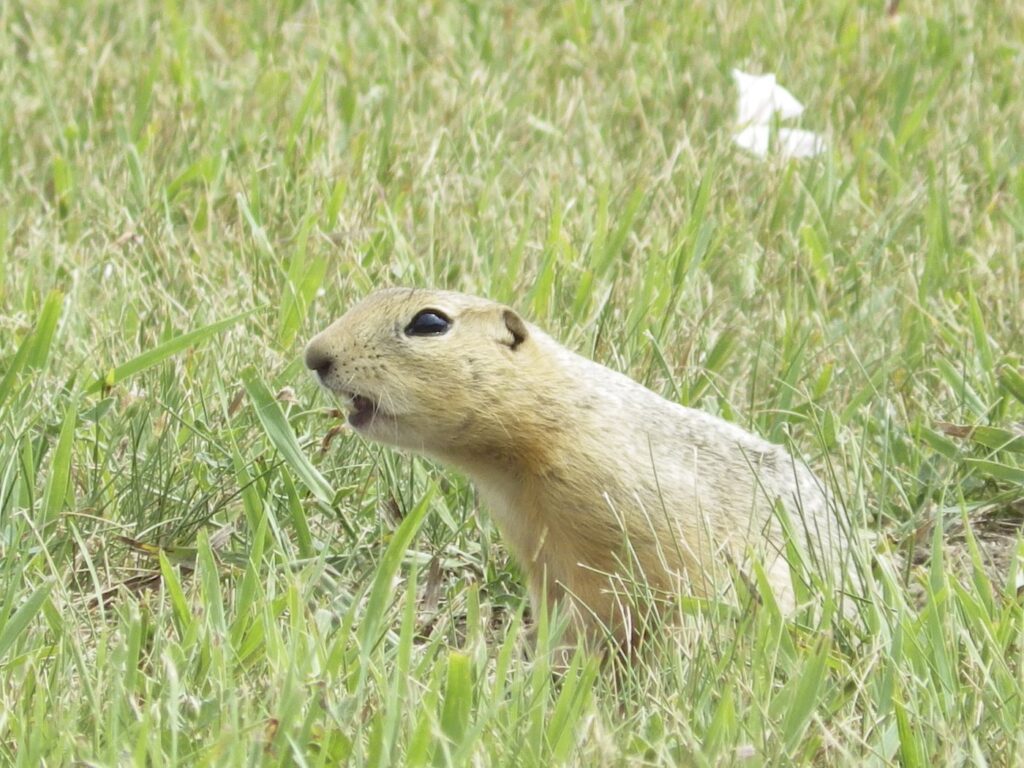
The first window for farmers in Alberta and Saskatchewan to access strychnine for controlling ground squirrel populations is nearing its end, leading many producers to hope for better conditions in the coming spring. Wade Nelson, a farmer located near High River, Alberta, approximately 66 kilometers south of Calgary, emphasizes the importance of addressing the rodent issue immediately after their hibernation and mating season.
“After the middle of June, you’re pretty well out of luck,” Nelson stated, underlining the urgency for farmers to act before that time. Health Canada previously imposed a ban on the chemical due to concerns about its impact on endangered species, including burrowing owls and swift foxes, as well as its effects on the wider ecosystem.
In March, however, the federal government announced that farmers could once again utilize two-percent liquid strychnine until November 2027 for controlling Richardson's ground squirrels, colloquially known as gophers in Western Canada. The president of Agromax, the sole producer of this strychnine formulation in Canada, revealed that they recently received a shipment of concentrated strychnine and have commenced its distillation for distribution.
“Distribution will go out to the municipalities starting at the beginning to the middle of next week, and some should have starting amounts next week and into the following week,” Brent Punga explained in a recent interview. He mentioned that the raw material supply from India was abundant, but a fuel shortage had led to the cancellation of many flights, delaying the distribution of hazardous materials.
Both the Alberta and Saskatchewan governments had been advocating for the lifting of the strychnine ban, as farmers reported increased crop damage and livestock injuries attributed to ground squirrels. Don Connick, a farmer near Gull Lake, Saskatchewan, highlighted that many people underestimate the destruction caused by a single Richardson's ground squirrel. “(They) will probably eat a five-metre circle around every hole that they dig, so there is serious damage,” Connick remarked.
Nelson, who is a member of the Foothills County Agricultural Services Board, recounted observing extensive damage on a 70-hectare canola field. “I lost an entire field, which didn’t even get a chance to germinate – the gophers ate the seed right out of the ground,” he recalled, noting that he received only $55 per acre from insurance while his costs exceeded $250 per acre for planting.
To regulate the use of strychnine, the federal government has established two strictly defined application periods: March 1 to June 15, before vegetation emerges, and July 15 to September 1, after the vegetation has died down. Nelson pointed out that using the chemical after late spring is largely ineffective, as the rodents have already inflicted considerable damage on crops by then.
Punga acknowledged farmers' frustrations regarding the supply chain, noting that the late decision made by the federal government hindered their ability to effectively control the gopher population during the early season. Both Connick and Nelson noted that a cool, wet spring appears to have suppressed gopher numbers after previous years of population booms due to hot and dry conditions.
However, Mark Brigham, a biology professor at the University of Regina, expressed uncertainty about whether weather conditions significantly affect the gopher populations. “Certainly with wet weather, there is more of a possibility of fungal infections or perhaps parasites,” he noted. Nonetheless, Brigham emphasized that there is insufficient scientific data to conclusively determine the effects of wet weather on ground squirrels.
Brigham contended that increases in hawk and fox populations may be more influential in regulating ground squirrel survival than weather conditions. “They are very, very good at catching lots of these animals,” he said. In his view, reintroducing strychnine poses a long-term risk, potentially harming numerous non-target species. “In this day and age, it is dumb to be putting stuff like that on the landscape,” he stated, warning against the unintended consequences of chemical use in agriculture.