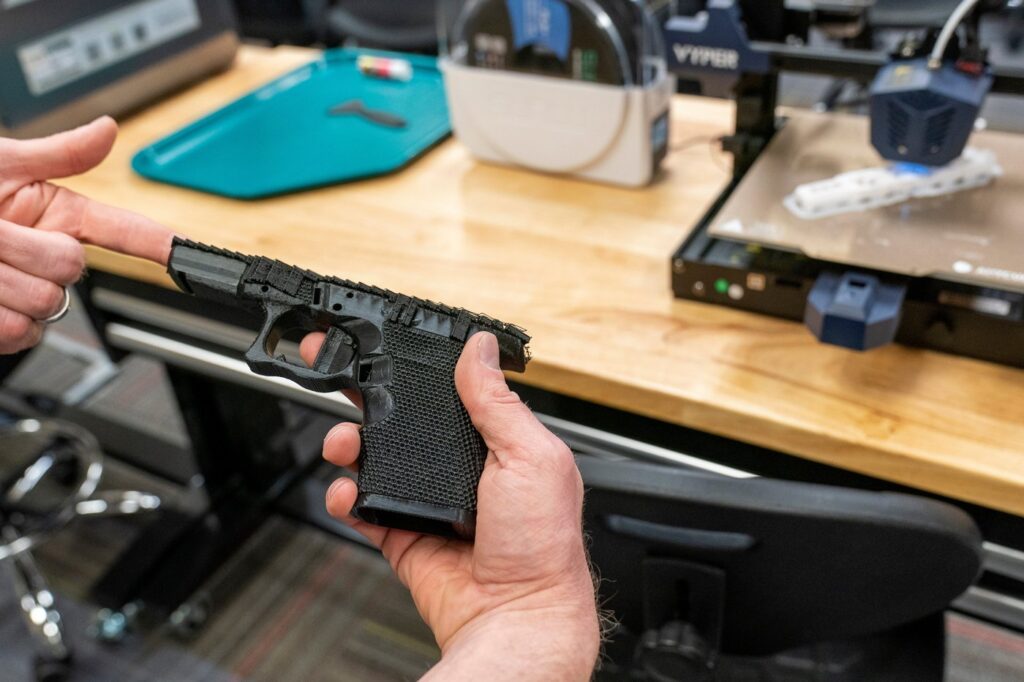
A groundbreaking law in New York is set to mandate that 3D printers sold for residential and commercial use should come equipped with technology designed to block the production of firearms. This innovative requirement is also being evaluated by lawmakers in California. The legislation aims to address the emergence of "ghost guns," which are untraceable firearms often implicated in criminal activities. However, it raises questions regarding the potential effectiveness of such technology, as well as concerns surrounding privacy and constitutional rights.
Currently, about one-third of U.S. states have implemented measures to regulate or ban firearms that can be assembled at home, and which lack serial numbers, thus circumventing the necessary background checks for purchasing firearms from licensed dealers. What distinguishes this new initiative is its focus on regulating the equipment used to produce guns rather than targeting the individuals who manufacture them.
The proposed technology could establish new industry standards for 3D printers and may serve as a blueprint for other Democratic-led states seeking to enhance their gun control regulations. Many of these regulations already include bans on specific semiautomatic weapons and provisions for temporarily confiscating firearms from individuals deemed a danger to themselves or others.
Over the last two decades, 3D printers have become increasingly prevalent. The number of such printers globally has skyrocketed from an estimated 30,000 in 2012 to over 3 million, with the industry’s value soaring from approximately $2 billion to $26 billion annually. While high-end printers can cost thousands of dollars, more affordable options are now available for several hundred dollars.
3D printers are versatile; they can create toys, prosthetic limbs, and airplane components. However, they are also capable of fabricating firearms and their components using digital blueprints accessible online. These homemade firearms, often referred to as “ghost guns,” are difficult for law enforcement to trace due to the lack of serial numbers.
There has been an alarming increase in the use of firearms produced via 3D printing in criminal activities, according to a U.S. Department of Justice report from last year. The number of privately made guns recovered in crimes and reported to federal authorities surged from around 1,600 in 2017 to nearly 27,500 in 2023, although the report did not specify how many of these originated from 3D printers. Notably, a 3D-printed firearm was reportedly linked to the murder of UnitedHealthcare’s CEO in 2024.
The New York law, which was signed last month, along with a bill currently in consideration in California, would mandate expert panels to develop standards for firearm blueprint detection algorithms. This technology would analyze submitted designs for 3D printing, comparing them to a library of firearm components and rejecting those deemed similar.
The implementation of the technology would not take effect until 2029 at the earliest in New York, contingent on the findings of the study group regarding its feasibility. The proposed methods for 3D printers could involve geometric analysis of design shapes and dimensions to refuse projects that closely resemble firearm parts.
While the Association of 3D Printing supports the proposed legislation, Bill Decker, the group’s executive chairman, expressed doubt about its effectiveness, suggesting it may be more of a political statement. He highlighted the persistent ability of criminals to develop designs that evade the technology, either by altering plans or seeking alternative printing avenues.
There are also concerns about the potential for the blocking technology to inadvertently restrict legitimate items. Rory Mir, from the Electronic Frontier Foundation, pointed out that more aggressive algorithms might mistakenly prevent the printing of harmless objects that could be misidentified as gun parts. This could result in an infringement on lawful expression and create privacy risks as print instructions are submitted for cloud-based analysis.
Gun safety advocates view the rise of 3D printing as a new method for individuals who cannot legally purchase firearms—such as minors and convicted felons—to gain access to them. Currently, 11 states prohibit 3D-printed firearms, while six mandate that these guns must be serialized, as indicated by the nonprofit organization Everytown for Gun Safety.
In summary, while 3D printing technology presents new challenges in the regulation of firearms, efforts like those in New York and California aim to address these issues head-on. However, the success and practicality of such initiatives remain subjects of scrutiny and debate among experts and stakeholders.