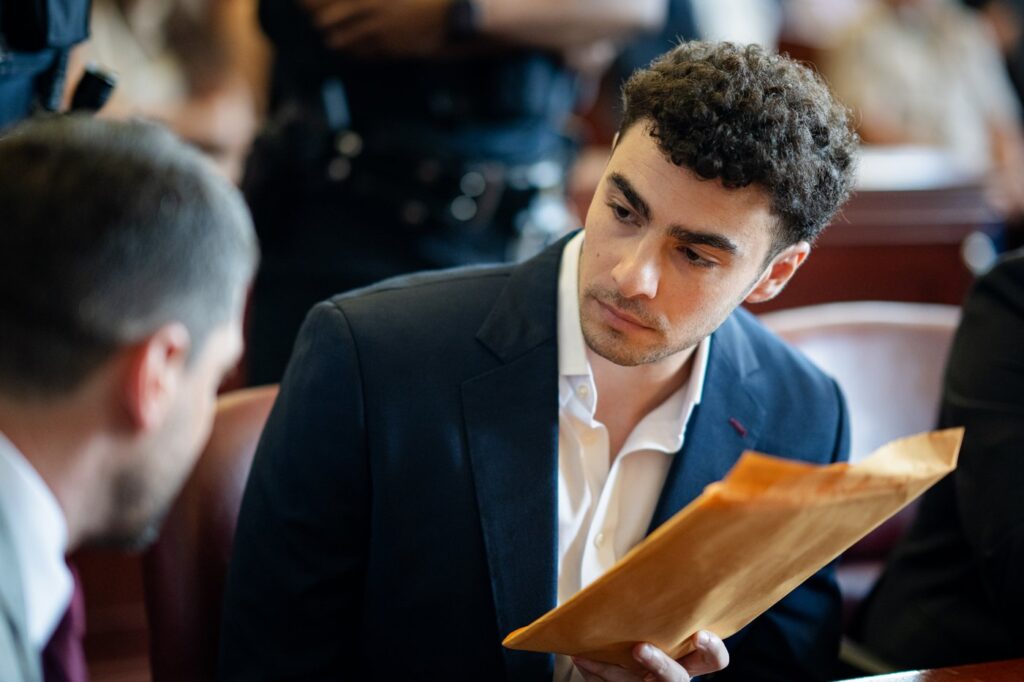
Luigi Mangione is asserting a psychiatric defense in his state murder trial, claiming he was under extreme emotional disturbance when he killed UnitedHealthcare CEO Brian Thompson on December 4, 2024, according to a recent announcement from Judge Gregory Carro. While this defense would not absolve him of the crime, if accepted by the jury, it could lead to a manslaughter conviction resulting in a reduced prison sentence of up to 25 years, rather than a potential life sentence for murder. Importantly, this defense is not available in Mangione's ongoing federal case, which involves additional stalking charges.
Judge Carro informed the courtroom that Mangione's legal team had first communicated their intention to pursue a psychiatric defense in a sealed letter last September, confirming this strategy during a hearing held on June 3. However, the judge indicated that the defense team's delay in providing evidence regarding what specifically caused Mangione's emotional disturbance could jeopardize their ability to present this argument at trial. "Nothing is going to be a surprise," Carro stated, emphasizing the need for Mangione's lawyers to disclose pertinent details to enable prosecutors to prepare their own psychological evaluation of the defendant.
The trial is scheduled to commence on September 8, and a subsequent federal trial is set for October 13. Mangione, who is currently 28 years old, has pleaded not guilty in both cases. During the preliminary hearing, he was observed attempting to shield his face from the media with an envelope, showing little visible reaction as the judge discussed the defense strategy.
It is essential to differentiate between an emotional disturbance defense and a not guilty by reason of insanity plea. The former requires that Mangione's lawyers demonstrate that his emotional state was so extreme it impaired his self-control, that there was a reasonable justification for this disturbance in his mind, and that it played a significant role in the killing of Thompson. According to Heather Cucolo, a professor at New York Law School and an expert in mental health law, the defense could employ a psychologist to testify about Mangione’s mental state at the time of the murder without needing to prove any form of mental illness or imminent danger.
However, the circumstances surrounding the case could pose a significant challenge for the defense. Prosecutors argue that the murder was premeditated, citing evidence that Mangione had documented his intentions in a notebook, which included writings about wanting to "wack" a health insurance executive. He traveled from out of state to ambush Thompson, who was 50 years old, as he walked to a Manhattan hotel for a business conference. Furthermore, phrases written on the ammunition found at the scene mirrored terminology often associated with how insurance companies avoid claim payments.
Cucolo suggests that jurors might find it difficult to accept an emotional disturbance defense in this case, primarily because such defenses are typically linked to crimes of passion or impulsive actions resulting from shocking revelations, rather than what appears to be a premeditated act of violence. As time elapses, jurors may become less inclined to sympathize with claims of sudden emotional responses leading to murder.
Mangione's attorney, Karen Friedman Agnifilo, voiced concerns regarding the judge's ruling to unseal materials related to the psychiatric defense, arguing that it could inherently prejudice Mangione's defense in both the state and federal trials. Last month, Judge Carro permitted the use of the notebook and a 3D-printed firearm as evidence against Mangione, though he ruled that certain items obtained during an "improper warrantless search" could not be included, specifically a loaded gun magazine. At the conclusion of Wednesday’s hearing, Carro dismissed the charge associated with the magazine.