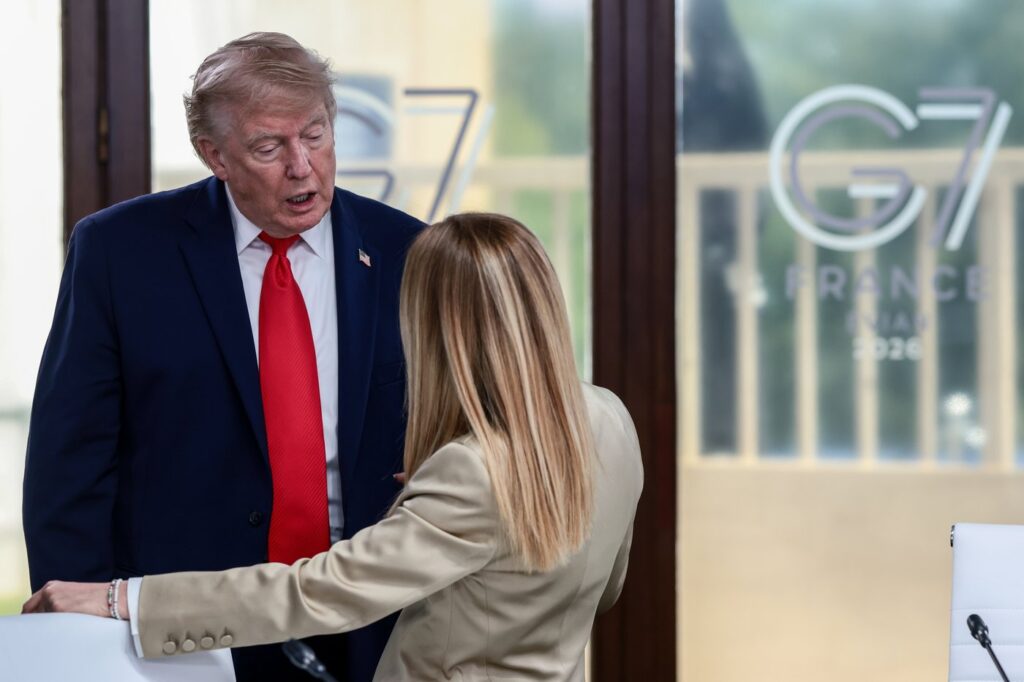
On a recent Saturday, former President Donald Trump publicly criticized Italian Prime Minister Giorgia Meloni, asserting that she repeatedly requested a photo with him during the recent Group of Seven (G7) summit in Évian-les-Bains, France. Trump's claims have escalated a dispute that began earlier in the week during an interview with an Italian broadcaster, where he alleged that Meloni "begged" for the photo. Meloni has since labeled Trump's remarks as "completely fabricated," prompting Italy's foreign minister to cancel a planned visit to the United States in support of the Prime Minister.
While at the Camp David presidential retreat, Trump took to his social media platform to express his views, even misspelling Meloni's name in his initial post, which he later corrected. He criticized her handling of Italy's relationship with the United States, claiming her declining popularity in Italy was due to her refusal to cooperate regarding the U.S. stance on Iran's nuclear capabilities. Trump emphasized that Meloni's decisions not only affected bilateral relations but also the overall security dynamics in Europe.
In response, Meloni characterized Trump's unsolicited attacks as "senseless" and stated that her popularity is independent of her relationship with him. She asserted her commitment to defending Italy's national interests and suggested that Trump should focus on his own popularity instead. This exchange underscores a growing rift between the two leaders, which has often mirrored Trump’s historically strained relationships with European nations.
The discord comes amidst ongoing tensions that have characterized Trump's interactions with European leaders, particularly over defense spending and trade policies. At the G7 summit, Trump had adopted a more conciliatory tone with other European leaders regarding their alignment on a temporary agreement to conclude the war in Iran. Nevertheless, he indicated frustration over Italy's refusal to permit the U.S. military to utilize its bases during military operations directed at Iran, a complaint he has reiterated ahead of a scheduled meeting with NATO Secretary-General Mark Rutte.
Earlier, during his interview on La7, Trump was questioned about Ukraine but shifted the focus to Meloni, expressing sympathy for her as he acknowledged his decision to take a photo with her. Furthermore, he vented his dissatisfaction that Meloni would not authorize the U.S. to use Italian runways during the Iran conflict, highlighting Italy's recent denial of access to a base in Sicily for American bombers without parliamentary approval. This decision reflected both constitutional constraints and significant domestic opposition in Italy toward involvement in the war.
Moreover, Meloni has insisted that any U.S. use of Italian bases for offensive military operations should await parliamentary consent, demonstrating her government’s resolve in adhering to national sovereignty and legislative authority. Trump's claims of a desire for reconciliation with Meloni in light of the initial agreement with Iran highlight the complexities of international diplomacy as each nation navigates its domestic and foreign policy imperatives.
As the U.S. prepares for the upcoming NATO summit in Ankara, the continued fallout from this spat with Meloni illustrates broader challenges facing the Trump administration in managing its partnerships with allied nations in Europe, particularly against the backdrop of fluctuating public opinion and national interests.