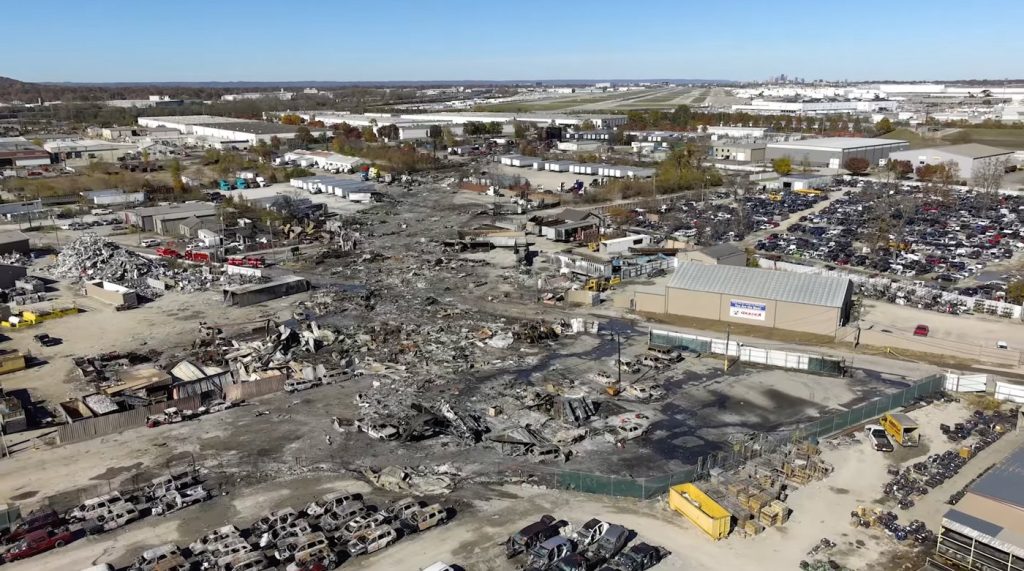
New documents released by crash investigators reveal that UPS did not implement detailed inspections to identify a mechanical issue that resulted in an engine detaching from one of its aircraft, ultimately leading to a fatal crash. The incident occurred while a UPS cargo plane was taking off from Louisville's Muhammad Ali International Airport in November, killing all three pilots and 12 individuals on the ground, while injuring 23 more.
According to UPS's submission to the National Transportation Safety Board (NTSB), the reason for not mandating the enhanced inspections of the bearings inside the pylons was based on Boeing's erroneous assertion that any failure of those bearings would not compromise flight safety. As a result, UPS did not require the more thorough inspections that had been recommended by Boeing in previous years.
The tragic crash highlighted failures at multiple levels of oversight, including those of Boeing, UPS, the Federal Aviation Administration (FAA), and the maintenance company STE San Antonio Aerospace. Jeff Guzzetti, an aviation safety expert, emphasized that all four entities share responsibility for the oversight failures that contributed to the accident. Guzzetti pointed out that the intricacies and miscommunication among these organizations obscured critical risks that ultimately went unaddressed.
Investigative hearings conducted in May raised awareness about the failures that allowed mechanics to overlook critical examinations of engine mount parts. Notably, the bearings securing the engines to the wings are located deep within the aircraft, making them difficult to inspect without removing the engines themselves. UPS indicated that its mechanics were only required to check for corrosion and not for indications of bearing failure, even though Boeing acknowledged that certain inspection requirements warranted attention. However, Boeing simultaneously stated that existing inspections were sufficient.
Despite recognizing the need for revised inspection protocols, Boeing did not integrate any changes into federally approved maintenance schedules that would have mandated the new procedures. UPS contended that their decision not to implement any additional maintenance changes was based on Boeing’s representations regarding the safety of the existing procedures.
Moreover, Boeing had previously successfully petitioned the FAA to extend the interval for required inspections of these bearings, allowing airlines to complete maintenance tasks simultaneously and minimizing downtime. This change came despite receiving multiple reports about faults in the bearings prior to the crash and even after discovering several other instances of similar issues among different operators of MD-11 aircraft.
The UPS plane that crashed had flown 21,043 cycles since its last thorough inspection, far exceeding the original inspection schedule that mandated checks after 19,900 cycles. Although only one other instance of engine detachment in a similar model had occurred decades earlier due to improper maintenance, more troubling was the fact that FedEx, a competitor, had documented at least ten other failures related to the same bearings. The reasons for the differences in maintenance practices between FedEx and UPS remain unclear.
Following the crash, FedEx resumed operating its MD-11s in May after the FAA approved Boeing's revised safety plan, which included closer inspections of engine mounts and regular replacement of spherical bearings after every 4,000 cycles. In contrast, UPS opted to retire its entire fleet of MD-11s ahead of schedule in response to the tragedy, marking a significant shift in their operational strategy.