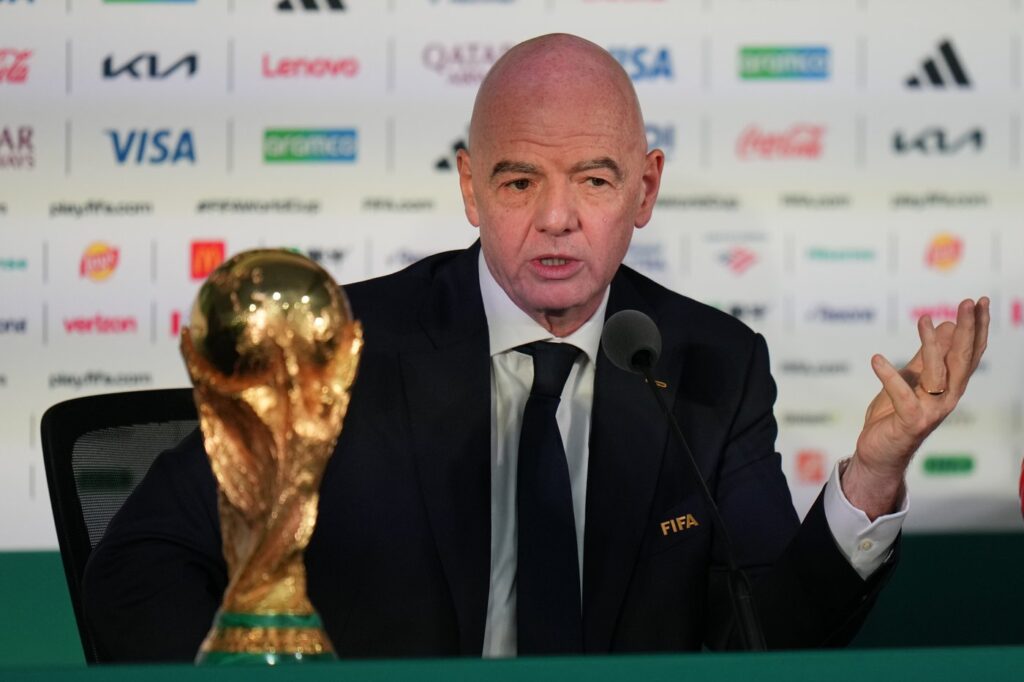
GENEVA (AP) — A coalition of European nations has made a significant decision to boycott the World Cup and all other FIFA competitions in response to FIFA President Gianni Infantino’s controversial plan to sell stakes in soccer’s premier tournament to private equity investors. This decision came after an urgent online meeting of the European football governing body UEFA, which includes its 55 member associations.
UEFA announced, “UEFA and its national associations will not participate in FIFA competitions,” highlighting their disapproval of Infantino’s financial maneuvers. The next scheduled FIFA tournament is the Women’s Under-20 World Cup, to be held in Poland starting on September 5, and the four British federations are currently the only bidders for the 2035 Women’s World Cup, with a decision expected by November 23.
In a firm statement, UEFA emphasized, “Some things are simply too important to sell. The FIFA World Cup belongs to football. It always will. And so long as Europe has a voice, it will never be for sale.” This strong stance was taken as part of a strategic response to counter Infantino’s proposal, which includes offering $20 million to each of FIFA’s 211 global members, contingent upon acceptance by mid-September.
Later on the same day, the Confederation of North, Central American and Caribbean Association Football (CONCACAF) convened and expressed its own rejection of Infantino’s proposal. In a statement, CONCACAF raised significant concerns regarding the “lack of due process,” the “artificially short deadline,” and the absence of necessary approvals from FIFA’s governance bodies. Furthermore, they questioned the need for outside investment in light of the recent record profits from the FIFA World Cup.
Infantino’s controversial project, which surfaced earlier in the week, involved the creation of a new subsidiary called FIFA Forward Enterprise (FFE) aimed at securing investment from private entities, including a New York investment firm tied to Joshua Kushner, the brother of Jared Kushner, former U.S. President Donald Trump’s son-in-law.
In his communication to FIFA’s members, Infantino noted that approving the FFE would allow their promised $10 million basic funding to double to $20 million over four years, projecting a total of $86 million in funding by 2038 instead of the previously estimated $36 million.
UEFA criticized Infantino’s approach as not just a failure in leadership, but as an abdication of FIFA’s responsibility to safeguard the interests of world football. This controversy and the backlash could jeopardize Infantino's previously secure status as FIFA President, as dissent grows among various soccer stakeholders, including three of the six continental football bodies.
As FIFA prepares for a presidential election scheduled for March 2024 in Rabat, Morocco, Infantino, who previously appeared to have a clear path for re-election for a fourth term, now finds his position increasingly precarious. Observers noted that he may have been eyeing a lucrative role at the FFE spinoff beyond 2031 while also facing internal challenges regarding his leadership.
UEFA further articulated their fears regarding the implications of external investment in FIFA competitions, stating, “The moment external investors acquire ownership interests in FIFA competitions, football changes forever.” They warned that such a shift would place relentless pressure on the game, focusing on commercial returns rather than the sport's integrity.
Despite FIFA’s projections that the investor plan could enhance global soccer funding, UEFA’s members expressed dissatisfaction that FIFA was not tapping into its own billion-dollar reserves to support development programs instead of seeking outside investments.
On the same day, the Asian Football Confederation (AFC) also issued rare criticism of Infantino’s actions, expressing concerns regarding the potential adverse effects on continental football and the sustainability of domestic competitions. Sheikh Salman bin Ibrahim Al Khalifa, the AFC President, warned that FIFA’s unilateral actions could undermine the foundational aspects of continental football.
In a video statement, Infantino attempted to frame the private equity offer as optional, stressing that it was “an offer, not an obligation.” However, many in the soccer community have responded skeptically, prompting increased scrutiny of FIFA’s future direction and governance.
In conclusion, the developments surrounding Infantino’s proposal and the subsequent reactions from UEFA and CONCACAF signify a critical juncture in the governance of soccer. As tensions mount between the desire for financial growth and the preservation of the sport’s integrity, the future of FIFA’s leadership and the structure of its competitions may be in jeopardy.