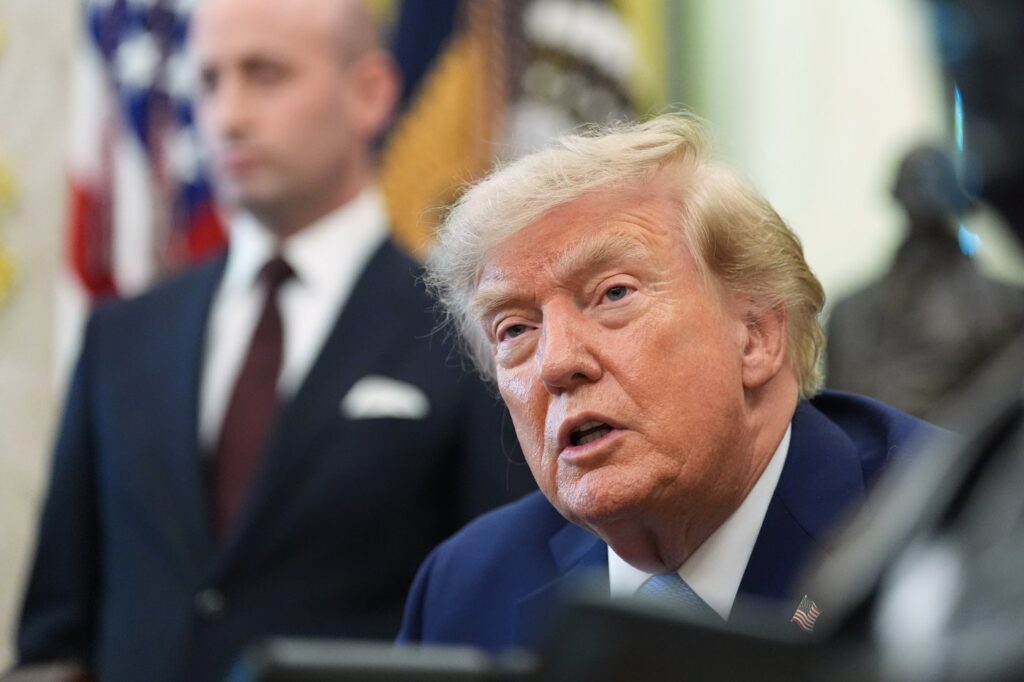
WASHINGTON (AP) - President Donald Trump has announced that he is once again attempting to limit the number of individuals who can automatically become American citizens by being born in the United States. This initiative comes in the wake of a previous effort to restrict birthright citizenship, which was rejected by the Supreme Court. Trump's latest move signals his continued commitment to reshape immigration policy, particularly as it pertains to who qualifies for citizenship.
In his latest statement, Trump revealed plans to sign two executive actions regarding immigration. One of these actions aims to modify the criteria for U.S. citizenship for individuals born in the country, while the second focuses on curbing what he refers to as “birth tourism,” where foreign visitors come to the U.S. specifically to give birth and thereby confer citizenship to their children.
The text of the executive order released on Thursday was narrower than its predecessor that faced legal challenges. The new order seeks to limit automatic citizenship to specific categories, including children born to parents with certain foreign affiliations, such as officials from foreign embassies, and those labeled as “alien enemies.” Additionally, it proposes to restrict citizenship for children whose parents committed fraudulent acts to acquire citizenship.
Trump’s second executive order targets tactics involved in “birth tourism” by imposing stricter requirements on visitors seeking visas to give birth in the United States. The effectiveness of these executive actions remains uncertain, and Trump has asserted his belief that these efforts are constitutionally sound. His administration views these measures as part of a broader strategy to redefine who can become an American citizen.
Previously, the Migration Policy Institute highlighted existing legal frameworks regarding visa fraud for individuals who seek visas with the intent to give birth to a child eligible for citizenship. Past administrations have also attempted to prosecute cases of “birth tourism” that involve women disguising their pregnancies while in the U.S. to deliver children.
Birthright citizenship has emerged as a focal point in Trump's anti-immigration agenda during his second term, with advocates arguing that it draws excessive immigration to the country. Proponents of restricting birthright citizenship contend that citizenship should be reserved for those who truly value it, rather than being granted by virtue of birth location alone.
On the other hand, immigration advocates and legal experts maintain that the Constitution clearly outlines citizenship rights. They argue that birthright citizenship is vital for fostering a sense of belonging and equal stake in the nation’s future amongst all inhabitants. Restricting citizenship eligibility would risk creating a marginalized class within the United States.
The Trump administration has depicted “birth tourism” as a significant issue, although estimates indicate that around 26,000 births annually may fit this classification out of approximately 3.5 million births in the U.S. According to the Migration Policy Institute, this presents a very small fraction of total births, which casts doubt on the extent of the problem as claimed by the administration.
In June, the Supreme Court dismissed Trump’s earlier attempts to assert that children born to individuals residing in the U.S. illegally or temporarily should not automatically receive citizenship, reinforcing a broad interpretation of birthright citizenship as established in the Constitution.
The American Civil Liberties Union (ACLU) has already predicted that Trump’s new attempt will similarly face legal challenges. ACLU deputy director Cody Wofsy remarked, “The Supreme Court already decided this issue: Birthright citizenship is guaranteed by the Constitution. No additional executive order can change the meaning of the Constitution.” This sentiment echoes concerns that any effort to alter birthright citizenship through executive action would likely meet the same legal resistance as past attempts.
On the first day of his second term, Trump had signed an executive order aimed at terminating birthright citizenship altogether, which led to immediate lawsuits asserting that such a move would violate the 14th Amendment of the Constitution, which guarantees citizenship to anyone born in the nation, with few exceptions. The original executive order faced legal obstacles in several lower courts, ultimately being blocked from implementation.
In a closely watched Supreme Court decision in June, Trump’s executive order was overturned by a 6-3 vote. However, the vote wasn’t overwhelmingly definitive, as only five justices affirmed the constitutional protection of birthright citizenship, while Justice Brett Kavanaugh expressed opposition to the executive order on grounds of federal law instead.