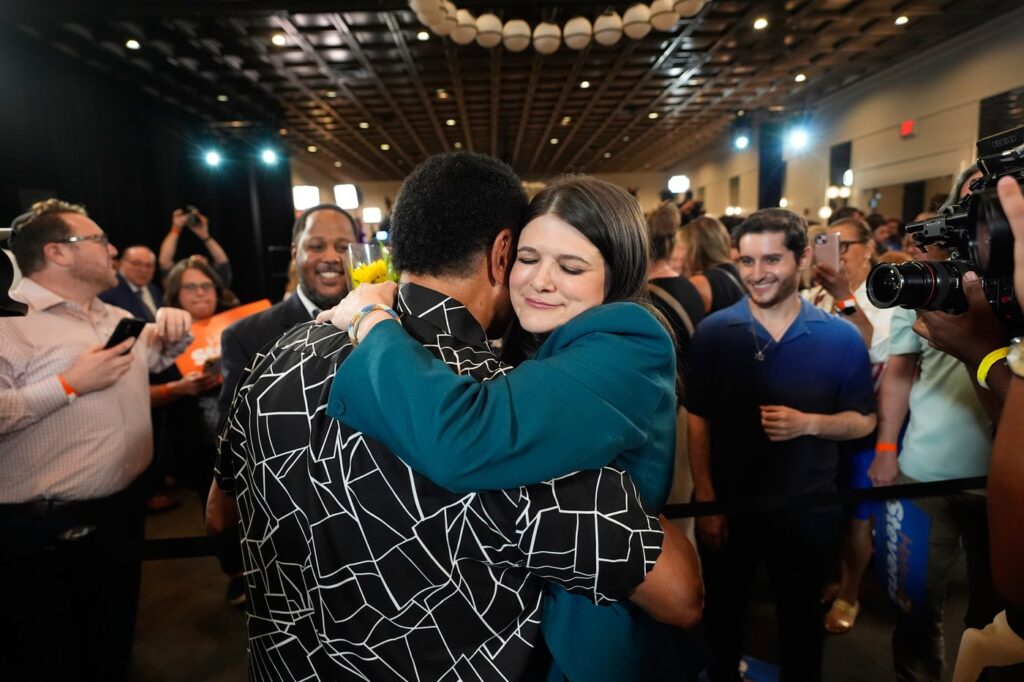
DETROIT (AP) Abdul El-Sayed, a former public health official, claimed a narrow victory over Rep. Haley Stevens in Michigan’s U.S. Senate primary, a pivotal examination for progressives in a critical battleground state. El-Sayed's win positions him to face Republican Mike Rogers, a former congressman, in the upcoming November election, which will influence the balance of power in the Senate. Following a divisive primary that showcased contrasting visions for a party eager to regain its footing, El-Sayed's immediate task will be to unify the factions within the Democratic Party.
The outcome of the primary was remarkably close. El-Sayed left his election night party without claiming victory, and the race was officially called only on Wednesday after almost all ballots were tabulated. When the Associated Press declared El-Sayed the victor, he was ahead of Stevens by a mere 14,893 votes, representing just under 1% of the more than 1.5 million ballots cast, marking the highest turnout in recent state history.
The implications of this narrow win reach far beyond the numbers. Senator Bernie Sanders, a prominent figure in the progressive movement and an early supporter of El-Sayed, called it one of the most remarkable victories in modern American politics. At 41 years old, El-Sayed has never previously held elected office and made a comeback after losing the Democratic gubernatorial primary in 2018 by over 20 percentage points. This time, he ran an unapologetically progressive campaign, overcoming over $60 million in outside spending and significant support for Stevens from many of Michigan's leading Democrats, including Governor Gretchen Whitmer, outgoing Senator Gary Peters, and Senate Democratic Leader Chuck Schumer.
In his victory speech, El-Sayed referenced Muhammad Ali, stating, "In the words of Muhammad Ali, we shook up the world," while standing in front of The Spirit of Detroit, a well-known statue in downtown. His campaign gathered momentum after McMorrow suspended her campaign in early July, leading to a two-person race against Stevens. El-Sayed then rallied his supporters, declaring the potential to win not only the election but also to reclaim political discourse.
Throughout the campaign, El-Sayed organized over 500 events, speaking in 110 cities and building a volunteer base of approximately 12,000 people. Campaign volunteer Julie Brink described the campaign initially feeling like an underdog but gaining consistent momentum over time. The campaign's media strategy capitalized on El-Sayed's previous experience outside of elected office, generating attention through traditional media, podcasts, and online platforms, although some appearances prompted controversy.
As the primary concluded, the focus shifted to the broader implications of El-Sayed's win for the progressive movement. Progressives, including Adam Green, co-founder of the Progressive Change Campaign Committee, view this victory as a critical indication that their approach could succeed even in competitive districts and swing states. El-Sayed’s platform included key progressive issues such as "Medicare for All," a cessation of military aid to Israel, and campaign finance reform. His victory not only represents a personal achievement but signifies a potential shift in progressive politics within the Democratic landscape.
Looking ahead, El-Sayed faces the challenge of translating his primary success into a strong showing in the general election against Rogers. With the Republican campaign arm already reserving $45 million for ads in Michigan to bolster Rogers' campaign, the stakes are high. Additionally, AIPAC, which heavily financed Stevens’ campaign, has indicated its intention to oppose El-Sayed due to his “radical anti-Israel agenda.”
The tight margin of victory also complicates efforts to draw sweeping conclusions about the Democratic Party’s direction. Nearly half of primary voters opted for Stevens, who had argued that her moderate approach made her a more viable candidate against Rogers. Stevens conceded to El-Sayed and offered her support, indicating a willingness to rally behind him as the party prepares for a unity breakfast and rally.
Michigan Democratic Party Chair Curtis Hertel stated that ideological disputes within the primary are not detrimental, emphasizing the importance of unity moving forward. "We will unite together, and we will win this race, because we have to," he asserted, underscoring the imperative for solidarity among party members as they prepare for the critical November election.