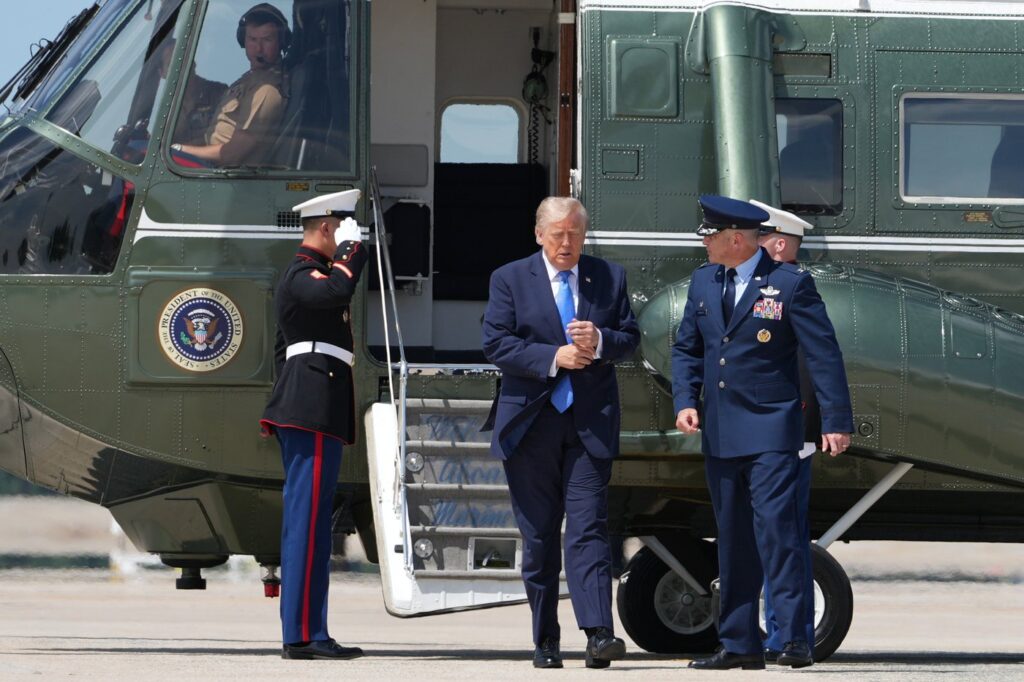
On a Tuesday afternoon, a concerning incident occurred at Ronald Reagan Washington National Airport involving President Donald Trump's helicopter, Marine One, and a commercial jet. The scenario raised alarms as it appeared to violate established safety protocols that were intended to prevent midair collisions following a tragic incident in January 2025, which resulted in 67 fatalities due to an airliner colliding with an Army Black Hawk helicopter. In light of this, the Federal Aviation Administration (FAA) had mandated that all takeoffs and landings at the airport be halted when helicopters are on a conflicting route.
On the day in question, Marine One was departing the White House en route to Andrews Air Force Base as part of the president's first leg of a West Coast trip. Simultaneously, a commercial airplane took off, climbing directly above Marine One. Fortunately, the two aircraft were not on a collision course. The FAA initiated a preliminary investigation into the events that unfolded, noting a "momentary loss of separation" between the two aircraft.
The air traffic controller persisted in communication with both the commercial pilot and Marine One’s pilot throughout the incident. The White House quickly reassured the public, emphasizing that President Trump was never in danger. Kush Desai, a spokesperson for the White House, stated, "Marine One flights are piloted by some of the best aviators in the world, and at no point was the President in harm's way."
Additionally, the Marine Corps defended the actions of their helicopter pilots, asserting that there were no "close calls" during the routine Marine One flight. Marine Corps spokesperson Capt. Jacob Sugg indicated that Washington National Tower did not issue any delays or alterations to the helicopter's flight profile.
Audio recordings from Air Traffic Control highlighted discrepancies in communication. The Marine One pilot announced plans to lift off three minutes prior to departure, but the air traffic controller did not acknowledge this message. Following a second attempt, the controller remarked that the prior transmission was "broken and unreadable." Upon learning of Marine One's imminent departure, the controller seemed surprised, leading to a brief moment of confusion before providing the helicopter with directions.
After being warned about the commercial flight taking off, the Marine One pilot acknowledged visual contact and stated, "We’ll be doing a momentary delay." This incident draws attention to the ongoing issues of communication between military and civilian air traffic controllers at Reagan National Airport, which have been problematic in the past. A hotline connecting the Pentagon to the tower had been inactive for over three years, underscoring lapses in airspace safety oversight.
In response to last year’s midair collision, the FAA implemented regulations designed to prevent aviation mishaps, which included requiring air traffic controllers to rely on radar rather than solely on pilots’ visual confirmations. The FAA mandated that military aircraft must broadcast their locations as part of these safety protocols.
Families of the victims from the previous collision have expressed frustration over the perceived lack of progress in preventing future accidents surrounding the busy airspace of Reagan. They continue to seek congressional support for aviation safety reforms recommended by the National Transportation Safety Board (NTSB) following the investigation of the 2025 crash.