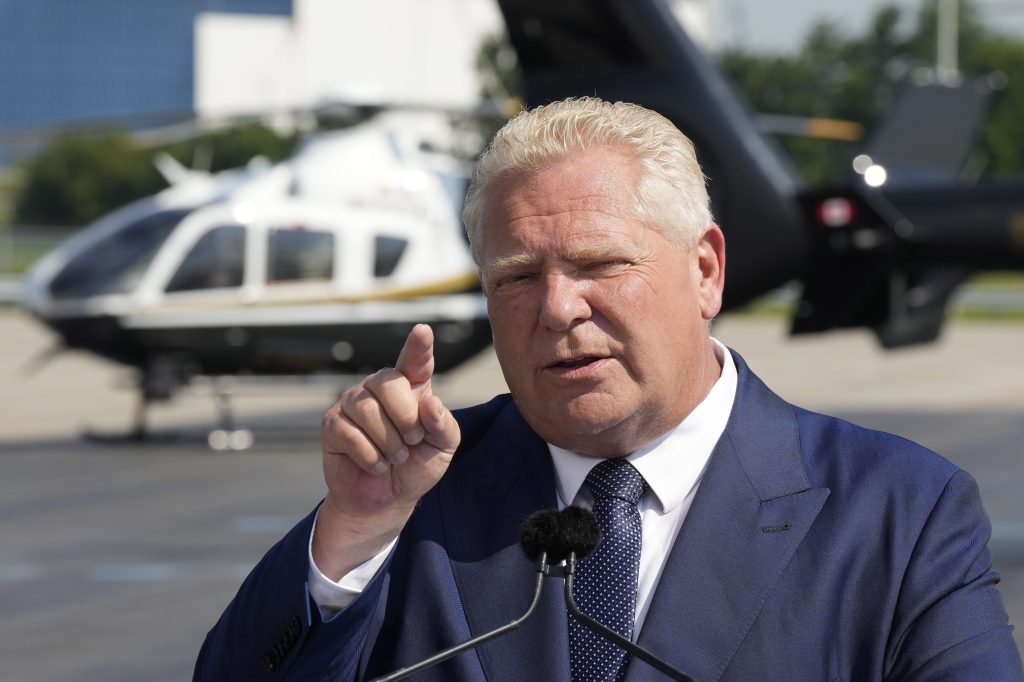
Ontario Premier Doug Ford and Alberta Premier Danielle Smith are experiencing a divergence in their approaches toward utilizing energy resources as leverage in trade negotiations with the United States. Despite their disagreements, both leaders express a commitment to increasing the flow of oil within Canada.
Ford recently called upon all provinces to adopt a "Team Canada" approach concerning the evolving tariff situation, advocating for the use of Canada’s oil resources to apply pressure on the U.S. in these trade discussions. However, Smith firmly opposes this strategy, stating that halting Alberta's energy exports to the United States would be detrimental to Canadians and is not a feasible solution.
Despite their differences, Ford and Smith are collaborating on advancing a proposed oil pipeline project intended to transport oil from Alberta to refineries in Sarnia, Ontario, traversing through Saskatchewan and Manitoba. Ford indicated his intention to visit Alberta to meet with Smith in person in the coming weeks to discuss these matters further.
On the subject of U.S. relations, Ford has moderated his rhetoric towards U.S. President Donald Trump following a recent press conference where he referred to Trump as a "loser" and a "bully." Nevertheless, he maintains that he does not regret his comments, believing they resonated on a global scale. Additionally, Ford stated that if the trade dispute were to escalate, all options would be considered, including potential restrictions on electricity and critical minerals from Ontario.
Ford has previously utilized electricity as leverage during earlier phases of trade disputes. At one point, Ontario enacted a 25% surcharge on electricity exported to Michigan, Minnesota, and New York. This tactic elicited a response from Trump, who threatened to double tariffs on Canadian steel and aluminum before both parties ultimately deescalated the situation.
In a related development on Wednesday, the White House announced that Trump had signed an executive order aimed at safeguarding the security, integrity, and reliability of bulk-power system electric equipment utilized in the U.S. This order underscores concerns regarding vulnerabilities associated with reliance on foreign sources for critical infrastructure in the electric power sector.
While it remains unclear whether this executive order was a direct response to Ford's threats regarding electricity, it illustrates the heightened tensions and complexities surrounding the trade relationship between Canada and the United States.