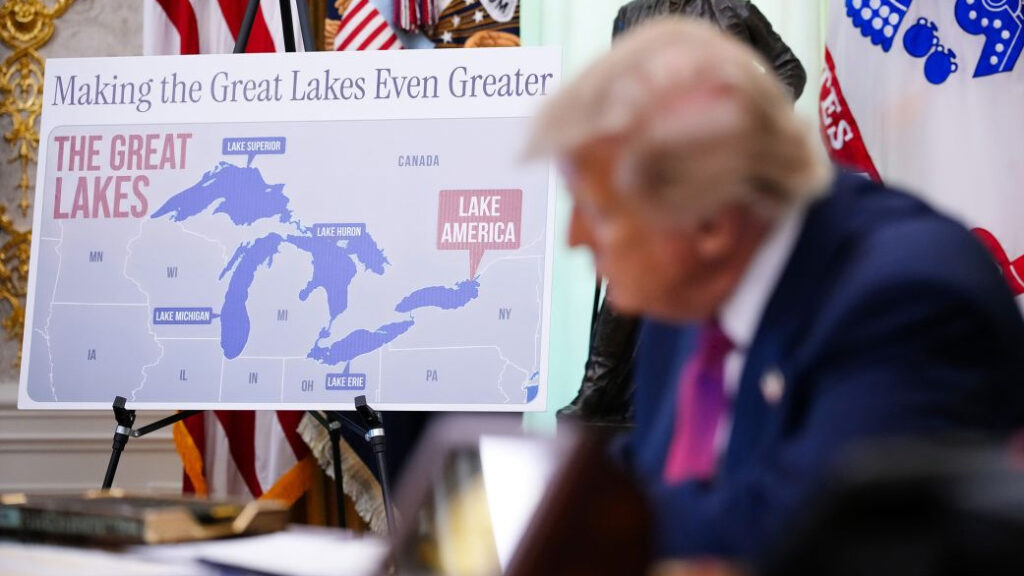
Indigenous leaders and advocates are expressing outrage following U.S. President Donald Trump's executive order signed on Thursday, which seeks to change the name of Lake Ontario to Lake America. The original name, Lake Ontario, derives from the Wendat word Ontari:io, meaning "the lake is beautiful, the lake is big." This significant historical context has prompted strong responses from Indigenous communities and leaders.
Canadian Prime Minister Mark Carney reaffirmed the lake's name, stating it will be known as Lake Ontario "then, now and always." Grand Chief Pierre Picard of the Wendat Nation expressed his nation’s shock at Trump's renaming effort, labeling it an infringement on their history and cultural identity. The Wendat Nation historically occupied territories from the St. Lawrence Valley to the Great Lakes, an area rich in trade routes. Picard pointed out that the name predates both Canada and the United States, underscoring the deep cultural significance it holds.
In light of the rebranding, Picard has requested a meeting with U.S. Ambassador to Canada Pete Hoekstra to express his nation’s concerns regarding the unilateral decision. He emphasized the importance of conveying Indigenous grievances, despite skepticism over Trump's willingness to reconsider the renaming. "It is unacceptable for us, as a nation, to have a president who can eradicate our history, our culture and our identity," Picard asserted, noting that he hopes mapping companies will reject the new name, a sentiment echoed by Carney regarding Canada's stance.
American mapping company MapQuest responded to Trump's declaration on social media, confirming it would not change the name of Lake Ontario. In a light-hearted post, the company invited users to choose a new name for the lake, illustrating the absurdity of the situation with an example name: "Lake Are We Doing This Again?" The humorous response exemplifies the growing ridicule surrounding Trump’s executive order.
The political reaction to the lake's renaming has also been notable. Wisconsin Governor Tony Evers mocked the order by signing a fast food napkin to decree that Lake Michigan would be renamed "Lake Wisconsin." This tongue-in-cheek demonstration aimed to highlight the absurdity of Trump’s actions, which Evers condemned. The city council in Rochester, New York—the largest American city bordering Lake Ontario—unanimously passed a proclamation denouncing Trump’s move and reaffirmed its commitment to using the name Lake Ontario. The proclamation stated, "No serious person from the Native Tribes or U.S. and Canadian cities which share the lake will ever call Lake Ontario ‘Lake America.’”
Critics have characterized the name change as a trivial distraction from pressing issues such as the economy and housing crises. Mohawk policy analyst Russ Diabo dismissed the renaming as "totally asinine," suggesting it reflects a broader trend of Trump's disregard for Indigenous cultures. Academic Veldon Coburn from McGill University argued that Trump's executive order holds no real power given the millennia-long presence of Indigenous nations in North America. He described the effort to erase Indigenous history as both humorous and futile, stating, "we’ve been here for thousands of years prior and we’re not going anywhere."
In a positive reflection on the controversy, Grand Chief Picard noted that the situation has sparked renewed awareness among Canadians regarding the true origins of the name Lake Ontario, acknowledging the Wendat Nation's legacy. "We’re proud of that, for sure," he concluded, emphasizing the resilience and continued presence of Indigenous peoples in the region.