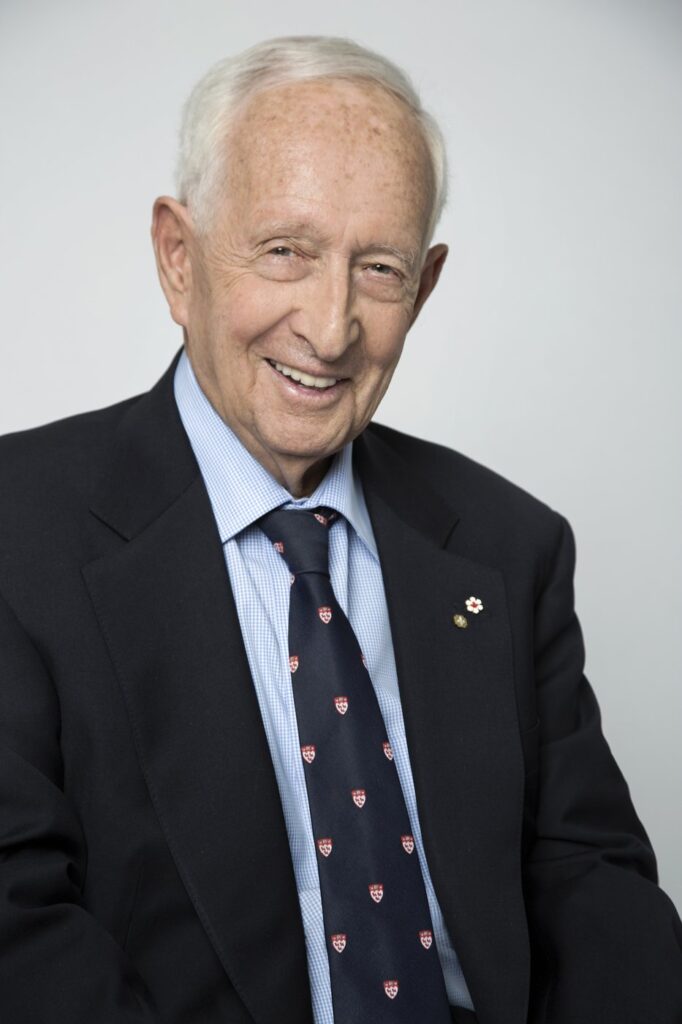
MONTREAL — Stephen Jarislowsky, the notable Canadian investment manager, ethical business advocate, and philanthropist, has passed away at the age of 101. He was widely recognized as "Canada's Warren Buffett" and had a profound impact on Canada's financial landscape.
Born in Berlin, Germany, in 1925, Jarislowsky founded Jarislowsky Fraser & Co. in 1955. Beginning with only $100 of his own funds and $50 from a partner, he established the firm in Montreal, which ultimately grew to become Canada’s largest pension fund manager at one point. After over six decades of leadership, he stepped down in 2012, during which time the firm was managing approximately $40 billion in assets. In 2018, Scotiabank acquired Jarislowsky Fraser for an impressive $950 million.
Throughout his life, Jarislowsky's commercial success resulted in a wealth estimated at approximately US$3.9 billion, a portion of which he dedicated to philanthropy. He contributed millions in donations, including establishing several research chairs at universities across Canada.
His book, “The Investment Zoo: Taming the Bulls and the Bears,” further solidified his public persona. This blend of memoir and investment guidance achieved bestseller status in 2007, notably surpassing the widely renowned “The Da Vinci Code” in French translation.
Despite his billionaire status, Jarislowsky led a notably humble lifestyle. At the age of 100, he remarked that he had never owned a yacht or private jet, and he continued to wash his own dishes. He drove his own vehicle until he was 99, only hiring a driver at the request of his wife.
Jarislowsky was known for his outspoken views on business and politics. He frequently commented on current affairs, criticizing questionable corporate practices and extravagant executive salaries. In 2002, he co-founded the Canadian Coalition for Good Governance, aiming to empower shareholders and rebuild confidence in capital markets. He also played a crucial role in creating the Montreal Institute for Governance of Private and Public Organizations.
Although he never ran for office, his strong opposition to Quebec independence drew media attention. Following the 1995 referendum, he controversially compared sovereignty leaders Jacques Parizeau and Lucien Bouchard to fascists of the 20th century. In 2011, he reiterated his viewpoint, stating that the sovereignty movement was still motivated by religious fervor.
Jarislowsky's early life was marked by significant challenges. Forced to flee Nazi-occupied Europe during his youth, he lived in the Netherlands, France, and the United States before settling in Montreal in the 1950s. He graduated from Cornell University with a degree in mechanical engineering before being drafted into the U.S. Army, where he worked in intelligence in Japan. Following his military service, he pursued advanced studies, earning a master’s degree in Far Eastern studies from the University of Chicago and an MBA from Harvard Business School, which led him to Alcan Aluminum Ltd.
At the age of 29, Jarislowsky founded his investment firm. Initially focused on selling financial data, Jarislowsky Fraser evolved to provide advisory services and manage investments for pension funds, corporations, and government entities in the 1960s. In 1991, he launched the Jarislowsky Foundation, which funded nearly 48 research chairs across various fields like democracy, governance, health, and the arts, donating about $10 million annually.
In recent years, he initiated five endowed chairs aimed at cultivating the next generation of government leaders. Jarislowsky expressed concern about the parallels between contemporary political threats and those observed during his childhood, particularly in light of Russia’s invasion of Ukraine. He emphasized the importance of learning from historical experiences to avoid repeating past mistakes, warning that once democracy is lost, it takes considerable time to restore.
Throughout his career, Jarislowsky was honored with numerous accolades, including honorary degrees from 20 universities and the Order of Canada. His philanthropic and governance efforts have left a lasting mark on Canadian society. He is survived by his wife, Gail, and their three children.