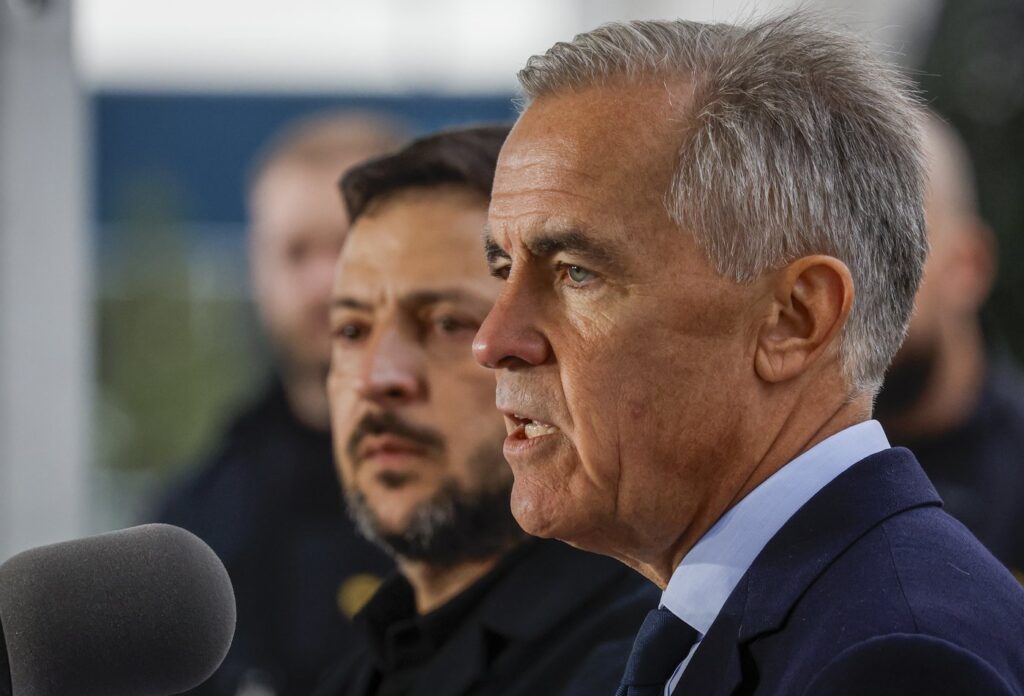
OTTAWA – Mark Carney, the Prime Minister of Canada, extended gratitude to U.S. President Donald Trump for his leadership in facilitating an “energy ceasefire” between Ukraine and Russia. The Prime Minister's Office (PMO) confirmed Carney's appreciation in a statement released on Sunday.
However, the same day, Carney also expressed concerns to Ukrainian President Volodymyr Zelenskyy regarding Trump’s new diesel supply agreement with Russia, which he believes undermines Canada’s efforts to resolve the ongoing war in Europe. Trump announced the energy ceasefire on his Truth Social account but provided no immediate details regarding the arrangement.
Carney expressed “strong support” for the ceasefire agreement following a discussion with Zelenskyy. He highlighted on his own social media platforms that this agreement could potentially help reduce the conflict, stating, “The new energy ceasefire being brokered by President Trump between Russia and Ukraine has the potential to significantly de-escalate the war and protect thousands of citizens from hardship.”
In contrast, Carney criticized Trump's proposed diesel fuel supply deal with Russia, disclosed on Friday, that aims to import millions of tonnes of Russian diesel into the United States. The PMO described this agreement as “in direct opposition to the efforts of Ukraine, Canada, and our allies to create peace and stability in Europe,” asserting it would provide Russia with additional revenue to continue its “illegal, unjustifiable war” against Ukraine.
Carney indicated he remains open to expanding Canada’s sanctions against Russia, emphasizing the need for continued pressure against the Kremlin. In the past few days, Trump has suggested it may be “time for Ukraine to get a new president,” claiming that his new fuel deal will alleviate price pressures for American consumers, who are increasingly concerned about affordability.
In a noteworthy move, Zelenskyy publicly expressed support for Trump's energy ceasefire. However, he indicated a desire for more details from the White House regarding this agreement. Both Carney and Zelenskyy called on Russia to cease attacks on Ukraine’s energy infrastructure and adhere to the terms of the ceasefire.
Zelenskyy reported on social media that there have been significant strikes on Ukraine's power plants and energy facilities in recent days, undermining the ceasefire communication. He noted, “This past week alone, the Russians have carried out more than 200 strikes on our electricity generation and transmission facilities in Ukraine, and another 17 strikes this week targeted gas and oil facilities.”
The issue of legality regarding Trump's diesel supply agreement also drew attention when U.S. Republican Senator Thom Tillis appeared on NBC’s “Meet the Press,” suggesting that the deal could potentially violate existing laws that prohibit Russian energy imports, passed by Congress in 2022. Tillis remarked, “I do believe there’s a legitimate case for saying the president’s not following the law.”
In response to concerns raised, U.S. Treasury Secretary Scott Bessent defended the agreement on Fox News, stating the administration would move forward using “all the legal authorities we have.”
In their discussion, Carney and Zelenskyy also focused on enhancing coordination with their European Union allies to address Ukraine’s air defense needs. Zelenskyy expressed gratitude for Carney’s support and acknowledged his awareness of Ukraine’s defense requirements, especially concerning anti-ballistic defense preparations for the winter months.
The Ukrainian leader commended Canada’s involvement in the development of the FREYJA anti-ballistic defense system, a collaborative European project intended to provide an alternative to the American Patriot missile system, being developed in conjunction with the Ukrainian defense company Fire Point.
On Sunday, Zelenskyy also engaged in discussions with several European leaders, including Finnish President Alexander Stubb, NATO Secretary-General Mark Rutte, and European Union Commission President Ursula von der Leyen. Von der Leyen emphasized that the military funding needs of Ukraine would be a pivotal topic during the upcoming European Council meetings.
This report highlights the complexities surrounding international relations in the context of the Ukraine-Russia conflict and the implications of American political decisions on global stability.